


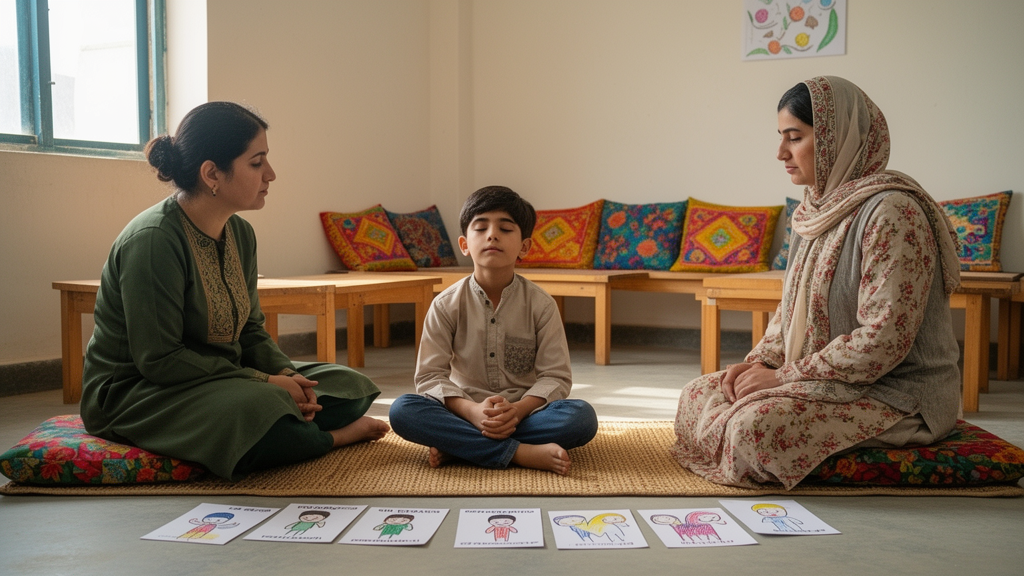
A culturally adapted, school-based Super Skills for Life program was delivered with high implementation fidelity and proved acceptable to children, parents and teachers in a small feasibility trial involving 18 primary school children in Pakistan. Researchers also reported preliminary within-group reductions in anxiety and depressive symptoms, together with improvements in self-esteem, social skills and quality of life, at post-intervention assessment. These findings establish feasibility and acceptability rather than definitive efficacy, because the study included no comparison group and was too small to support broad causal or population-level conclusions.
The mixed-methods trial examined the Super Skills for Life Program—Children Version, abbreviated SSL, after its translation and cultural adaptation in Pakistan. Adaptation followed the Planned Adaptation approach, with the goal of making the CBT-oriented program relevant to the country’s cultural context. The investigators assessed implementation fidelity, participant acceptability and practical feasibility while also collecting pre- and post-intervention measures of anxiety, depressive symptoms, self-esteem, social skills and quality of life.
The study population comprised 18 children recruited from a private school system, so the results primarily apply to this limited group and setting. Implementation fidelity was high, with the study reporting an inter-rater reliability coefficient of κ = 0.99. The research team also found satisfactory acceptability across children, parents and teachers, indicating that those groups regarded the adapted program as suitable.
Together, these observations provide evidence that SSL could be introduced within the tested Pakistani school environment. The authors considered the results sufficient to support a future cluster randomized controlled trial, which they said would require only minor procedural changes to the SSL methodology. Preliminary outcome analyses showed statistically significant within-group changes across all five measures.
For anxiety, the post-assessment comparison produced t = 5.87 with p < .001, while depressive symptoms yielded t = 4.93 with p < .001, indicating lower symptom levels at the post-intervention assessment. The researchers also observed improvements in self-esteem, for which the reported test result was t = 4.04 with p < .001; social skills, t = 5.64 with p < .001; and quality of life, t = 3.25 with p < .001. These are preliminary before-and-after observations from the same participants, not estimates of benefit relative to a control condition.
Accordingly, they cannot establish that SSL itself produced the changes or that its effects would persist beyond the assessed period. The trial’s central contribution is evidence that a culturally adapted school program for childhood anxiety can be delivered consistently and accepted by the children, parents and teachers involved. Its accompanying reductions in anxiety and depressive symptoms and improvements in self-esteem, social skills and quality of life are promising, but require confirmation in a larger controlled study.
The trial was registered in the Registry of Efficacy and Effectiveness Studies on 28 May 2022 under the identifier 12720.1v1 and was retrospectively registered in ClinicalTrials.gov on 18 August 2025 under NCT07162402. The authors concluded that SSL showed high implementation fidelity, high acceptability and feasibility alongside encouraging preliminary within-group changes among the participating primary school children in Pakistan.
Subject of Research: Feasibility of the culturally adapted Super Skills for Life program for childhood anxiety in Pakistani schools
Article Title: Beyond the clinic: a feasibility trial of the super skills for life program for childhood anxiety in Pakistan
Article References: Mustafa, N., Maqsood, A., & Khan, S. R. (2026). Beyond the clinic: a feasibility trial of the super skills for life program for childhood anxiety in Pakistan. BMC Psychology. https://doi.org/10.1186/s40359-026-05458-6
Image Credits: AI Generated
DOI: 10.1186/s40359-026-05458-6
Keywords: childhood anxiety, Pakistan, school-based intervention, Super Skills for Life, cultural adaptation, feasibility trial, depressive symptoms, self-esteem, social skills, quality of life, Beyond, clinic
Cite Scienmag News
Glenn Wilkins. (October 26, 2026). Research report: Beyond the clinic: a feasibility trial of the super skills for life program for childhood anxiety in Pakistan. Scienmag. https://scienmag.com/research-report-beyond-the-clinic-a-feasibility-trial-of-the-super-skills-for-life-program-for-childhood-anxiety-in-pakistan/
Glenn Wilkins. "Research report: Beyond the clinic: a feasibility trial of the super skills for life program for childhood anxiety in Pakistan." Scienmag, 26 October 2026, https://scienmag.com/research-report-beyond-the-clinic-a-feasibility-trial-of-the-super-skills-for-life-program-for-childhood-anxiety-in-pakistan/. Accessed 26 October 2026.
Glenn Wilkins. "Research report: Beyond the clinic: a feasibility trial of the super skills for life program for childhood anxiety in Pakistan." Scienmag. October 26, 2026. https://scienmag.com/research-report-beyond-the-clinic-a-feasibility-trial-of-the-super-skills-for-life-program-for-childhood-anxiety-in-pakistan/


