


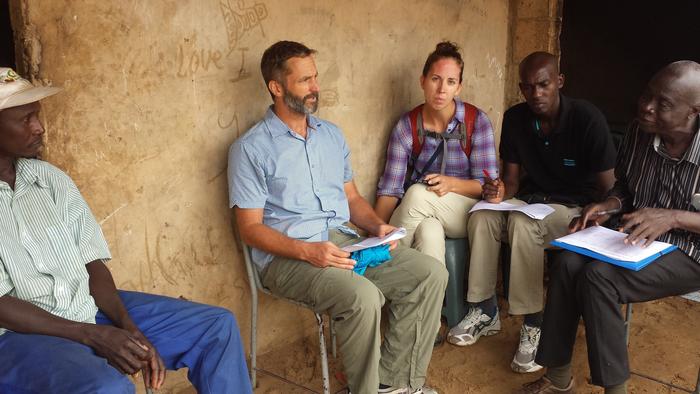
(Santa Barbara, Calif.) — What if you could take an ecologically degraded environment that presents a public health problem, and devise a powerful and elegant solution that not only restores its functionality but also reduces its health impacts while addressing food and water access and alleviating poverty? An international team of biologists, social scientists and medical researchers in the U.S. and Senegal did just that, and for their innovation and research, published in the journal Nature, has received several prestigious awards.

Credit: UC Santa Barbara
(Santa Barbara, Calif.) — What if you could take an ecologically degraded environment that presents a public health problem, and devise a powerful and elegant solution that not only restores its functionality but also reduces its health impacts while addressing food and water access and alleviating poverty? An international team of biologists, social scientists and medical researchers in the U.S. and Senegal did just that, and for their innovation and research, published in the journal Nature, has received several prestigious awards.
“It feels gratifying to be recognized for work finding win-win solutions for the environment and people,” said UC Santa Barbara geographer David López-Carr, the lead social scientist on the diverse international team. Titled “A planetary health innovation for disease, food and water challenges in Africa,” the paper follows the researchers’ efforts to reduce the prevalence of schistosomiasis in northeastern Senegal. A parasitic disease second only to malaria in terms of impact, schistosomiasis affects 240 million people worldwide, according to the World Health Organization, prevalent in tropical and subtropical areas, in places without adequate water quality and sanitation. Approximately 700,000 people are at risk for infection.
Removal of the vegetation associated with a snail that plays host to the blood fluke proved to be highly successful in reducing rates of infection, and not only that — the plant material could then be repurposed as cheap livestock feed and compost.
Read more about the research here.
“By turning a public health hazard into a valuable resource, the research demonstrates a scalable solution that benefits both human health and the environment,” according to the Ecological Society of America, the nation’s largest organization of professional ecologists. ESA awarded the team a 2024 Sustainability Science Award, for “scholarly work that makes the greatest contribution to the emerging science of ecosystem and regional sustainability through the integration of ecological and social sciences. According to the ESA, the paper “stands as a prime example of how sustainable practices can significantly improve wealth, health, food and water access simultaneously, embodying the principles of sustainability science and offering a model for global ecological and social challenges.”
The team also has been recognized as U.S. National Champion and International Champion for the Frontiers Planet Prize from the U.S. National Academy of Sciences, which “celebrates breakthroughs in Earth system and planetary science that address the environmental challenges that humanity is facing and enable society to stay within our planet’s safe ecological boundaries.”
Read more about López-Carr’s other collaborations to fight schistosomiasis here.
The Nature paper is one piece of a body of work for which López-Carr also has been honored with a 2024 Research Excellence Award by the Human Dimensions of Global Change, a specialty group of the American Association of Geographers. The award “recognizes a scholar for research contributions that advance fundamental understanding of the human dimensions for global change.” He is also the recipient of the 2024 CLAG Award from the Conference of Latin American Geography for two decades of teaching, research and mentorship.
Cite Scienmag News
Ophelia Keating. (June 27, 2024). Research and efforts to combat schistosomiasis earn geographer David López-Carr several high-profile awards. Scienmag. https://scienmag.com/research-and-efforts-to-combat-schistosomiasis-earn-geographer-david-lopez-carr-several-high-profile-awards/
Ophelia Keating. "Research and efforts to combat schistosomiasis earn geographer David López-Carr several high-profile awards." Scienmag, 27 June 2024, https://scienmag.com/research-and-efforts-to-combat-schistosomiasis-earn-geographer-david-lopez-carr-several-high-profile-awards/. Accessed 4 September 2026.
Ophelia Keating. "Research and efforts to combat schistosomiasis earn geographer David López-Carr several high-profile awards." Scienmag. June 27, 2024. https://scienmag.com/research-and-efforts-to-combat-schistosomiasis-earn-geographer-david-lopez-carr-several-high-profile-awards/

