


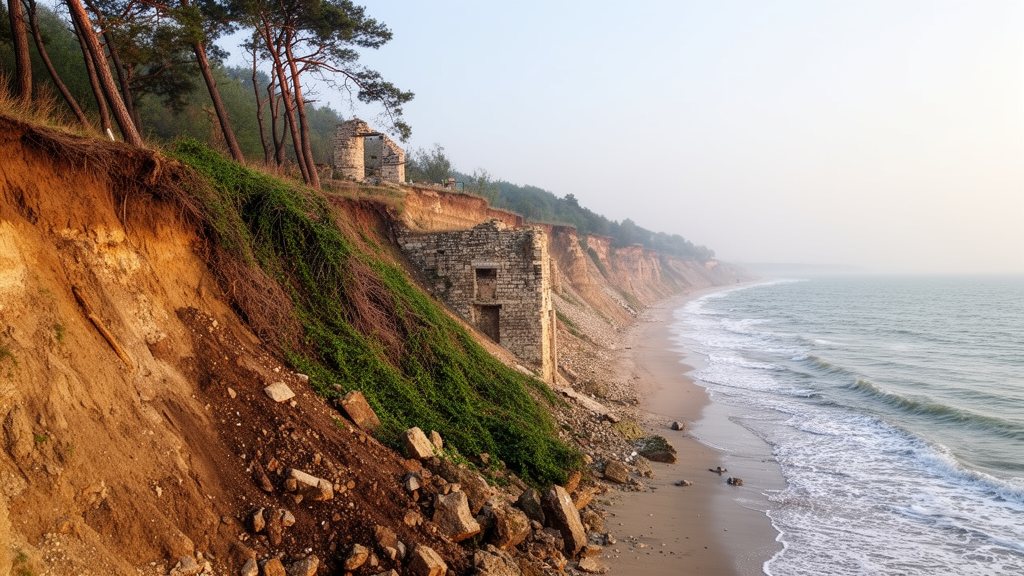
A quantitative assessment of landslides along Bulgaria’s northern Black Sea coast estimated that the section between Cape Kaliakra and the Kranevo resort had the highest integrated socio-ecological risk among three assessed regions. The framework combined hazard, exposure and vulnerability with coping capacity and adaptability, while also considering biodiversity and archaeological heritage. Estimated integrated risk was about 24–25% in the northernmost section, 85–86% between Cape Kaliakra and Kranevo, and 58% between Kranevo and Varna.
The study covered the coastal zone from the Romanian border to Varna and divided it into three regions for analysis. Landslides affect approximately 55,000 decares across the full area, including about 2,042 decares of active landslides. In the section from the Romanian border to Cape Kaliakra, landslides occupy 1,338 decares, of which about 4 decares are active. Between Cape Kaliakra and Kranevo, the affected area is 12,560 decares, including about 1,168 active decares. The third section, from Kranevo to Varna, contains 41,097 decares affected by landslides, of which about 870 decares are active. Risk profiles were calculated specifically for the summer tourist season.
The methodology defines socio-ecological risk as a function of five components: hazard, exposure, vulnerability, adaptability and coping capacity. Its equation is R = (wH + wE + wV) − wA − wCC, with corresponding weights applied to each term. Data were converted to a unitless common scale, and the weighting coefficients were required to sum to 100. Indicators were assigned three levels—low, medium and high—and combined into risk categories ranging from very low to very high. This was a regional modelling and risk-assessment exercise rather than a direct measurement of landslide losses or an evaluation of a mitigation programme.
Geological conditions vary substantially among the three sections. Small landslides in the northern area affect an eroded loess complex. The step-shaped Taukliman and Yaylata landslides north of Cape Kaliakra probably developed after strong earthquakes; their geological setting includes Oligocene clays beneath 30–40 metres of limestone from the Odartsi Formation. In the central section, old landslide bodies commonly reach depths of 40–60 metres, and additional landslide packages extend below the present sea level. Along the Frangya Plateau in the southern section, deep-seated, circus-type landslide complexes are associated mainly with marine abrasion. More recent local activity occurs against the background of these older, conditionally stabilised landslides.
Protected areas and cultural heritage were incorporated alongside conventional social and infrastructure considerations. Around 15 protected areas in the study region are included in the Natura 2000 network. The Shabla Lake Complex covers 3,175 hectares and supports 260 bird species, 70 of which are listed in Bulgaria’s Red Book. The 687.5-hectare Kaliakra Reserve contains more than 400 plant species, including 47 described as extremely rare and endangered, and more than 310 bird species, 106 protected at European level. Archaeological features considered in the wider study included sites associated with Durankulak, Yaylata, Cape Kaliakra and the coastal landscape near Varna.
The results distinguish among the three sections rather than establishing a single coast-wide risk level. In Region 1, archaeological-site risk ranged from low through medium to high, biodiversity showed a similar range, and social risk varied from low to medium. Its total integrated risk was about 24–25%. Region 2 had the highest result, at approximately 85–86%. Archaeological sites were its most vulnerable component and were joined by high social risk, while biodiversity risk was assessed as medium. Region 3 occupied an intermediate position at 58%; archaeological-site risk ranged from high to low, social sites were considered vulnerable in connection with intensive population distribution, and biodiversity risk was predominantly medium.
The analysis also found that Regions 2 and 3 combined significant landslide susceptibility with coping capacity, while adaptive capacity was relatively moderate to low compared with coping ability. The authors state that coping capacity alone is insufficient to achieve the resilience needed to lower risk. They identify transformability—the capacity to shift development paths or create alternatives—as a major focus for socio-ecological risk management. Within the framework, reducing vulnerability and increasing adaptive capacity were identified as the most efficient strategies, especially where archaeological sites and protected natural areas occur close together.
The authors report that the acquired data were consistent with recorded landslide occurrences and empirical analysis, and they describe the methodology as flexible and adaptable. They also note that at high risk levels, a disaster could lead to biodiversity loss and ecosystem damage that could not be reversed. The framework can accommodate additional indicators, including climate-related parameters, but the reported regional percentages remain model estimates based on the selected data, scores and weighting assumptions rather than observed outcomes from a future landslide event.
A principal limitation identified by the authors is the absence of a comprehensive, detailed assessment of contemporary geological hazard and risk at archaeological sites along the northern Bulgarian Black Sea coast. Such work would require specialists in geology, engineering geology and the assessment of present-day hazards at heritage locations. The risk estimates also depend on indicator scores, weighting assumptions and the availability of data for hazards, exposure, vulnerability, adaptability and coping capacity. As a result, the study provides a comparative socio-ecological assessment of the three sections, with the central section between Cape Kaliakra and Kranevo identified as the riskiest under the proposed methodology.
Subject of Research: Regional assessment of socio-ecological landslide risk across three sections of Bulgaria’s northern Black Sea coast
Article Title: Rethinking the landslide risk assessment for socio-ecological systems using the example of the northern Bulgarian Black Sea coast
Article References: Frantzova, A., Ivanov, P., Dobrev, N., Berov, B., Nankin, R., Krastanov, M., & Ranguelov, B. (2024). Rethinking the landslide risk assessment for socio-ecological systems using the example of the northern Bulgarian Black Sea coast. One Ecosystem, 9, Article e136166. https://doi.org/10.3897/oneeco.9.e136166
Image Credits: AI Generated
Keywords: landslide risk, socio-ecological systems, Bulgarian Black Sea coast, Cape Kaliakra, Kranevo, Varna, biodiversity, archaeological heritage, adaptive capacity, risk modelling, Rethinking, landslide
Cite Scienmag News
Margaret Porter. (October 20, 2026). Region 2 had highest socio-ecological landslide risk in three-section assessment of Bulgaria’s northern Black Sea coast. Scienmag. https://scienmag.com/region-2-had-highest-socio-ecological-landslide-risk-in-three-section-assessment-of-bulgarias-northern-black-sea-coast/
Margaret Porter. "Region 2 had highest socio-ecological landslide risk in three-section assessment of Bulgaria’s northern Black Sea coast." Scienmag, 20 October 2026, https://scienmag.com/region-2-had-highest-socio-ecological-landslide-risk-in-three-section-assessment-of-bulgarias-northern-black-sea-coast/. Accessed 20 October 2026.
Margaret Porter. "Region 2 had highest socio-ecological landslide risk in three-section assessment of Bulgaria’s northern Black Sea coast." Scienmag. October 20, 2026. https://scienmag.com/region-2-had-highest-socio-ecological-landslide-risk-in-three-section-assessment-of-bulgarias-northern-black-sea-coast/


