


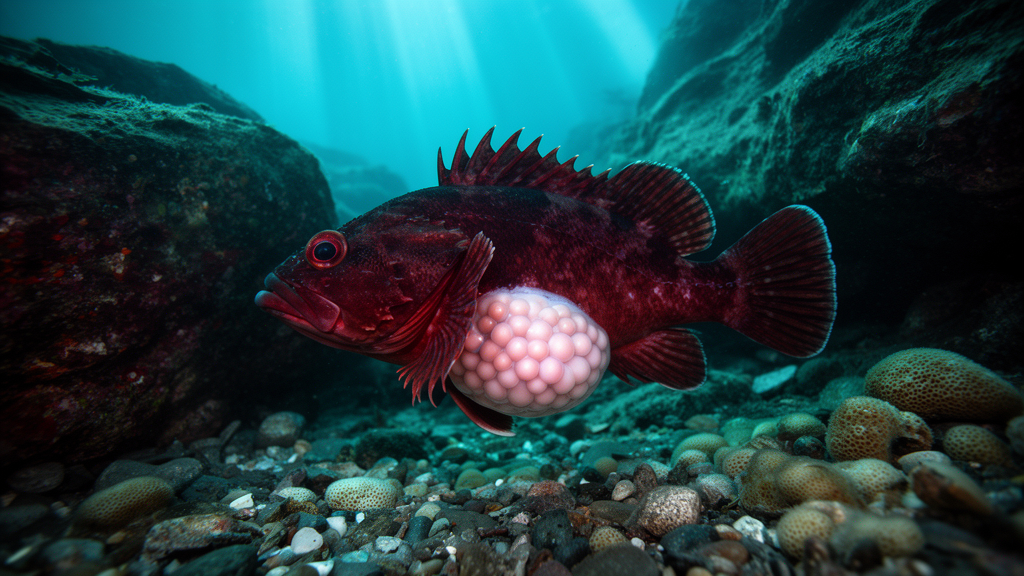
A one-year observational study of bluemouth rockfish, Helicolenus dactylopterus , collected in the central Mediterranean fishing area GFCM-GSA 12 found marked seasonal differences in reproductive indices, relative growth, muscle composition and fatty-acid profiles. The study sampled fish monthly throughout 2022 along the northern Tunisian coast and compared males and females across spring, summer, autumn and winter. Researchers collected 931 fish, including 538 males and 393 females, and transferred them to the biological laboratory of the Higher Institute of Marine Sciences in Bizerte.
Total length, total weight, eviscerated weight, gonad weight and liver weight were measured. Fresh specimens were used for biological analyses, damaged fish were excluded, and muscle from 24 fish per sex per season was stored at −80°C for biochemical assays. Among 849 fish included in the sex-ratio analysis, 501 were male and 348 female, giving a male-biased ratio of 1.44 that differed significantly from an equal sex ratio (χ² = 27.57, degrees of freedom = 1, P < 0.05).
Hepatosomatic indices were highest in spring and lower in summer, autumn and winter for both sexes. Male gonadosomatic indices followed a similar pattern, increasing markedly in spring, whereas female gonadosomatic indices showed no significant seasonal variation. The authors associated the seasonal pattern with the species’ cold-season reproductive cycle, although the observational design did not establish that reproductive activity directly caused the biochemical changes.
Weight–length models showed predominantly negative allometry. Exponents for total weight relative to total length ranged from 2.606 to 2.863, while those for eviscerated weight relative to total length ranged from 2.912 to 3.047. Eviscerated weight showed negative allometry in autumn for both sexes, but positive allometry in winter, spring and summer.
Season significantly affected the slopes of both relationships, whereas sex did not. The researchers cautioned that growth relationships generally represent cumulative cohort trends, making genuine seasonal changes unlikely; limited sample sizes in some periods may have contributed to the observed differences. Muscle composition also varied by season and, for some measures, by sex.
Protein ranged from 41.325 to 77.390 mg·g−1 of fresh weight, with the lowest values recorded in winter for both sexes. Females also had significantly lower protein content in spring. Female lipid content peaked in autumn at 15.006 ± 0.882 mg·g−1 and fell to 1.085 ± 0.382 mg·g−1 in winter; male lipid content also declined significantly in winter.
Female glycogen measured 1.198 ± 0.208 mg·g−1 in summer and 1.203 ± 0.230 mg·g−1 in autumn, compared with 0.110 ± 0.062 mg·g−1 in winter, and male glycogen also reached its minimum in winter. Moisture ranged from 71.7% to 89.7%, while ash ranged from 17.7% to 20.5% in females and from 18.6% to 19.3% in males. Polyunsaturated fatty acids formed the dominant class in female muscle, followed by monounsaturated and saturated fatty acids.
The female n-3 polyunsaturated fraction was 27.75 ± 0.39% in spring and 28.83 ± 0.59% in summer, compared with 10.73 ± 1.03% in autumn and 13.64 ± 2.43% in winter. Eicosapentaenoic acid and docosahexaenoic acid were among the principal n-3 components. Males had their highest total polyunsaturated proportion in summer, at 43.57 ± 0.76%, including 23.63 ± 0.72% n-3 polyunsaturated fatty acids.
Saturated-fatty-acid patterns differed between the sexes, so one uniform seasonal pattern could not be applied to both groups. Nutritional quality indices varied seasonally. Essential n-3 polyunsaturated fatty acids were lower in both sexes during cold seasons than during warm seasons, while the n-6 proportion was lowest in spring.
The polyunsaturated-to-saturated and n-3-to-n-6 ratios varied by sex and season and had their lowest values in winter. These measurements characterize the relative fatty-acid composition of sampled muscle; they do not by themselves demonstrate clinical benefits from consuming the fish. Principal component analysis of fatty acids explained 62% of cumulative variance and separated winter from the other seasons, while male and female samples from spring and summer overlapped almost completely.
A second analysis combining biological and biochemical variables explained 53.6% of total variance across two components. Morphometric traits were associated mainly with the first component, while biochemical and reproductive indices contributed more strongly to the second, with seasonal clustering and partial separation between the sexes. Overall, the study documents coordinated seasonal changes in bluemouth rockfish sampled from northern Tunisia.
Spring was associated with higher male reproductive and liver indices, while winter samples had the lowest protein, lipid and glycogen measurements. Warm-season muscle contained higher proportions of n-3 polyunsaturated fatty acids, and the species combined substantial protein with relatively low lipid values. The study covered one fishing area and one annual cycle, and its fatty-acid analysis relied on pooled samples, limiting broader generalization.
It did not test fishing restrictions or measure the effects of management measures.
Subject of Research: Seasonal biological and biochemical variation in Mediterranean bluemouth rockfish
Article Title: Seasonal variations in the biological characteristics and biochemical composition of bluemouth rockfish, Helicolenus dactylopterus ( Actinopterygii , Perciformes , Sebastidae ), in the central Mediterranean Sea
Article References: Helali, A., Ghribi, F., Bejaoui, S., Ben Ali, M., Hedfi, A., Hassan, M., Hajlaoui, W., Belhassen, D., Chetoui, I., Ennouri, R., Agrebi, S., & Mili, S. (2025). Seasonal variations in the biological characteristics and biochemical composition of bluemouth rockfish, Helicolenus dactylopterus (Actinopterygii, Perciformes, Sebastidae), in the central Mediterranean Sea. Acta Ichthyologica et Piscatoria, 55, 317-331. https://doi.org/10.3897/aiep.55.160771
Image Credits: AI Generated
Keywords: bluemouth rockfish, Helicolenus dactylopterus, northern Tunisia, Mediterranean Sea, seasonal variation, fatty-acid composition, muscle composition, reproductive indices, relative growth, fisheries biology, Seasonal, variations
Cite Scienmag News
Daisy Hatcher. (October 20, 2026). Seasonal biology and muscle composition of bluemouth rockfish in northern Tunisia. Scienmag. https://scienmag.com/seasonal-biology-and-muscle-composition-of-bluemouth-rockfish-in-northern-tunisia/
Daisy Hatcher. "Seasonal biology and muscle composition of bluemouth rockfish in northern Tunisia." Scienmag, 20 October 2026, https://scienmag.com/seasonal-biology-and-muscle-composition-of-bluemouth-rockfish-in-northern-tunisia/. Accessed 20 October 2026.
Daisy Hatcher. "Seasonal biology and muscle composition of bluemouth rockfish in northern Tunisia." Scienmag. October 20, 2026. https://scienmag.com/seasonal-biology-and-muscle-composition-of-bluemouth-rockfish-in-northern-tunisia/


