


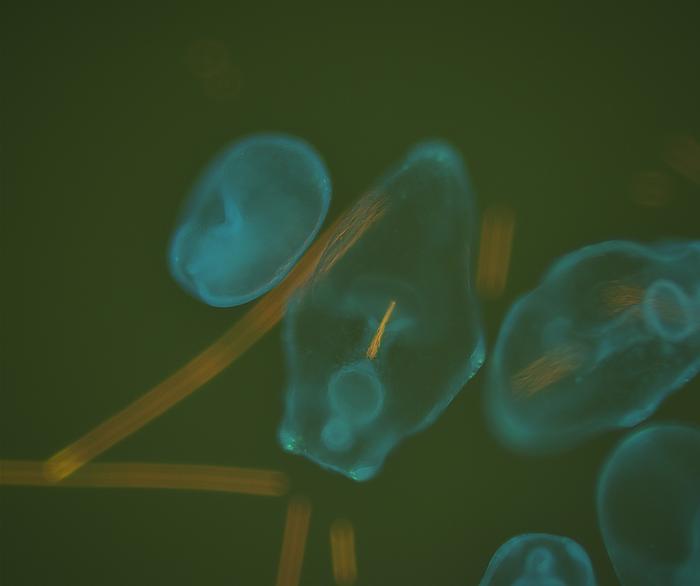
Researchers have uncovered an under-the-sea phenomenon where coral-destroying crown-of-thorns starfish larvae have been feasting on blue-green algae bacteria known as ‘sea sawdust’.
The team of marine scientists from The University of Queensland and Southern Cross University found crown-of-thorns starfish (COTS) larvae grow and thrive when raised on an exclusive diet of Trichodesmium – a bacteria that often floats on the ocean’s surface in large slicks.

Credit: Benjamin Mos
Researchers have uncovered an under-the-sea phenomenon where coral-destroying crown-of-thorns starfish larvae have been feasting on blue-green algae bacteria known as ‘sea sawdust’.
The team of marine scientists from The University of Queensland and Southern Cross University found crown-of-thorns starfish (COTS) larvae grow and thrive when raised on an exclusive diet of Trichodesmium – a bacteria that often floats on the ocean’s surface in large slicks.
UQ’s Dr Benjamin Mos from the School of Environment said scientists had thought almost nothing touched this threadlike bacteria because of its toxicity and poor nutritional content.
“Until now, not much has been known about sea sawdust as a food source, so we were certainly surprised to say the least,” Dr Mos said.
“Blue-green algae blooms can extend hundreds to thousands of kilometres across the ocean and often float on the surface in large rafts like sawdust – hence the name.
“It plays a crucial role in marine ecosystems by making nitrogen from the atmosphere available to other sea life, but now we know it is also a food source.
“By knowing how sea sawdust helps COTS thrive, we can potentially change the way we combat this very damaging coral predator.”
By tracing atoms from bacteria to COTS larvae, researchers found the larvae digested nitrogen from sea sawdust, with the nitrogen moving into their tissues for sustenance.
“With sea sawdust blooms on the rise in recent years, our findings suggest this could help explain the increase in COTS populations, which have devastated our coral reefs for decades,” Dr Mos said.
These findings build on earlier research that suggests human activities, such as fertiliser use, sewage treatment, and stormwater runoff, may be responsible for the increase in blue-green algae blooms.
“It’s important we understand the flow-on effect of how human impacts in one ecosystem might flow on to other seemingly unrelated ecosystems,” Dr Mos said.
Professor Symon Dworjanyn from Southern Cross University’s National Marine Science Centre said further work was needed to investigate the potential connection between sea sawdust blooms and the number of coral-eating COTS.
“If we can figure out how to reduce the impact of COTS, we might give coral reefs a little more time,” Professor Dworjanyn said.
“We don’t yet know if sea sawdust blooms result in more adult COTS on coral reefs, so this research needs more work.
“However, our findings could be an important part of cracking that puzzle.”
This research is published in Science Advances.
Journal
Science Advances
Cite Scienmag News
Drew Townsend. (July 17, 2024). Reef pest feasts on ‘sea sawdust’. Scienmag. https://scienmag.com/reef-pest-feasts-on-sea-sawdust/
Drew Townsend. "Reef pest feasts on ‘sea sawdust’." Scienmag, 17 July 2024, https://scienmag.com/reef-pest-feasts-on-sea-sawdust/. Accessed 4 September 2026.
Drew Townsend. "Reef pest feasts on ‘sea sawdust’." Scienmag. July 17, 2024. https://scienmag.com/reef-pest-feasts-on-sea-sawdust/

