


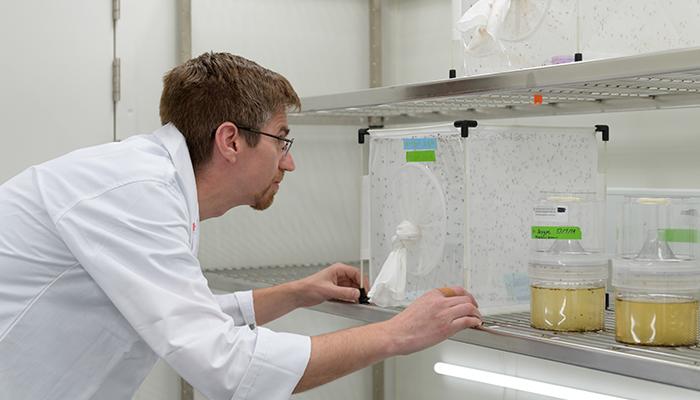
A Macquarie University team proposes using genetically engineered black soldier flies (Hermetia illucens) to address worldwide pollution challenges and produce valuable raw materials for industry, including the USD $500 billion global animal feed market.

Credit: Macquarie University
A Macquarie University team proposes using genetically engineered black soldier flies (Hermetia illucens) to address worldwide pollution challenges and produce valuable raw materials for industry, including the USD $500 billion global animal feed market.
In a new paper published on 24 July in the journal Communications Biology, scientists at Macquarie University outline a future where engineered flies could transform waste management and sustainable biomanufacturing, addressing multiple United Nations Sustainable Development Goals (SDGs).
Synthetic biologist Dr Kate Tepper is lead author of the paper and a Postdoctoral Research Fellow at Applied BioSciences, Macquarie University.
“One of the great challenges in developing circular economies is making high-value products that can be produced from waste,” says Dr Tepper.
Landfill Emitters
An estimated 40 to 70 per cent of global organic waste finds its way to landfills.
“The landfilling of organic waste creates about five per cent of annual global greenhouse gas emissions and we need to get this to zero per cent,” Dr Tepper says.
Organic by-products from sewage treatment – municipal biosolids – can be used as an alternative to synthetic fertiliser to grow crops and close nutrient cycles.
However Dr Tepper notes there are rising concerns about toxic chemicals in waste, including dangerous ‘forever chemicals’ such as per- and poly-fluoroalkyl substances (PFAS).
In developing countries, organic wastes dumped in open areas can contaminate water used for drinking or irrigation, attracting pests, spreading disease and degrading natural habitat, and farmers often burn leftover crop parts they can’t use, causing air pollution.
Black soldier flies are already valued in waste management where they consume commercial organic wastes before being processed as ‘insect biomass’ into foods for domestic pets and commercial chicken and fish farmers.
But the Macquarie team believes genetic engineering could extend the usefulness of the black soldier fly, enabling them to turn waste inputs into enhanced animal feeds or valuable industrial raw materials.
The larvae could bio-manufacture industrial enzymes currently for use in livestock, textile, food and pharmaceutical industries and representing a global market worth billions of dollars annually.
The flies can also be engineered to generate specialised lipids for use in biofuels and lubricants, replacing fossil-fuel derived products.
Engineering insects to make industrial enzymes and lipids that are not used in food supply chains will expand the types of organic wastes that can be used, and the research team propose modifying the fly so it can digest contaminated organic wastes, sewage sludge, and other complex organic wastes.
“Even the fly-poo, called ‘frass,’ could be enhanced to improve fertiliser,” Dr. Tepper says. “The flies could be engineered to clean up chemical contaminants in their frass, which can be applied as pollutant free fertiliser to grow crops and prevent contaminants entering our food supply chains.”
Sustainable biomanufacturing
Senior author Dr Maciej Maselko, who heads an animal synthetic biology lab at Macquarie University’s Applied BioSciences,
Genetically engineered microbes require sterile environments to prevent contamination, along with lots of water and refined nutrient inputs.
“We can feed black soldier flies straight, dirty trash rather than sterilised or thoroughly pre-processed. When it is just chopped into smaller pieces black soldier flies will consume large volumes of waste a lot faster than microbes,” Dr Maselko says.
The researchers suggest genetic engineering could piggyback on the existing framework, elevating the flies from simple waste processors to high-tech biomanufacturing platforms. In the paper the researchers outline a roadmap calling for better genetic engineering tools in key insects.
“Physical containment is part of a series of protections. We are also developing additional layers of genetic containment so that any escapees can’t reproduce or survive in the wild,” Dr Maselko says.
Commercialisation
Macquarie University in partnership with some members of the research team has filed patent applications related to black soldier fly biomanufacturing, already underway through a Macquarie University spin-out company, EntoZyme.
Dr Tepper says that the introduction of genetically engineered insects has potential, not just in the multi-billion dollar waste management market, but also in the production of a range of high-value industrial inputs.
“If we want a sustainable circular economy, the economics of that have to work,” says Dr Tepper.
“When there is an economic incentive to implement sustainable technologies, such as engineering insects to get more value from waste products, that will help to drive this transition more rapidly.”
Journal
Communications Biology
Method of Research
Systematic review
Subject of Research
Animals
Article Title
Diverting organic waste from landfills via insect biomanufacturing using engineered black soldier flies (Hermetia illucens)
Article Publication Date
24-Jul-2024
COI Statement
The authors declare the following competing interests: K.T. and M.M. have filed patent applications relevant to BSF biomanufacturing. O.E. is the CEO
of EntoZyme PTY LTD. K.T. andM.M. are co-founders of EntoZyme. All other authors declare no competing interests.
Cite Scienmag News
Drew Townsend. (August 13, 2024). Reduce, reuse, reflycle. Scienmag. https://scienmag.com/reduce-reuse-reflycle/
Drew Townsend. "Reduce, reuse, reflycle." Scienmag, 13 August 2024, https://scienmag.com/reduce-reuse-reflycle/. Accessed 3 September 2026.
Drew Townsend. "Reduce, reuse, reflycle." Scienmag. August 13, 2024. https://scienmag.com/reduce-reuse-reflycle/

