


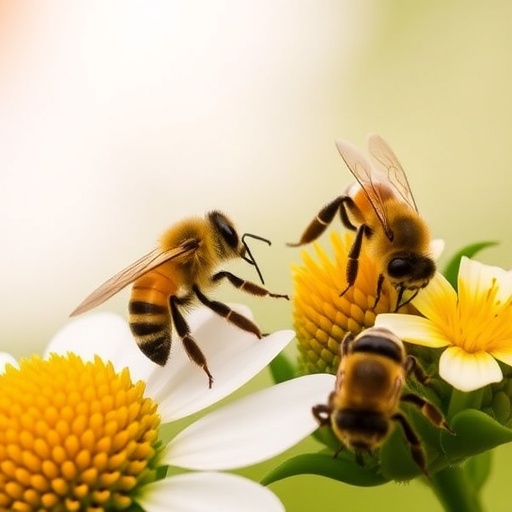
A groundbreaking study led by researchers at the University of Oxford has unveiled a remarkable nutritional adaptation in honeybees, highlighting their ability to finely regulate food intake based on the balance of essential amino acids present in their diet. This discovery provides unprecedented insight into how honeybees avoid the toxic effects of protein imbalance and underscores the intricacy of their feeding strategies, particularly regarding the specialized “baby food” they produce to nourish their larvae.
It is well established that bees rely on floral resources, chiefly nectar and pollen, for sustenance. Nectar, rich primarily in carbohydrates, fuels their energetic needs, while pollen serves as the vital protein source. However, pollen’s primary biological role is plant reproduction—it conveys the male gametes necessary for fertilization—rather than acting as a nutritional aid tailored to pollinators. Consequently, pollen’s nutritional profile, and more specifically the ratios of essential amino acids it contains, rarely aligns perfectly with the physiological requirements of bees.
To address this nutrient mismatch, the Oxford-led team conducted a comprehensive biochemical analysis comparing essential amino acid profiles from the tissues of honeybees against those of pollen collected from 99 UK flowering plant species, spanning 26 distinct botanical families. Such a comparative approach provided a robust framework for understanding the nutritional discrepancies bees encounter in their natural foraging environments.
The researchers then synthesized artificial diets designed to replicate the amino acid compositions of either different pollen sources or the bee’s own tissue profile. These diets were administered to newly emerged worker honeybees in a tightly controlled lab setting, permitting an objective assessment of feeding behavior and physiological responses. Remarkably, bees consuming diets mimicking their tissue amino acid profile exhibited higher food intake, greater body mass accumulation, and a more balanced uptake of protein nutrients, suggesting an intrinsic dietary regulation mechanism.
One critical finding emerged from manipulating the levels of histidine, an essential amino acid typically required in small amounts. When histidine was elevated relative to branched-chain amino acids like leucine and isoleucine—known to be central for bee development—the bees significantly reduced their overall food consumption. This observation implies a complex post-ingestive feedback system, wherein bees detect and respond to amino acid imbalances to circumvent potential toxicity and maintain homeostatic balance.
This adaptive response echoes phenomena reported in other animals, such as rats, where excess histidine is metabolized into histamine—an active compound that influences central nervous system pathways regulating appetite and satiety. Drawing this parallel, the research suggests that bees’ nutritional regulation may involve neurochemical signaling pathways that calibrate feeding according to internal amino acid thresholds.
Intriguingly, honeybees appear to have evolved a sophisticated compensatory strategy to ensure proper larval nutrition despite the shortcomings of pollen. Their practice of collecting diverse pollen types and storing them as ‘bee bread’ within the hive facilitates nutritional mixing, effectively evening out the amino acid deficits of individual plant pollens. Nurse bees then process this mixture, converting it into glandular secretions, including royal jelly, which comprises an optimized composition of essential amino acids closely matching that of bee tissues.
Chemical profile analyses revealed that royal jelly’s amino acid composition surpasses that of both bee bread and raw pollen in nutritional quality, highlighting its role as an exquisitely engineered “superfood” fine-tuned to maximize larval growth and development. This finding positions royal jelly as a crucial nexus in the nutritional ecology of honeybee colonies and emphasizes the evolutionary pressures shaping their brood care strategies.
However, this finely tuned nutritional system is not universal among all bee species. Wild pollinators, including bumblebees and solitary bees, often bypass intermediate processing steps and feed pollen directly to their larvae. This direct transfer means these species heavily rely on the diversity and availability of pollen sources within their habitat. Limited floral variety could imperil their ability to obtain balanced nutrition, potentially impacting larval growth, survival, and reproductive success.
From an ecological and conservation perspective, the study’s conclusions advocate for a shift in how pollinator-supportive habitats are designed and managed. Efforts aimed solely at providing an abundance of flowers must be supplemented with considerations of pollen quality and variety. Diverse floral assemblages might be essential to sustaining healthy bee populations by ensuring access to the full spectrum of nutritionally complementary pollen amino acids.
Professor Geraldine Wright, lead author of the study, emphasized the evolutionary trade-offs inherent in the plant-pollinator relationship. While pollen’s primary role is reproductive, honeybees have evolved to navigate this conflict by manipulating pollen into nutritionally superior glandular secretions for their young. This evolutionary innovation underscores the complex interplay between plant reproductive strategies and pollinator nutritional ecology.
Beyond enriching our understanding of bee biology, this research carries practical implications for agriculture and biodiversity. As pollinators face global declines, uncovering the nutrient-based constraints on bee health illuminates a path toward more effective conservation and agricultural practices. Strategic planting schemes that prioritize nutrient diversity alongside floral abundance may bolster pollinator resilience and, by extension, ecosystem sustainability and crop productivity.
The multi-institutional study, which also included collaborators from the University of Southampton, Lancaster University, Newcastle University, and The Hebrew University of Jerusalem, was published in the journal Current Biology. Their collective findings mark a significant advancement in the field of nutritional ecology, providing a nuanced picture of how pollinators interact with their environment on the molecular and behavioral levels.
In summary, honeybees possess an extraordinary ability to regulate their nutrient intake, avoiding the pitfalls of amino acid toxicity through a combination of selective feeding and biochemical processing. This intricate balance highlights the sophistication of bee nutrition and the importance of multifaceted approaches to supporting pollinator populations amid changing landscapes and environmental pressures.
News Publication Date: 17 June 2026
Web References:
- DOI: 10.1016/j.cub.2026.05.070
- University of Oxford Department of Biology: www.biology.ox.ac.uk
Cite Scienmag News
Daisy Hatcher. (June 17, 2026). Bees Balance Pollen Nutrients to Avoid Overindulgence, New Study Finds. Scienmag. https://scienmag.com/bees-balance-pollen-nutrients-to-avoid-overindulgence-new-study-finds/
Daisy Hatcher. "Bees Balance Pollen Nutrients to Avoid Overindulgence, New Study Finds." Scienmag, 17 June 2026, https://scienmag.com/bees-balance-pollen-nutrients-to-avoid-overindulgence-new-study-finds/. Accessed 4 September 2026.
Daisy Hatcher. "Bees Balance Pollen Nutrients to Avoid Overindulgence, New Study Finds." Scienmag. June 17, 2026. https://scienmag.com/bees-balance-pollen-nutrients-to-avoid-overindulgence-new-study-finds/


