


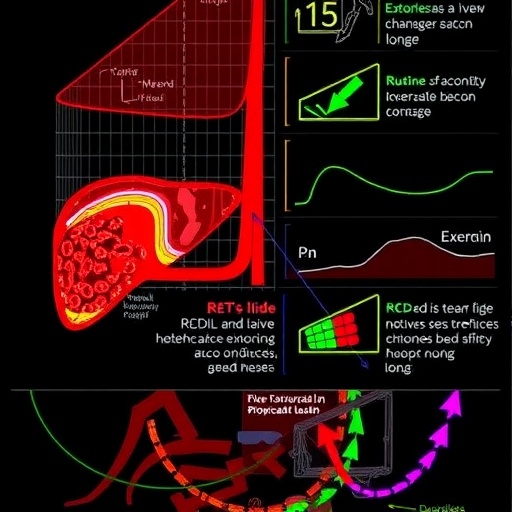
In an era where the interplay between metabolism and physical exertion is becoming increasingly pivotal to understanding human health and disease, a groundbreaking study from Horiuchi, Kaneko, Hosaka, and colleagues published in Nature Metabolism has shed new light on the redox-dependent mechanisms regulating liver gluconeogenesis during exercise. This research not only uncovers novel biochemical pathways but also elucidates how different intensities of exercise modulate hepatic glucose production through redox-sensitive processes in mice, offering profound implications for metabolic physiology and potential therapeutic avenues.
The liver’s role as a metabolic hub, particularly its capacity to maintain glucose homeostasis during fasting and physical activity, is well-established. However, the precise molecular mechanisms linking redox states to gluconeogenic flux under various exercise intensities remained elusive until now. The research team employed state-of-the-art redox biochemistry methods coupled with in vivo exercise models in mice, meticulously dissecting how alterations in cellular redox balance govern the output of glucose from the liver. These findings highlight a finely tuned regulatory system, wherein the oxidative environment directly influences enzymatic activities implicated in gluconeogenesis.
Central to this metabolic control is the modulation of key enzymes and redox-sensitive cofactors within hepatocytes, which respond dynamically to shifts in the ratios of reduced and oxidized nicotinamide adenine dinucleotide (NADH/NAD+) and nicotinamide adenine dinucleotide phosphate (NADPH/NADP+). The study illustrates that during low- to moderate-intensity exercise, a specific redox poise favors increased gluconeogenic flux, ensuring adequate glucose supply to peripheral tissues. Conversely, at higher intensities, changes in the redox environment fine-tune enzyme function and metabolic pathways to balance energy demands and oxidative stress.
To characterize these phenomena, the researchers utilized sophisticated metabolomics coupled with isotope-tracing techniques, enabling them to quantify fluxes through gluconeogenic pathways with unparalleled precision. This approach revealed that redox-dependent modifications in enzyme activity and substrate availability orchestrate hepatic glucose output in a context-dependent manner, varying notably with exercise intensity. The nuanced control suggests an evolved mechanism by which liver metabolism integrates systemic oxidative signals with energy production requirements.
Of particular interest is the role of mitochondrial function in this redox-sensitive gluconeogenic regulation. The study provides compelling evidence that mitochondrial-generated reactive oxygen species (ROS), traditionally viewed as deleterious byproducts, serve as important signaling molecules modulating enzyme activities and gene expression linked to gluconeogenesis. These findings align with a growing body of literature repositioning ROS from mere markers of oxidative damage to central players in metabolic regulation and adaptive responses to physiological stresses such as exercise.
Crucially, the authors demonstrated that perturbations in redox homeostasis, induced either genetically or pharmacologically, led to marked alterations in exercise capacity and metabolic flexibility. Mice with disrupted redox signaling pathways exhibited impaired glucose production during physical activity, underscoring the functional relevance of these molecular mechanisms. This correlation provides a potential framework for understanding metabolic dysregulation in conditions such as diabetes, where gluconeogenic control is compromised.
Moreover, the study elegantly links systemic metabolic adaptations to intracellular redox shifts, suggesting that the liver’s ability to sense and respond to oxidative cues is vital for coordinating whole-body energy metabolism during exercise. This concept challenges previous models that largely considered hepatic glucose production as governed predominantly by hormonal and substrate-level regulation, expanding the scope to include redox-based molecular switches as integral components.
From a translational perspective, these insights pave the way for novel interventions targeting hepatic redox balance to optimize glucose metabolism in metabolic diseases. Therapeutic strategies that modulate redox-sensitive pathways could enhance metabolic flexibility, improve exercise performance, and ameliorate hyperglycemia. Such approaches may also address the growing public health concerns around sedentary lifestyles and metabolic syndrome by fine-tuning endogenous regulatory networks.
The nuances uncovered in the intensity-dependent modulation of redox states and their impact on gluconeogenesis also carry implications for athletic training and sports medicine. Tailoring exercise regimens to exploit the beneficial redox-mediated metabolic adaptations could improve endurance and recovery while minimizing oxidative damage. The concept that a certain threshold of exercise intensity triggers distinct hepatic metabolic responses adds a new dimension to personalized exercise prescription.
From a methodological standpoint, the integration of cutting-edge redox probes, in vivo imaging, and comprehensive metabolic flux analysis represents a significant advancement in metabolic research. These tools enable the dissection of complex biochemical interactions in physiologically relevant contexts, facilitating a deeper understanding of how redox biology interfaces with organ function. The study by Horiuchi and colleagues exemplifies the power of combining multidisciplinary approaches to unravel intricate biological processes.
Beyond exercise physiology, these findings resonate with broader themes in hepatic biology and systemic energy regulation. The liver’s capacity to integrate signals from mitochondria, cytosolic redox couples, and extracellular cues exemplifies the organ’s role as a metabolic conductor, adjusting substrate partitioning to maintain homeostasis. This adaptive capacity is paramount in responding to environmental challenges, dietary changes, and pathological states.
Furthermore, the research highlights the evolutionary conserved nature of redox regulation in metabolism, suggesting that similar mechanisms may operate across mammalian species. Understanding these universal principles holds promise for developing cross-species models of metabolic diseases and refining therapeutic approaches.
The interplay between redox homeostasis and gluconeogenesis also intersects with aging biology and chronic disease progression, where oxidative imbalance and impaired metabolic adaptability are common hallmarks. Thus, insights from this study could inform strategies aimed at preserving metabolic health across the lifespan.
Overall, this seminal work advances our comprehension of how redox signals sculpt metabolic responses during exercise, unveiling a layer of regulation that integrates biochemical status with physiological demands. It challenges the traditional paradigms of glucose metabolism and opens exciting avenues for research and clinical innovation.
As future studies build upon these findings, there is potential to further dissect the molecular players within redox signaling cascades and their temporal dynamics. Understanding how these processes interact with other metabolic pathways and hormonal networks will be critical for holistic insights into energy homeostasis.
In conclusion, the revelations provided by Horiuchi, Kaneko, Hosaka, and their team underscore the significance of redox-dependent regulation in liver gluconeogenesis during exercise, revealing the liver not just as a passive glucose supplier but as an active sensor and integrator of systemic metabolic cues. This paradigm shift empowers researchers and clinicians alike to reevaluate metabolic control through the lens of redox biology, with profound implications for health, disease, and human performance.
Cite Scienmag News
Ophelia Keating. (September 18, 2025). Redox-Controlled Liver Gluconeogenesis Affects Exercise Intensity. Scienmag. https://scienmag.com/redox-controlled-liver-gluconeogenesis-affects-exercise-intensity/
Ophelia Keating. "Redox-Controlled Liver Gluconeogenesis Affects Exercise Intensity." Scienmag, 18 September 2025, https://scienmag.com/redox-controlled-liver-gluconeogenesis-affects-exercise-intensity/. Accessed 3 September 2026.
Ophelia Keating. "Redox-Controlled Liver Gluconeogenesis Affects Exercise Intensity." Scienmag. September 18, 2025. https://scienmag.com/redox-controlled-liver-gluconeogenesis-affects-exercise-intensity/


