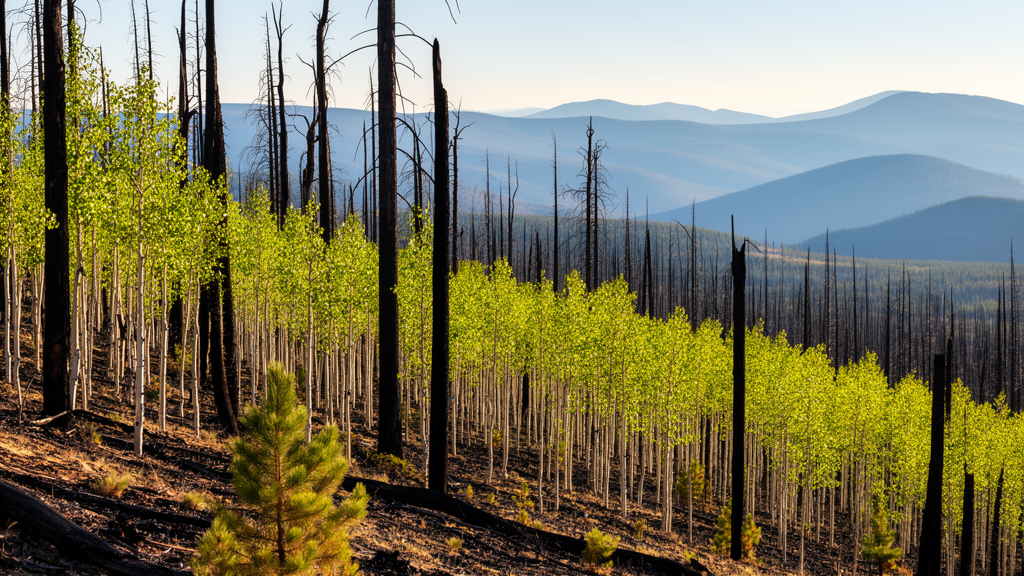
When wildfires strike the same high-elevation forest twice within 25 years, the young forest that comes back can look strikingly different from the one that burned. A new field study in British Columbia’s Glacier National Park finds that short-interval reburns shift both regenerating trees and understory plants away from the shade-tolerant conifers that define these mountains, toward fast-growing pioneers such as lodgepole pine, trembling aspen and black cottonwood. Forests burned only once, by contrast, largely regained their original character.
The study, published in the journal Fire Ecology, surveyed vegetation across a site in the Beaver Valley where a lightning-ignited fire burned 211 hectares in June 1992 and another lightning-caused blaze scorched 3,111 hectares over two months in July 2017 before rain extinguished it. Roughly 100 hectares burned in both events, creating a natural experiment in what happens when fires arrive closer together than the 100 to 300 years that high-elevation coniferous forests in interior British Columbia typically experience between stand-replacing fires.
Researchers from the region surveyed 75 plots across seven subsites between mid-July and early August in 2022 and 2023, four to six weeks after snowmelt. The subsites covered every combination the two fires allowed: areas burned only in 2017 at low or high severity, areas burned in both years in low-low, low-high, high-low and high-high severity pairings, and a control forest with no recorded fire in roughly 150 years. Burn severity for each fire was derived from satellite imagery using the Relativized delta Normalized Burn Ratio, then grouped into low and high classes and checked against field indicators such as soil charring and canopy consumption.
The team counted young trees, seedlings up to 30 centimeters tall and saplings up to 130 centimeters, in circular subplots at each plot, and recorded understory plant percent cover and species presence in one-square-meter quadrats. Across the whole site, only eight tree species were found regenerating: subalpine fir, Engelmann spruce, whitebark pine, lodgepole pine, trembling aspen, black cottonwood, Douglas-fir and mountain hemlock.
Stem density told a nuanced story. Young tree density was significantly lower in areas burned once at high severity and in areas where a low-severity 1992 fire was followed by a high-severity 2017 fire, compared with unburned forest and with low-low and high-low reburns. But in the most heavily disturbed areas, burned at high severity in both fires, stem density did not differ significantly from the unburned forest. That abundance, the authors caution, should not be read as resilience, because it reflects a completely different regeneration pathway dominated by colonizers rather than the recovery of the original forest.
Composition revealed the clearest signal. Young trees in unburned and single-fire areas, and generally in low-low reburns, consisted exclusively of conifers such as subalpine fir, Engelmann spruce and whitebark pine. In reburned areas other than low-low, regeneration was dominated by lodgepole pine and deciduous species such as black cottonwood and trembling aspen. Lodgepole pine can regenerate rapidly after fire because its cones are serotinous, releasing seeds en masse when heated, even when local seed-bearing trees were killed. A statistical comparison of community composition confirmed that every subsite type hosted a distinct tree community, with unburned, single-fire and low-low areas clustering most closely together.
Distance to the nearest living seed source emerged as a key factor. Plots in reburned areas with at least one high-severity fire lay farthest from continuous unburned forest, and those distant sites were dominated by wind-dispersed colonizers such as poplar and fireweed rather than conifers, which depend on shorter dispersal distances. Species richness of regenerating trees peaked in the high-low reburn subsite and was lowest in the single high-severity area, a pattern the researchers attribute to pioneer species temporarily inflating richness in early succession before shade-tolerant conifers would normally reassert dominance.
The understory responded differently. Total understory plant cover was largely consistent across disturbance levels, with significant differences only between the single high-severity burn, which had the lowest cover, and the single low-severity and unburned areas. Species richness, however, declined with increasing disturbance: the unburned forest had the highest richness and the high-high reburn the lowest. Reburned areas were dominated by shrubs such as willows, thimbleberry and false azalea, plants with deep rhizomes that survive intense fire and resprout, while unburned and single-fire forests supported shade-tolerant species including partridge-foot, white mountain-heather and grouse whortleberry. Fireweed, a long-distance disperser, was most abundant in severely burned ground.
The authors frame these patterns using a classic classification of plant fire strategies: fire avoiders, whose reproductive tissues in the soil duff layer burn up in high-severity fire; endurers, which survive via deep rhizomes; and invaders, which disperse into burns from afar. If reburns grow more frequent and severe, they write, invaders and endurers are likely to dominate the post-fire understory, progressively crowding out the late-successional, shade-tolerant species poorly adapted to repeated high-severity fire. Such shifts could carry long-term consequences for carbon storage, hydrology and habitat in these ecosystems.
The study carries important caveats. It rests on a single reburn site in one region of southern interior British Columbia, and satellite-derived severity indices are known to under- or overestimate severity in reburned landscapes, though the team ground-truthed classifications in the field. Unmeasured factors such as soil depth, texture and moisture may also vary across the site, and burn severity and topography are often correlated in mountainous terrain, making the effects hard to fully disentangle without manipulative experiments. Because the forests are still in early regeneration, the observed trajectories may yet change. Still, the findings carry practical weight for fire management: low-low and high-low reburn areas retained tree communities resembling the pre-fire forest and could be prioritized as refugia, while high-severity reburns dominated by aspen and poplar, which burn less readily than conifers, may merit investigation as candidates for planned fuel breaks. No invasive plants were found in the surveys, but the authors note that reburned areas near transport corridors could be vulnerable to invasion and warrant early monitoring.
Subject of Research: Effects of short-interval reburns on tree and understory regeneration in a high-elevation coniferous forest in British Columbia
Article Title: Short-interval reburns drive shifts to early species composition at a high-elevation forest site
Article References: Maslowski, N. I., Singh, J. P., Macauley, K. A. P., & Harvey, J. E. (2026). Short-interval reburns drive shifts to early species composition at a high-elevation forest site. Fire Ecology, 22(1), Article 169. https://doi.org/10.1186/s42408-026-00583-4
Image Credits: AI Generated
DOI: 10.1186/s42408-026-00583-4
Keywords: wildfire, short-interval reburn, forest regeneration, high-elevation forests, lodgepole pine, trembling aspen, subalpine fir, burn severity, understory plants, Glacier National Park, British Columbia, seed dispersal
Cite Scienmag News
Drew Townsend. (October 27, 2026). Reburns push high-elevation forests toward pine and aspen, study finds. Scienmag. https://scienmag.com/reburns-push-high-elevation-forests-toward-pine-and-aspen-study-finds/
Drew Townsend. "Reburns push high-elevation forests toward pine and aspen, study finds." Scienmag, 27 October 2026, https://scienmag.com/reburns-push-high-elevation-forests-toward-pine-and-aspen-study-finds/. Accessed 30 October 2026.
Drew Townsend. "Reburns push high-elevation forests toward pine and aspen, study finds." Scienmag. October 27, 2026. https://scienmag.com/reburns-push-high-elevation-forests-toward-pine-and-aspen-study-finds/