


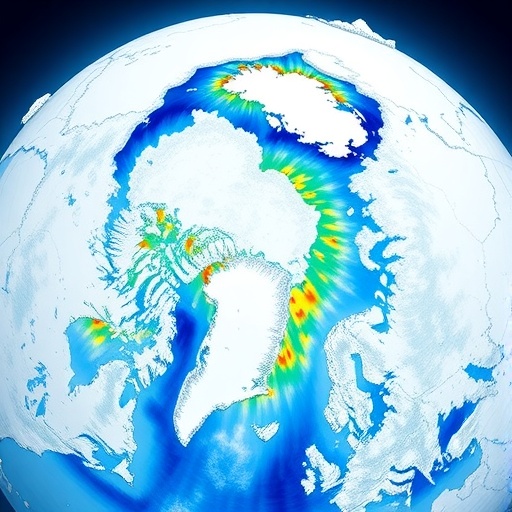
As the Arctic faces unprecedented changes, its sea ice plays a pivotal role in regulating our planet’s climate system. The extent of sea ice in this polar region influences not only local ecosystems but also global patterns of ocean circulation and atmospheric dynamics. These cascading effects extend their reach far beyond the Arctic, impacting extreme weather events and climatic conditions worldwide. With accelerating climate change driving a rapid diminishment of Arctic sea ice, the ability to accurately predict sea ice extent (SIE) in real time has become a critical scientific and environmental challenge.
In a breakthrough study published in the journal Chaos, a collaborative group of researchers from both the United States and the United Kingdom unveiled a new predictive approach that achieves remarkable accuracy in forecasting September Arctic sea ice extent — the month when sea ice reaches its annual minimum and serves as a key metric for assessing ice health. This advancement represents a significant stride in climate science, offering novel insights into the complex interplay of factors that govern sea ice dynamics.
Central to the researchers’ methodology is the conceptualization of sea ice evolution as a multifaceted system influenced by interacting atmospheric and oceanic oscillations operating on varying temporal scales. The model incorporates elements such as long-term climate memory, annual seasonal cycles, and rapid weather fluctuations, treating them as distinct yet intertwined processes. By leveraging historical daily average SIE data compiled by the National Snow and Ice Data Center dating back to 1978, the team was able to delineate the relationships between these oscillatory components and the resultant sea ice coverage.
When tested against live data from September 2024, as well as retrospective data from previous Septembers, the model demonstrated a striking capacity to anticipate variations in sea ice extent up to four months in advance. These predictions robustly captured nuances from subseasonal to seasonal timescales, outshining existing forecasting frameworks. This represents a substantial leap forward, especially given the inherent difficulties in making precise short-term climate predictions in such a volatile, multifactorial environment.
Historically, climate models have found more success in generating reliable long-term forecasts, whereas short-term predictions frequently suffered from inaccuracies driven by rapid environmental changes and incomplete data integration. The innovative aspect of this study lies in its emphasis on incorporating regional variability into the model’s structure. By addressing the diverse sea ice conditions across large Arctic subregions within the pan-Arctic system, the researchers enhanced the model’s granular understanding of spatial heterogeneity, thereby boosting its overall predictive performance.
The implications of this work extend profoundly into both ecological and socio-economic realms. Indigenous communities inhabiting the Arctic depend intimately on the presence of sea ice as habitat for key species such as polar bears, seals, and walruses, which are essential to their subsistence and cultural heritage. Moreover, economic activities including offshore drilling, commercial fishing, and tourism benefit substantially from early warnings regarding ice conditions. Accurate predictions can reduce operational risks, increase safety, and lower costs associated with Arctic ventures.
Despite the current success, the scientists acknowledge that ongoing development is necessary to refine their model’s responsiveness to rapid environmental fluctuations. Plans are underway to integrate additional oceanographic and atmospheric variables—such as ambient air temperature and sea level pressure—both of which can precipitate swift changes in ice dynamics that remain insufficiently represented in the current framework. This prospective enhancement aims to elevate the model’s predictive agility and reliability during summer months when sea ice is highly sensitive.
This research not only advances the technical frontiers of nonlinear climate modeling but also underscores the indispensable relevance of Arctic sea ice as a climate indicator and driver. The sophisticated blending of physical science with statistical and mathematical tools exemplifies the interdisciplinary nature crucial to unraveling complex Earth system behaviors. As the Arctic continues to warm at an alarming rate, cutting-edge predictive capabilities like those presented are vital for informing policy decisions, shaping conservation strategies, and safeguarding vulnerable communities.
Such real-time predictive power promises to support a more adaptive and resilient response to Arctic environmental change. By unveiling the patterns embedded within the chaotic fluctuations of sea ice extent, this model offers a lens through which scientists and stakeholders alike can anticipate and prepare for emerging challenges. It heralds a new dawn in climate science, where we move closer to mastering the intricacies of one of the planet’s most dynamic and consequential regions.
Ultimately, this study is more than a technical achievement—it represents a beacon of hope amidst the accelerating impacts of global warming. As we deepen our understanding of the Arctic’s changing cryosphere, the ability to forecast its future trajectory with precision will be invaluable. The work of Dimitri Kondrashov, Ivan Sudakow, Valerie N. Livina, and QingPing Yang in Chaos exemplifies the innovative research required to confront and mitigate the cascading effects of climate change.
Readers interested in exploring the full details of this transformative research can access the article titled “Accurate and robust real-time prediction of September Arctic sea ice” published on February 3, 2026. The findings therein not only enrich our scientific knowledge but also provide actionable insights that could shape the future of Arctic stewardship and global climate resilience.
News Publication Date: February 3, 2026
Web References: https://doi.org/10.1063/5.0295634
Cite Scienmag News
Russell Cooper. (February 3, 2026). Real-Time Accurate Predictions of Arctic Sea Ice. Scienmag. https://scienmag.com/real-time-accurate-predictions-of-arctic-sea-ice/
Russell Cooper. "Real-Time Accurate Predictions of Arctic Sea Ice." Scienmag, 3 February 2026, https://scienmag.com/real-time-accurate-predictions-of-arctic-sea-ice/. Accessed 4 September 2026.
Russell Cooper. "Real-Time Accurate Predictions of Arctic Sea Ice." Scienmag. February 3, 2026. https://scienmag.com/real-time-accurate-predictions-of-arctic-sea-ice/


