


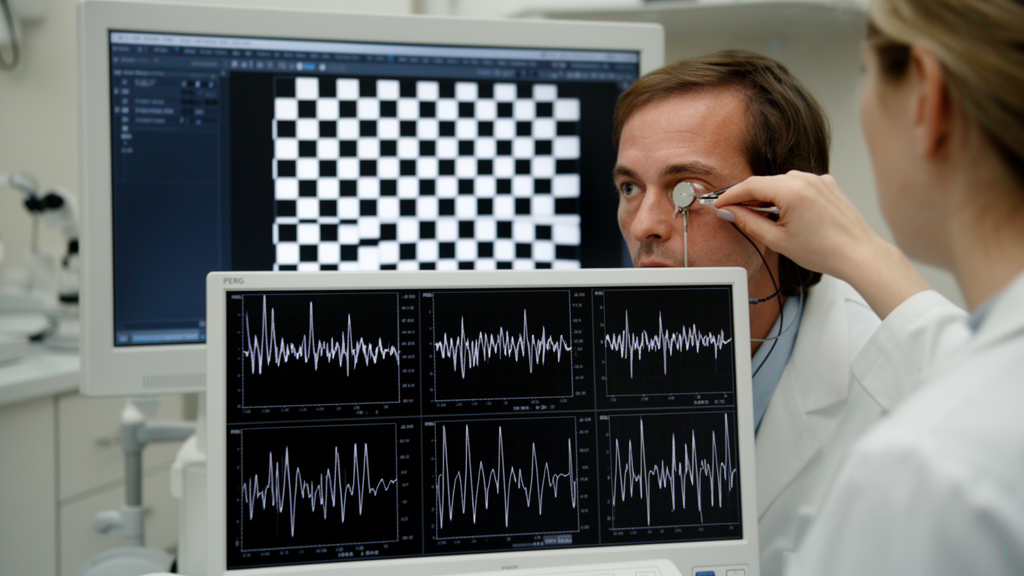
A comparative study of machine-learning approaches for interpreting pattern electroretinography (PERG) found that raw, amplitude-preserving waveforms produced the strongest classification performance in four of six retinal and optic nerve conditions. The analysis used the publicly available PERG-IOBA dataset to distinguish Birdshot chorioretinopathy, cone-rod dystrophy, hereditary optic atrophy, macular dystrophy, retinitis pigmentosa and Stargardt disease from healthy controls. These were internally validated results, so the findings do not yet establish performance in independent clinical populations.
PERG is a non-invasive test of macular and retinal ganglion cell function, but its transient waveform has low amplitude and varies substantially between participants. The study examined whether diagnostic information was better retained in the complete waveform, in a smaller set of engineered numerical descriptions, or in a combined representation. Investigators evaluated three approaches under one protocol: a raw 255-point waveform that preserved amplitude; 60 descriptors covering clinical, spectral, wavelet and complexity characteristics; and a hybrid representation of 343 variables that combined both approaches and included multi-wavelet features based on the db4, sym2 and coif3 wavelets.
The dataset comprised 672 recordings from 336 examinations of 304 participants, including recordings from both eyes and repeat visits. Each recording underwent six stages of preprocessing. Model performance was estimated with 10 × 5-fold cross-validation grouped by participant, so both eyes and all repeat examinations from an individual remained in the same partition. Hyperparameter selection was nested, while every preprocessing step derived from the data was fitted within the training fold. This design reduced the possibility that repeated measurements from the same person would inflate the reported performance, although participant-grouped cross-validation cannot substitute for external, multi-centre validation.
Under the pre-specified primary classifier, the raw waveform achieved the highest pooled out-of-fold area under the receiver operating characteristic curve, or AUC, in four of the six disease-versus-control tasks. Its AUC was 0.906 for cone-rod dystrophy, 0.842 for retinitis pigmentosa, 0.755 for macular dystrophy and 0.673 for hereditary optic atrophy. The engineered descriptors ranked first in the other two tasks, with an AUC of 0.803 for Stargardt disease and 0.657 for Birdshot chorioretinopathy. The hybrid representation did not rank first in any task. It fell below the raw waveform in five of six conditions by 0.002 to 0.018 AUC, while no non-linear classifier showed a hybrid advantage above 0.006 in mean AUC. The comparison therefore did not support the idea that adding engineered features to the full waveform necessarily improved classification.
A sensitivity analysis showed why preserving amplitude mattered. When each PERG signal was z-scored to remove its absolute amplitude scale, the raw representation lost an average of 0.055 AUC, compared with an average loss of 0.023 for the engineered descriptors. This change reversed the ordering of the three representations, indicating that amplitude-related information contributed substantially to the strongest results. At the same time, reducing the engineered descriptors to 60 variables made the classification problem more tractable for linear models, which gained 0.128 in mean AUC through the dimensionality reduction. The engineered descriptors thus offered a benefit for simpler model classes, but they did not improve on the raw waveform overall.
The study’s central conclusion is specific to the six conditions and the analysed dataset: the complete amplitude-preserving PERG waveform was more effective than either replacing it with engineered features or adding those features in a larger hybrid representation. The AUC values describe model discrimination under the study’s cross-validation protocol, not diagnostic performance in routine care. The lower results for hereditary optic atrophy and Birdshot chorioretinopathy also indicate that the task remained difficult for some conditions. Participant-independent, multi-centre validation is required before the approach can be considered for clinical application, but within this internal comparison, retaining the absolute amplitude of the raw signal was central to performance.
Subject of Research: Machine-learning comparison of raw, engineered and hybrid PERG representations for classifying six retinal and optic nerve conditions
Article Title: Comparison of raw-signal, feature-based and hybrid representations for machine-learning classification of retinal diseases from pattern electroretinography
Article References: Aygün, A. B., Açıkgöz, R., Coşkun, M., & Erden, M. A. (2026). Comparison of raw-signal, feature-based and hybrid representations for machine-learning classification of retinal diseases from pattern electroretinography. Medical & Biological Engineering & Computing. https://doi.org/10.1007/s11517-026-03698-7
Image Credits: AI Generated
DOI: 10.1007/s11517-026-03698-7
Keywords: pattern electroretinography, retinal disease classification, machine learning, raw waveform analysis, feature engineering, amplitude preservation, cone-rod dystrophy, retinitis pigmentosa, Stargardt disease, Birdshot chorioretinopathy, Comparison, raw-signal
Cite Scienmag News
Denise Maddox. (October 20, 2026). Raw PERG waveforms lead in four of six retinal disease classification tasks. Scienmag. https://scienmag.com/raw-perg-waveforms-lead-in-four-of-six-retinal-disease-classification-tasks/
Denise Maddox. "Raw PERG waveforms lead in four of six retinal disease classification tasks." Scienmag, 20 October 2026, https://scienmag.com/raw-perg-waveforms-lead-in-four-of-six-retinal-disease-classification-tasks/. Accessed 20 October 2026.
Denise Maddox. "Raw PERG waveforms lead in four of six retinal disease classification tasks." Scienmag. October 20, 2026. https://scienmag.com/raw-perg-waveforms-lead-in-four-of-six-retinal-disease-classification-tasks/


