


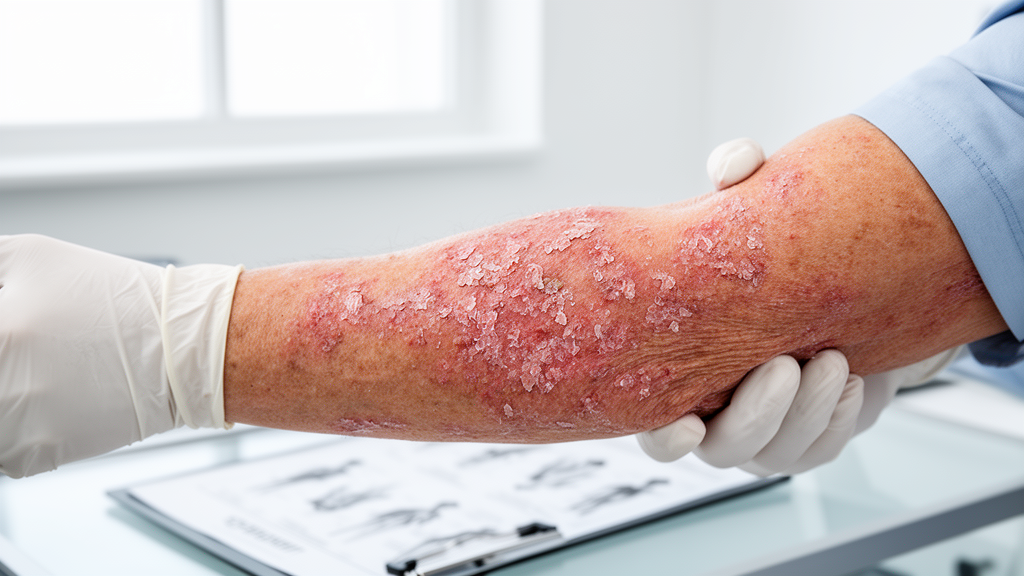
A rare and often debilitating inflammatory skin condition, long dismissed by dermatologists as a purely dermatologic problem, may be sending a far more ominous signal from within. Pityriasis rubra pilaris, or PRP, a disorder that blankets the body in orange-red, scaly plaques and thickened palms and soles, has now been linked for the first time in a large population-based analysis to a substantially increased risk of blood cancers. The new study, published in the Archives of Dermatological Research, found that adults with PRP were roughly twice as likely to be diagnosed with leukemia and nearly three times as likely to develop lymphoma compared with carefully matched patients suffering from psoriasis, one of the most common and best-characterized inflammatory skin diseases in the world.
The research, conducted by Henry O. Herrera of Case Western Reserve University School of Medicine and Jeremy S. Bordeaux of University Hospitals Cleveland Medical Center, represents the largest effort to date to move the question beyond scattered case reports. For years, dermatologists have occasionally described patients whose sudden, fulminant PRP-like eruptions coincided with an underlying cancer, raising the uncomfortable possibility that the skin disease could sometimes function as a paraneoplastic syndrome, a cutaneous warning light for a hidden malignancy. Until now, however, those observations rested on individual anecdotes, which can never establish whether the co-occurrence is genuine or merely coincidence in a rare disease.
To answer the question with real statistical power, the team turned to TriNetX, a vast federated electronic health record network that aggregates de-identified clinical data from multiple health systems across the United States. Using the International Classification of Diseases code L44.0, the investigators identified adults aged eighteen and older who carried a diagnosis of PRP. As a comparator, they selected patients with psoriasis, coded under L40, a deliberate and methodologically important choice. Psoriasis is a chronic inflammatory skin disease that shares clinical overlap with PRP, brings patients into dermatologic care at similar rates, and carries its own well-documented systemic associations, making it a rigorous benchmark against which any excess cancer risk in PRP could be measured.
Raw comparisons between unequal patient groups can easily mislead, so the researchers employed propensity score matching, a statistical technique that pairs each PRP patient with a psoriasis patient who shares a similar demographic and clinical profile. Age, sex, race, and key comorbidities were balanced across the two cohorts, effectively simulating the randomization of a controlled trial within observational data. After matching, the final analysis included 1,501 patients with PRP and 1,501 matched psoriasis controls, a sample size that dwarfs every previously published case series on the topic and lends the findings a weight that anecdotes alone could never carry.
The results were striking. Patients with PRP showed significantly higher odds of leukemia, the family of cancers of the blood-forming tissues classified under ICD-10 codes C91 through C95, with an odds ratio of 2.20 and a 95 percent confidence interval spanning 1.07 to 4.51. Because that confidence interval excludes 1.0, the association is statistically significant, meaning it is unlikely to be a fluke of sampling. The signal was even stronger for lymphoma, the group of cancers of the lymphatic system coded C81 through C86, where the odds ratio reached 2.99 with a confidence interval of 1.66 to 5.40. In practical terms, a PRP patient in this cohort faced roughly triple the odds of a lymphoma diagnosis compared with an otherwise similar psoriasis patient.
Not every blood cancer followed the pattern. For multiple myeloma and malignant plasma cell neoplasms, grouped under ICD-10 code C90, the study found no significant difference between the two cohorts, with an odds ratio of exactly 1.00 and a wide confidence interval of 0.42 to 2.41. That null result is itself informative. It suggests the association is not a blanket elevation of all hematologic malignancies but is concentrated in the lymphoproliferative and myeloid compartments, hinting that whatever mechanism links PRP to blood cancers may be specific to particular immune cell lineages rather than a generalized state of malignant predisposition in the bone marrow.
The biological story behind these numbers remains an open question, but the study’s authors and the broader literature point toward the immune system as the likely common thread. PRP is an inflammatory dermatosis, and chronic immune activation is a recognized driver of lymphoid malignancies, where relentlessly stimulated lymphocytes accumulate the mutations that lead to lymphoma. Case reports published in recent years have sharpened this suspicion. Dermatologists have documented patients whose PRP-like eruptions preceded or accompanied diagnoses of Sézary syndrome, an aggressive T-cell lymphoma of the skin that can masquerade as inflammatory dermatoses, as well as other underlying malignancies that resolved or improved when the cancer was treated. Such sequences fuel the hypothesis that, in at least some patients, PRP is not the disease itself but the skin’s visible expression of a dysregulated immune landscape in which lymphocytes are already veering toward malignancy.
The authors of the new study are careful about what their design can and cannot prove. A retrospective cohort analysis of billing codes can establish association, but it cannot untangle causation, and several alternative explanations deserve scrutiny. Diagnostic suspicion is one: a dermatologist who knows that PRP has been reported alongside cancer may look harder, order more blood counts, and refer more patients to hematologists, inflating apparent risk. Surveillance bias could also run the other way, since psoriasis patients are famously well monitored for systemic comorbidities and might be expected to have more cancers detected, not fewer, which would make the observed excess in PRP all the more notable. Reverse causation is another possibility, with an occult lymphoma or leukemia provoking the PRP-like eruption rather than the skin disease predisposing to cancer. Distinguishing among these scenarios will require longitudinal follow-up and, ideally, mechanistic studies of the immune signatures in PRP skin and blood.
Clinically, the findings arrive at a moment when dermatologists are already rethinking PRP’s status. The disease has traditionally been classified as non-paraneoplastic, taught as an orphan papulosquamous disorder of uncertain cause with no systemic cancer implications. The new data, drawn from more than 1,500 patients across many U.S. health systems, challenge that comfortable framing. If the association holds up, it could eventually argue for a lower threshold for blood counts, serum protein electrophoresis, or dermatopathology review in patients with atypical, treatment-refractory, or unusually late-onset PRP, particularly when the eruption behaves in ways that defy the classical patterns. The authors themselves stop short of recommending specific screening protocols, noting that further studies are warranted to clarify the underlying mechanisms before practice changes.
What is already clear is that a disease once considered a dermatologic curiosity now sits at an intriguing intersection of immunology, oncology, and clinical epidemiology. The convergence of large-scale health record analytics with a rare disease that was previously studied only case by case shows how modern data infrastructure can surface signals invisible to individual clinicians. Whether PRP proves to be a true paraneoplastic syndrome in a subset of patients, a marker of shared immune dysregulation, or something more subtle, the study by Herrera and Bordeaux gives researchers a concrete, quantified target: a threefold lymphoma signal and a doubled leukemia signal that demand explanation. For the patients living with this painful, disfiguring skin disease, the hope is that the same inflammation that reddens their skin may soon reveal, through careful science, exactly what it has been trying to say all along.
Subject of Research: Association between pityriasis rubra pilaris and risk of hematologic malignancies
Article Title: Hematologic malignancies in pityriasis rubra pilaris: a retrospective matched cohort study
Article References: Herrera, H. O., & Bordeaux, J. S. (2026). Hematologic malignancies in pityriasis rubra pilaris: a retrospective matched cohort study. Archives of Dermatological Research, 318(1), Article 435. https://doi.org/10.1007/s00403-026-04938-4
Image Credits: AI Generated
DOI: 10.1007/s00403-026-04938-4
Keywords: pityriasis rubra pilaris, hematologic malignancies, leukemia, lymphoma, multiple myeloma, paraneoplastic syndrome, psoriasis, TriNetX, retrospective cohort study, dermatology, propensity score matching, inflammatory skin disease
Cite Scienmag News
Nathaniel Bowman. (October 9, 2026). Rare Skin Disease Pityriasis Rubra Pilaris Linked to Higher Odds of Leukemia and Lymphoma. Scienmag. https://scienmag.com/rare-skin-disease-pityriasis-rubra-pilaris-linked-to-higher-odds-of-leukemia-and-lymphoma/
Nathaniel Bowman. "Rare Skin Disease Pityriasis Rubra Pilaris Linked to Higher Odds of Leukemia and Lymphoma." Scienmag, 9 October 2026, https://scienmag.com/rare-skin-disease-pityriasis-rubra-pilaris-linked-to-higher-odds-of-leukemia-and-lymphoma/. Accessed 9 October 2026.
Nathaniel Bowman. "Rare Skin Disease Pityriasis Rubra Pilaris Linked to Higher Odds of Leukemia and Lymphoma." Scienmag. October 9, 2026. https://scienmag.com/rare-skin-disease-pityriasis-rubra-pilaris-linked-to-higher-odds-of-leukemia-and-lymphoma/


