


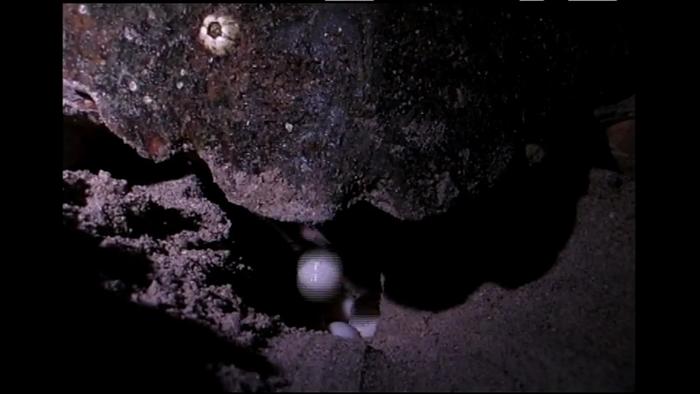
Female sea turtles lay their eggs, cover the nest with sand and then return to the ocean, leaving them to develop and hatch on their own. From nest predators to rising temperatures, odds of survival are bleak. Once hatched and in the ocean, about one in 1,000 make it to adulthood.

Credit: Florida Atlantic University
Female sea turtles lay their eggs, cover the nest with sand and then return to the ocean, leaving them to develop and hatch on their own. From nest predators to rising temperatures, odds of survival are bleak. Once hatched and in the ocean, about one in 1,000 make it to adulthood.
Hatchling size matters. Larger hatchlings, which move faster, are more likely to survive because they spend less time on risky beach sands.
Research shows that both air and sand temperatures crucially impact sea turtle hatchlings. Cooler temperatures produce larger, heavier hatchlings with more males, while warmer temperatures accelerate hatching and offer predator protection. For endangered loggerhead (Caretta caretta) and green (Chelonia mydas) sea turtles, cooler and moister conditions result in stronger hatchlings. However, rising temperatures might shorten incubation periods, and erratic rainfall can disrupt growth, potentially affecting survival.
Balancing temperature and moisture is vital for the health of these vulnerable sea turtles. Too much moisture can be deadly for embryos.
An internationally collaborative study by Florida Atlantic University and led by the University of Tübingen in Germany, delves into how fluctuating rainfall impacts the development of sea turtle hatchlings, revealing that it has a more profound effect than changes in air temperature.
The research, which spans data from 37 beaches worldwide – a longitudinal study in Florida, and experimental studies on the Cape Verde Islands – shows that precipitation plays a crucial role in determining hatchling body size. Rainfall cools the beach surface and enhances the moisture needed for egg development, making it a better predictor of body size than temperature.
Results of the study, published in BMC Ecology and Evolution, reveal that the impact of rainfall varies between species. For loggerhead turtles, heavier rainfall results in hatchlings with smaller carapaces (shell) but greater weight, while green turtle hatchlings grow smaller carapaces without a change in body mass.
“Findings from our study highlight the need for more localized data on how regional weather influences incubation and hatchling development,” said Jeanette Wyneken, Ph.D., co-author and professor, Department of Biological Sciences, FAU Charles E. Schmidt College of Science. “These data are essential for refining conservation strategies to protect sea turtles amidst global warming.”
The study started with data from Boca Raton, comparing hatchling size (length, width, and mass) with local climate factors. Next, data were collected from 19 beaches with loggerhead hatchlings and 17 beaches with green turtle hatchlings. A third part of the study looked at hatchlings in Cabo Verde after a few days of rain during their dry season to see how precipitation affected their size.
In the Mediterranean, particularly on the beaches of Cyprus and Turkey, the dry season brings very little rain from the North Atlantic. For green turtles in these drier areas, the effects of precipitation become noticeable only after the dry season ends. In Florida, however, precipitation levels stay fairly consistent throughout the nesting season due to local weather patterns, though droughts and heatwaves typically occur in July and October.
“It’s not clear exactly how rain affects hatchling size,” said Wyneken. “One idea is that rain cools the nests, which can change the temperature and impact the sex ratio of the hatchlings. This could lead to differences in hatchling size and shape, similar to how male and female hatchlings of other turtles, like the giant river turtle, have different shell shapes.”
As climate change shifts rainfall patterns – making wet areas wetter and dry areas drier – the impact on sea turtle nesting sites suggests that global conservation strategies for loggerhead and green sea turtles likely need to be updated.
“Effective management units for conservation should focus on regularly updating and including important nesting sites, highlighting the importance of local conservation efforts,” said Wyneken. “Analyzing local data from various nesting sites is crucial for understanding sea turtle nesting patterns. These local databases should be made more accessible and widely shared to improve our knowledge and support local conservation efforts.”
Study co-authors are first author Omar Rafael Regalado Fernández, Ph.D., University of Tübingen; Parima Parsi-Pour, The Humboldt University of Berlin; John A. Nyakatura, Ph.D., The Humboldt University of Berlin; and Ingmar Werneburg, Ph.D., University of Tübingen.
The research is supported by the German Research Foundation (Deutsche Forschungsgemeinschaft WE 5440/6-1).
– FAU –
About Florida Atlantic University:
Florida Atlantic University, established in 1961, officially opened its doors in 1964 as the fifth public university in Florida. Today, the University serves more than 30,000 undergraduate and graduate students across six campuses located along the southeast Florida coast. In recent years, the University has doubled its research expenditures and outpaced its peers in student achievement rates. Through the coexistence of access and excellence, FAU embodies an innovative model where traditional achievement gaps vanish. FAU is designated a Hispanic-serving institution, ranked as a top public university by U.S. News & World Report and a High Research Activity institution by the Carnegie Foundation for the Advancement of Teaching. For more information, visit www.fau.edu.
Journal
BMC Ecology and Evolution
Method of Research
Observational study
Subject of Research
Animals
Article Title
Correlations between local geoclimatic variables and hatchling body size in the sea turtles Caretta caretta and Chelonia mydas
Article Publication Date
15-Aug-2024
Cite Scienmag News
Violet Maxwell. (August 28, 2024). Rain or shine? How rainfall impacts size of sea turtle hatchlings. Scienmag. https://scienmag.com/rain-or-shine-how-rainfall-impacts-size-of-sea-turtle-hatchlings/
Violet Maxwell. "Rain or shine? How rainfall impacts size of sea turtle hatchlings." Scienmag, 28 August 2024, https://scienmag.com/rain-or-shine-how-rainfall-impacts-size-of-sea-turtle-hatchlings/. Accessed 4 September 2026.
Violet Maxwell. "Rain or shine? How rainfall impacts size of sea turtle hatchlings." Scienmag. August 28, 2024. https://scienmag.com/rain-or-shine-how-rainfall-impacts-size-of-sea-turtle-hatchlings/

