


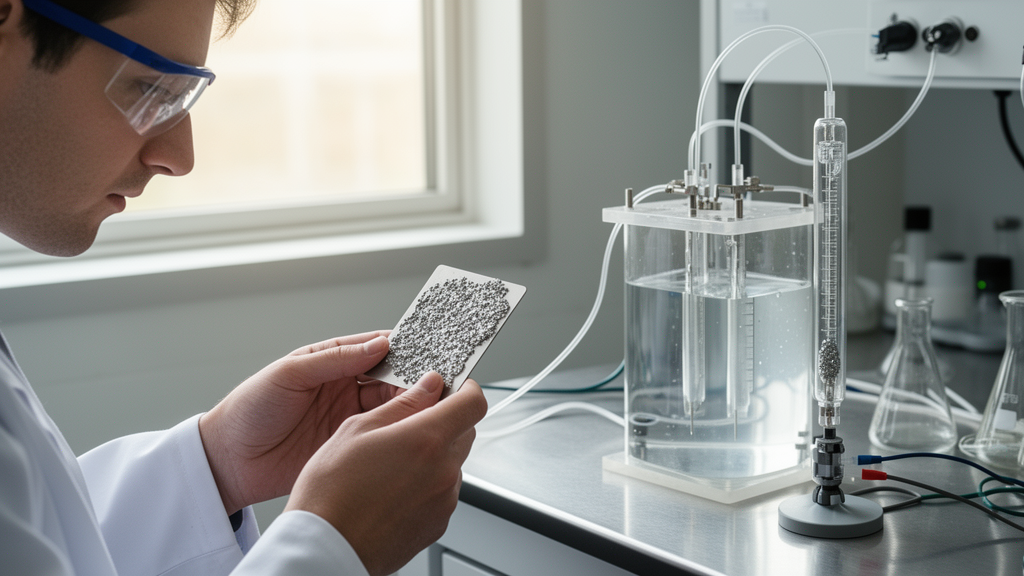
Hydrogen made from ethanol instead of plain water could slash the energy bill of electrolysis, and a new family of four-metal platinum catalysts shows how close that idea is moving to practical use. In a study published in the journal Ionics, researchers in Brazil synthesized two quaternary electrocatalysts — PtSnNiRu and PtSnNiGa dispersed on carbon — and tested them for the electrochemical reforming of ethanol. Their best ruthenium-containing material, Pt61Sn3Ni17Ru19/C, oxidized ethanol at the lowest onset potential of the series, delivered peak current densities of up to 53.97 mA cm−2 and showed the slowest surface-poisoning rate, while a gallium-rich formulation, Pt37Sn8Ni16Ga39/C, converted electrical charge into hydrogen gas with a Faradaic efficiency of 97.1 percent.
The motivation behind the work lies in a well-known bottleneck of water electrolysis. Splitting water is the dominant route to green hydrogen, but the oxygen evolution reaction at the anode is sluggish, and the authors cite estimates that roughly 90 percent of the energy consumed in the process is tied up by the hydrogen evolution side of the cell. Replacing water oxidation with ethanol oxidation changes the thermodynamics dramatically: instead of the 1.23 V required for water splitting, ethanol oxidation can proceed at potentials around 0.6 V, depending on the products formed at the anode. On top of that, ethanol oxidation releases three times more hydrogen per mole than water electrolysis, so a perfectly efficient ethanol electroreformer would consume roughly five times less energy than its water-splitting counterpart.
The catch is the catalyst. Platinum is the standard anode material for ethanol oxidation, but it is expensive, and in alkaline media it deactivates quickly. Ethanol never fully converts to carbon dioxide at around 0.6 V; instead, strongly adsorbed carbonaceous intermediates such as carbon monoxide, CHx species, acetyl fragments and enolates accumulate on the active sites. These poisons block the surface, slow subsequent oxidation steps and push the reaction toward partial products like acetate or acetic acid. Only above about 0.6 V does platinum itself form the Pt–OH and Pt–O species capable of removing adsorbed CO through the reaction CO + OH → CO2, so the surface spends much of its operating life clogged.
To fight both problems — cost and poisoning — the team turned to multimetallic formulations. Work on binary catalysts such as PtSn and PtRu has shown that adding a second metal can help, and previous studies suggest that moving to quaternary systems optimizes electroreforming further. Earlier reports found that adding nickel and gallium to PtSn raised current densities and steered the reaction toward more oxidized products like acetic acid, while tin and ruthenium together promoted carbon–carbon bond cleavage and cut electroreforming energy consumption by about half relative to water electrolysis. The new study combined nickel’s ability to boost alcohol conversion with ruthenium’s strength as a CO-oxidation co-catalyst on one side, and gallium’s activity and stability benefits with nickel’s high-polarization performance on the other.
Synthesis relied on the thermal decomposition of polymeric precursors, a soft-chemistry route. The researchers first functionalized Vulcan XC72 carbon by washing, acid treatment and calcination, then prepared separate citric acid–ethylene glycol resins for platinum, tin, nickel, ruthenium and gallium from their metal salts. After mixing the resins with the functionalized carbon and evaporating the solvent, calcination at 350 °C for three hours in air produced the finished catalysts, each carrying a total metal load of 40 percent by mass. Transmission electron microscopy revealed predominantly spherical nanoparticles clustered on the carbon, with average diameters falling in a narrow window from about 4.1 to 6.1 nm — dimensions consistent with the literature for comparable platinum-based electrocatalysts.
Structural characterization told a story of substitutional alloying. X-ray diffraction showed the face-centered cubic pattern of platinum in all samples, with no detectable reflections from the promoter metals or their oxides in isolated form, although the authors note such phases could exist below the detection limit, in highly dispersed form or as amorphous material. Tin, with its atomic radius of 151 pm versus 139 pm for platinum, expanded the lattice parameter, confirming a substitutional solid solution, while the radii of nickel (125 pm), gallium (122 pm) and ruthenium (134 pm) exceeded the dimensions of the octahedral and tetrahedral interstitial sites of the platinum lattice, ruling out interstitial positioning. Energy-dispersive X-ray spectroscopy confirmed that Sn, Ni, Ru and Ga had been incorporated into the platinum structure but also revealed significant deviations from nominal compositions — oxygen contents ranged from 3.99 percent for pure Pt/C to 75.15 percent for the gallium-rich catalyst — which the team attributed to different decomposition kinetics of the precursor salts and the strong tendency of oxophilic elements like Ni and Ga to segregate to the surface as stable oxides.
Electrochemical testing, performed in 1.0 mol L−1 KOH with an Hg/HgO reference electrode, highlighted the quaternary catalysts’ advantages. On the reversible hydrogen electrode scale, the onset potential for ethanol oxidation shifted from 0.52 V for pure Pt/C to 0.40 V for the gallium system and just 0.30 V for Pt61Sn3Ni17Ru19/C — negative shifts of 120 and 220 mV respectively, comparable to or better than most binary and ternary Pt-based catalysts compiled from the literature, including PtSn/C at 0.45 V and PtNi/C at roughly 0.6 V. The gallium catalyst achieved the highest electrochemically active surface area of the series at 40 m2 per gram of platinum, followed by the ruthenium system at 23 m2 gPt−1, though the authors caution that for Ru-containing catalysts the overlap of hydrogen desorption with the onset of Ru oxidation may inflate these apparent values, which they use only for internal comparison rather than as absolute surface areas.
Stability proved equally important. In chronoamperometric tests held at −0.4 V versus Hg/HgO for one hour, every catalyst showed a sharp drop in current density during the first ten minutes as oxidation intermediates piled up on active sites. After that, currents stabilized on a plateau sustained by the bifunctional mechanism and the ligand effect: the secondary metals form hydrated oxides at lower potentials than platinum, supplying the oxygenated species that oxidize adsorbed CO and free the Pt sites, while their electronic influence on platinum weakens the binding of intermediates. Pt61Sn3Ni17Ru19/C recorded the lowest poisoning rate in the series and retained the highest residual current density, which the researchers read as superior tolerance to surface deactivation.
The practical payoff came in an H-cell electroreforming test. Using a proton exchange membrane cell with the new materials as anodes prepared on carbon cloth and a commercial 1 cm² platinum black carbon cloth electrode as the cathode, the team applied roughly 4.0 V and collected cathodic gas over 30 minutes in an inverted burette submerged in water, with all experiments run in triplicate. Pt61Sn3Ni17Ru19/C generated the largest gas volume, 12.0 mL, and the highest flow rate, 0.40 mL per minute, at an operating current of 60 mA. The gallium-rich catalyst, despite its larger electrochemical surface area, lagged kinetically — the authors link this to the insulating character of its very high oxygen content, which raises charge-transfer resistance — but it achieved the best Faradaic efficiency of the series at 97.1 percent, meaning nearly all the supplied charge went into the desired gas. For context, the authors note that current efficiencies reported for aqueous ethanol electrolysis generally fall between 57.6 and 97.7 percent.
The authors attribute the ruthenium system’s overall superiority to synergistic interactions among the oxophilic promoters, which modify platinum’s electronic structure and continuously renew the catalytic surface, and they position Pt61Sn3Ni17Ru19/C as a strong candidate for reducing platinum loading without sacrificing initial activity. As with any laboratory-scale study, caveats remain: potentials at peak currents may be slightly shifted by uncompensated resistance, the comparison with literature catalysts is qualitative because electrolytes, pH values, ethanol concentrations, catalyst loadings and supports differ across studies, and the one-hour stability window was chosen partly because of the risk of non-noble metal leaching, particularly nickel and gallium. Still, by cutting the energy needed to start ethanol oxidation, outproducing pure platinum in gas generation and keeping active sites clear of carbonaceous poisons, the quaternary alloys offer a credible, lower-cost route to hydrogen from bio-based ethanol.
Subject of Research: Multimetallic platinum electrocatalysts for hydrogen production by ethanol electroreforming
Article Title: Synthesis and characterisation of Pt–Sn–Ni–Ru and Pt–Sn–Ni–Ga heterogeneous multi-metal electrocatalysts for the electrochemical reforming of ethanol
Article References: Silva, A. G. S., García, R. R., de Souza, L. E., Jr, Filho, Y. F., & Ribeiro, J. (2026). Synthesis and characterisation of Pt–Sn–Ni–Ru and Pt–Sn–Ni–Ga heterogeneous multi-metal electrocatalysts for the electrochemical reforming of ethanol. Ionics. https://doi.org/10.1007/s11581-026-07607-8
Image Credits: AI Generated
DOI: 10.1007/s11581-026-07607-8
Keywords: hydrogen production, ethanol electroreforming, platinum catalysts, electrocatalysis, PtSnNiRu, PtSnNiGa, Faradaic efficiency, bifunctional mechanism, nanoparticles, green hydrogen, alkaline electrolysis, surface poisoning
Cite Scienmag News
Denise Maddox. (October 23, 2026). Quaternary Platinum Alloys Push Ethanol Electroreforming Toward Cheaper Green Hydrogen. Scienmag. https://scienmag.com/quaternary-platinum-alloys-push-ethanol-electroreforming-toward-cheaper-green-hydrogen/
Denise Maddox. "Quaternary Platinum Alloys Push Ethanol Electroreforming Toward Cheaper Green Hydrogen." Scienmag, 23 October 2026, https://scienmag.com/quaternary-platinum-alloys-push-ethanol-electroreforming-toward-cheaper-green-hydrogen/. Accessed 23 October 2026.
Denise Maddox. "Quaternary Platinum Alloys Push Ethanol Electroreforming Toward Cheaper Green Hydrogen." Scienmag. October 23, 2026. https://scienmag.com/quaternary-platinum-alloys-push-ethanol-electroreforming-toward-cheaper-green-hydrogen/


