Millions of cubic meters of rock and soil are ripped out of mountains and underground strata every year as engineers drive tunnels for railways, subways, and highways. Most of this spoil is treated as waste, stockpiled on land where it can trigger dust pollution, soil erosion, and safety hazards. In the construction of the Sichuan-Tibet Railway alone, previous studies estimate that roughly 240 million cubic meters of excavation slag will be produced. A new laboratory study now reports that this debris can be converted into a high-density concrete strong enough for structural ambitions, provided the mixing process itself is redesigned around a surprising pairing of negative pressure and mechanical shaking.
The research, conducted in China, used tunnel muck excavated from a tunnel in Sichuan Province as its primary raw material. Chemically, the muck proved well suited to the task: X-ray fluorescence showed it is dominated by silicon dioxide at 64.5 percent and aluminum oxide at 20 percent, with iron oxide, calcium oxide, magnesium oxide, and titanium oxide making up most of the remainder. That mineral profile, rich in quartz, feldspar, and clay minerals, closely mirrors the composition of the natural sands and gravels that conventional concrete quarries out of rivers and pits. After drying and crushing, the muck became a fine aggregate with a bulk density of 1.642 grams per cubic centimeter, a particle density of 2.481 grams per cubic centimeter, and a water absorption of 8.3 percent.
The researchers formulated four mixes, labeled C1 through C4, in which cement content rose progressively from 46 to 71 kilograms per batch while tunnel muck fines made up the bulk of the solid content. A conventional C25 ordinary concrete, with natural sand and coarse aggregate, served as a control. The challenge with so-called fine-particle high-density concrete is structural: without coarse aggregate grains to tumble through the mixture and mechanically disperse fines and paste, the small, lightweight particles tend to clump together, trap air, and leave behind pockets of localized porosity. Ordinary paddle mixing, the team reasoned, simply cannot wring those defects out of a system whose particles are this fine and whose internal surface area is this large.
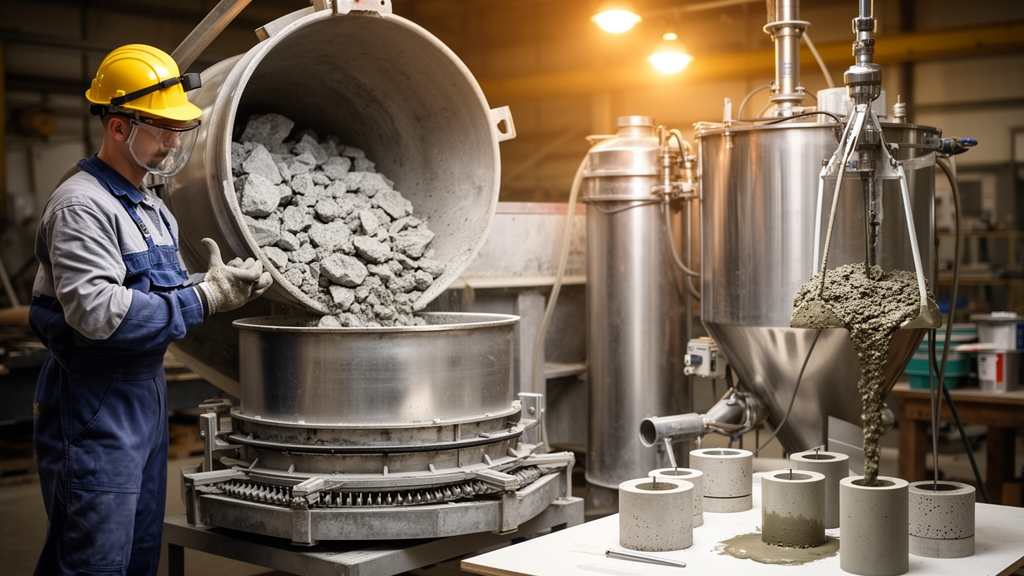
Their solution was to seal a conventional mixer and bolt on a vacuum extraction system capable of pulling the mixing chamber down to a gauge pressure of minus 0.09 megapascals. The idea works on two fronts: negative pressure draws entrapped air and excess water vapor out of the blend, while the resulting compaction pushes particles into closer contact. In a second modification, vibration was added to the mixer, with the goal of nudging fine particles into better packing arrangements and helping cement paste coat each grain more evenly. The team tested four regimes on a representative C3 mixture: plain mechanical mixing, mechanical plus vacuum, mechanical plus vibration, and the full vacuum-vibration combination.
The strength results were striking. At 7 days, vacuum-assisted mixing lifted the compressive strength of the C1 to C4 mixes from 14.4, 18.9, 24.2, and 28.3 megapascals to 17.3, 22.3, 28.4, and 32.5 megapascals respectively, gains of roughly 20.1, 18.0, 17.4, and 14.8 percent. At 28 days the corresponding improvements were about 14.3, 11.7, 10.0, and 8.0 percent. Notably, the same trick applied to ordinary C25 concrete yielded far smaller gains, only 9.3 percent at 7 days and 6.7 percent at 28 days, suggesting that the vacuum process is especially valuable where fine particles and abundant interfaces dominate the microstructure. The gains were also largest in the lower-strength mixes, pointing to a simple physical explanation: when binder content is low and inherent porosity is high, the pore structure established during mixing matters enormously to later strength development.
Vibration alone told a very different story. Without vacuum, shaking the mix slightly reduced compressive strength at both ages and delivered no meaningful flexural benefit, apparently because the disturbance loosens the fine-particle skeleton rather than compacting it. But when vibration was applied under negative pressure, the two effects fused into something greater than either alone. The combined process pushed 28-day compressive strength to 33.5 megapascals, matching or slightly exceeding vacuum mixing by itself, and raised 28-day flexural strength to 6.3 megapascals, roughly 34.0 percent above conventionally mixed concrete. Since flexural strength reflects crack resistance and structural integrity, that jump is arguably the study’s most practically meaningful result. The authors emphasize the effects are not linearly additive: vacuum dominates by densifying, while vibration homogenizes only within the constraint that the vacuum imposes.
Workability shifted in a way that matched this interpretation. Slump flow dropped modestly under vacuum, from 200 to 192 millimeters for the C3 mix, for example, a 4.0 percent reduction attributed to the removal of air and free water and to tighter particle packing. Vibration alone raised slump flow to 208 millimeters by temporarily lubricating the blend, but when combined with vacuum the value fell back to 194 millimeters, showing that the densification effect overrides the fluidizing one. In all cases the mixes remained workable enough to cast.
A battery of microstructural probes explained why. X-ray diffraction found the same crystalline phases, chlorite, illite, calcium hydroxide, quartz, albite, calcite, and muscovite, in every specimen, meaning the mixing processes changed how hydration products were distributed rather than what was produced. Thermogravimetric analysis supported this, showing similar chemically bound water contents across regimes. Scanning electron microscopy revealed a loosely packed, flocculent gel structure with abundant incompletely hydrated cement grains in conventionally mixed samples, while vacuum-mixed samples showed fewer pores, more continuous gel networks, and tighter interfacial bonding. The combined vacuum-vibration specimen displayed the densest, most homogeneous fabric of all.
Pore measurements quantified the densification. Mercury intrusion porosimetry put total porosity at 19.81 percent for conventionally mixed concrete, falling to 17.84 percent with vacuum mixing, but rising to 21.86 percent with vibration alone, which also produced the largest average pore diameter at 26.29 nanometers and median diameter at 75.74 nanometers. The combined process landed at 20.61 percent porosity and shifted the distribution toward the benign 10 to 100 nanometer range while suppressing pores larger than 100 nanometers. X-ray computed tomography, scanned at 25 micrometer resolution on conventionally and vacuum-mixed samples, confirmed the picture in three dimensions: the vacuum specimen had fewer resolvable pores, less connectivity, and a more concentrated pore volume distribution, with continuous through-pores largely absent.
The broader ecological case rests on several legs. Reusing muck on or near construction sites cuts both spoil disposal and the haulage of natural aggregates, with transportation emissions falling as a function of mass, distance, and emission factor. Achieving denser, stronger concrete without extra cement means more performance per kilogram of binder, and the resulting low porosity should slow the ingress of harmful agents, potentially extending service life and reducing maintenance demand over the long term. The authors are careful to frame the durability argument as an inference from density and porosity rather than measured field performance, and the study remains a laboratory investigation with 100-millimeter cube and prism specimens, three replicates per condition, and standard curing at 20 plus or minus 2 degrees Celsius. Still, as tunnel networks multiply across mountainous regions, a process that turns the very spoil those tunnels generate into a denser, crack-resistant concrete offers an appealingly circular answer to two problems at once: what to do with the waste, and where to find the sand.
Subject of Research: Vacuum-vibration mixing of tunnel-muck-based fine-particle high-density concrete
Article Title: Mechanical and microstructural properties of muck-based fine-particle high-density concrete prepared via a vacuum and vibration mixing process
Article References: Feng, S., Kan, D., Yan, Z., Jiang, X., & Zhou, L. (2026). Mechanical and microstructural properties of muck-based fine-particle high-density concrete prepared via a vacuum and vibration mixing process. Case Studies in Construction Materials, 25, Article e06649. https://doi.org/10.1016/j.cscm.2026.e06649
Image Credits: AI Generated
DOI: 10.1016/j.cscm.2026.e06649
Keywords: concrete, tunnel muck, vacuum mixing, vibration, pore structure, compressive strength, flexural strength, recycled aggregates, construction waste, cement hydration, microstructure, sustainability
Cite Scienmag News
Denise Maddox. (October 23, 2026). Vacuum and vibration mixing turns tunnel waste into high-density concrete. Scienmag. https://scienmag.com/vacuum-and-vibration-mixing-turns-tunnel-waste-into-high-density-concrete/
Denise Maddox. "Vacuum and vibration mixing turns tunnel waste into high-density concrete." Scienmag, 23 October 2026, https://scienmag.com/vacuum-and-vibration-mixing-turns-tunnel-waste-into-high-density-concrete/. Accessed 23 October 2026.
Denise Maddox. "Vacuum and vibration mixing turns tunnel waste into high-density concrete." Scienmag. October 23, 2026. https://scienmag.com/vacuum-and-vibration-mixing-turns-tunnel-waste-into-high-density-concrete/