


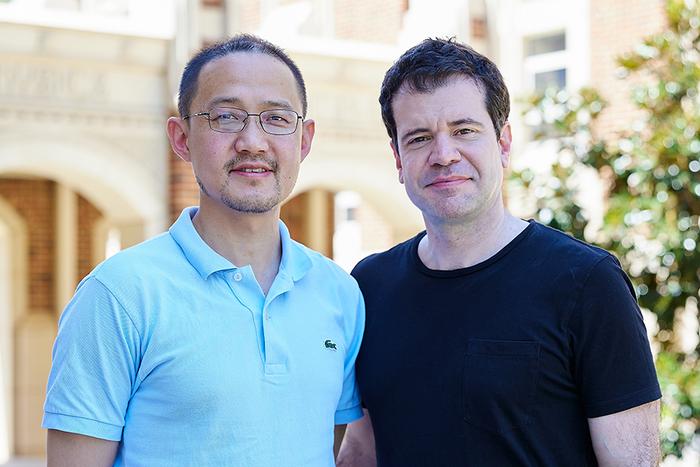
Bruno Uchoa, a professor of condensed matter physics, and Hong-yi Xie, a postdoctoral fellow in condensed matter physics at the University of Oklahoma, have published research in the journal Proceedings of the National Academy of Sciences that predicts the existence of a new type of exciton. These particles could lead to the advancement of future quantum devices.

Credit: Sophia Armoudian, University of Oklahoma
Bruno Uchoa, a professor of condensed matter physics, and Hong-yi Xie, a postdoctoral fellow in condensed matter physics at the University of Oklahoma, have published research in the journal Proceedings of the National Academy of Sciences that predicts the existence of a new type of exciton. These particles could lead to the advancement of future quantum devices.
Excitons are created when electrons and the holes they form, which are oppositely charged, bind together. Excitons have long been observed in insulators and semiconductors, the materials that power modern computers. In this publication, Uchoa and Xie have predicted the existence of a new type of exciton with finite vorticity, called a ‘topological exciton,’ that exists in a class of materials known as Chern insulators.
Topology is a branch of mathematics that studies the properties of shapes and surfaces that don’t change, even when stretched, twisted or bent. For example, a doughnut with a hole in the middle and a mug with a hole in the handle both describe surfaces that belong to the same topological class because each can be continuously deformed into the other. Scientists use topological ideas to describe materials with electronic properties that are unaffected by imperfections. Churn refers to a class in topology where the key characteristics of shapes can be represented by whole numbers.
“Chern insulators are materials that allow electrons to orbit the edge of a material but do not conduct any electricity internally,” Uchoa said. “They do, however, spontaneously form unidirectional currents flowing either clockwise or counterclockwise along the edges of a two-dimensional material. These one-way currents are precisely measured in basic units of current.”
In this work, Uchoa and Xie predicted that, under well-defined conditions, excitons created by shining light through Chern insulators would inherit the nontrivial topological properties of the electrons and holes in the host material. This prediction is powerful because it is based on fundamental concepts instead of computer simulations.
“In insulators, light excites electrons from the valence band where they normally live to the conduction band where they can move freely,” Unchoa said. “When those two bands are topologically distinct, the resulting excitons are topological themselves. Once those excitons decay by releasing energy, they were predicted to spontaneously emit circularly polarized light.”
According to Xie, these topological excitons could be used to design a novel class of optical devices. At low temperatures, excitons could form a new type of neutral superfluid that could be used to create powerful polarized light emitters or advanced photonic devices for quantum computing.
“The prediction of this composite particle could help develop new optoelectronic devices based on topology,” Uchoa said. “Not only could it aid in quantum communication applications, but it could also help engineer qubits that have two entangled states, on and off, based on the vorticity or polarization of the emitted light. I’m very excited about these possibilities.”
Learn more about this research through the Uchoa Group and about quantum research at OU’s Center for Quantum Research and Technology.
About the project
“Theory of topological exciton insulators and condensates in flat Chern bands” has been published in the journal Proceedings of the National Academy of Sciences, DOI No. 10.1073/pnas.2401644121. Xie and Uchoa, the Ted and Cuba Webb Presidential Professor in the Dodge Family College of Arts and Sciences, collaborated with researchers from Harvard University and the City University of New York.
Journal
Proceedings of the National Academy of Sciences
Method of Research
Computational simulation/modeling
Subject of Research
Not applicable
Article Title
Theory of topological exciton insulators and condensates in flat Chern bands
Article Publication Date
23-Aug-2024
Cite Scienmag News
Katie Riggs. (August 27, 2024). Quantum researchers publish ‘exciting’ particle prediction. Scienmag. https://scienmag.com/quantum-researchers-publish-exciting-particle-prediction/
Katie Riggs. "Quantum researchers publish ‘exciting’ particle prediction." Scienmag, 27 August 2024, https://scienmag.com/quantum-researchers-publish-exciting-particle-prediction/. Accessed 3 September 2026.
Katie Riggs. "Quantum researchers publish ‘exciting’ particle prediction." Scienmag. August 27, 2024. https://scienmag.com/quantum-researchers-publish-exciting-particle-prediction/

