


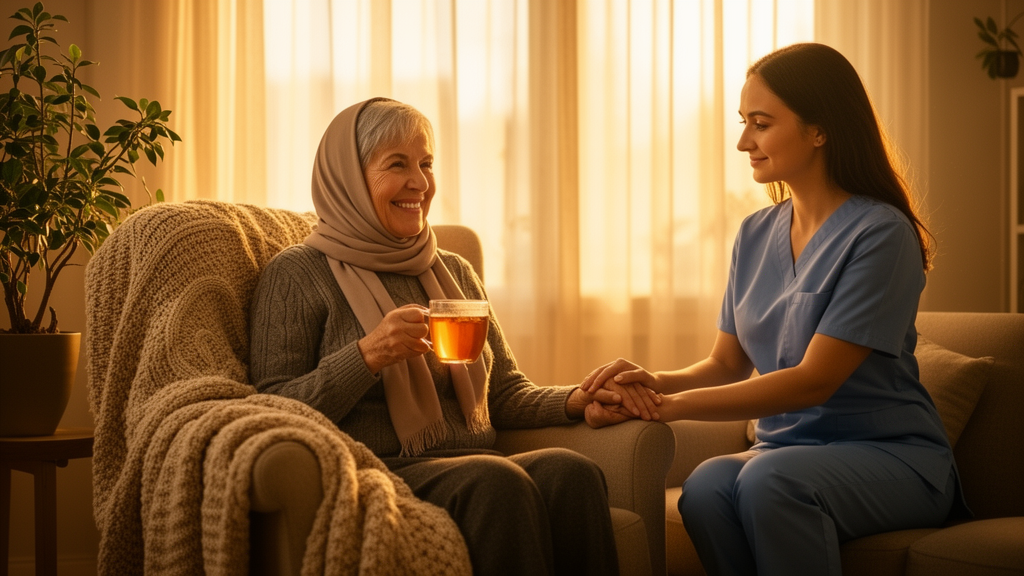
An eight-week therapeutic program built around quality-of-life education has produced a striking rise in happiness among older women undergoing breast cancer treatment, according to a quasi-experimental study published in BMC Psychology. The research, conducted at Peymanieh Educational Hospital in Jahrom, Iran, offers one of the clearest demonstrations yet that a structured, low-cost psychological intervention can move a measurable well-being indicator in a population often overlooked by positive psychology research: older women living with cancer.
The study team recruited 50 older women with breast cancer attending the hospital’s chemotherapy unit in 2025, using convenience sampling before randomly allocating participants to an intervention or control group of 25 each. Happiness was measured with the Oxford Happiness Questionnaire, a 29-item instrument widely used in well-being research, alongside a demographic questionnaire. At baseline, the two groups were statistically indistinguishable, with no significant difference in mean happiness scores, setting the stage for a clean test of the program’s effect.
The intervention itself consisted of eight weekly 60-minute sessions spread over two months, each grounded in a therapeutic quality-of-life–based educational framework. Rather than targeting tumor biology, the program addressed the psychological architecture of daily living: coping with illness-related stressors, maintaining social connection, and rebuilding a sense of purpose during treatment. The control group received routine care only. Data were analyzed with SPSS version 22 using descriptive statistics, independent- and paired-samples t-tests, the chi-square test, and analysis of covariance.
The results were unambiguous. In the intervention group, the mean happiness score climbed from 34.72 ± 9.20 at pretest to 44.84 ± 5.74 at posttest, a gain of roughly ten points that reached statistical significance at p < 0.001. The control group, by contrast, showed no meaningful movement over the same period, with a paired comparison yielding p = 0.92. The magnitude of the change is notable given that the intervention required no pharmacological component and no specialized equipment, only trained facilitators and consistent weekly contact.
Because baseline scores can inflate apparent treatment effects in pretest–posttest designs, the researchers turned to analysis of covariance, a statistical technique that adjusts post-intervention outcomes for pre-existing differences between groups. ANCOVA, controlling for baseline happiness, confirmed a significantly higher post-intervention happiness score in the intervention group than in the control group at p < 0.001. This dual confirmation—significant within-group change paired with significant between-group difference after adjustment—strengthens the causal interpretation that the program, not natural recovery or routine care, drove the improvement.
Why does happiness matter clinically in this population? The study’s authors frame it as a key indicator of psychological well-being that shapes how patients adapt to illness and, ultimately, their health outcomes. Breast cancer is among the most prevalent malignancies in older women, and its treatment burden—chemotherapy sessions, fatigue, body-image concerns, and fear of recurrence—can erode psychological well-being and overall quality of life. Happiness, in this framing, is not a luxury but a resource: a psychological buffer that supports adherence to treatment, social engagement, and adjustment to a life reorganized around disease.
The intervention’s design reflects a broader shift in supportive cancer care away from deficit-focused models and toward quality-of-life–based frameworks that treat well-being as an active target of therapy. Programs of this type draw conceptually on positive psychology and, in many implementations, on cognitive behavioral techniques that help patients restructure illness-related thoughts and behaviors. The eight-session, 60-minute format is deliberately feasible: it fits within routine chemotherapy scheduling, requires minimal material cost, and can be delivered by nursing and midwifery staff already embedded in oncology services, which the authors describe as making it an effective, low-cost, and feasible supportive intervention.
The study’s limitations are the standard ones for quasi-experimental work of this scale. Convenience sampling from a single hospital’s chemotherapy unit restricts how broadly the findings generalize, and the sample of 50 participants, while adequate for detecting large effects, leaves room for sampling variability. The authors themselves recommend further studies with larger sample sizes and longer follow-up periods to evaluate whether the happiness gains persist after the program ends—a critical question, since psychological interventions can fade without reinforcement. The absence of a clinical trial registration and the pretest–posttest structure also mean that expectancy effects, though mitigated by the control group, cannot be fully excluded.
Even with those caveats, the implications for health systems are concrete. The authors argue that integrating structured quality-of-life–based programs into supportive care and educational services may improve psychosocial outcomes for older women with breast cancer, a group whose psychological needs are frequently subsumed under the medical management of their disease. In settings where oncology psychology services are scarce, a program deliverable within routine care at minimal cost represents a pragmatic bridge between biomedical treatment and the psychological adjustment that determines how well patients live through it.
The research, approved by the Ethics Committee of Jahrom University of Medical Sciences and conducted in accordance with the Declaration of Helsinki, adds to a growing evidence base suggesting that happiness is modifiable in older cancer patients—not through dramatic technological breakthroughs, but through consistent, human-delivered weekly sessions that give patients tools for living well during treatment. As the population ages and cancer survival rates climb, interventions of this kind may become an increasingly central part of what supportive cancer care means: not only extending life, but measurably improving the psychological experience of living it.
Subject of Research: Health
Article Title: The effect of a therapeutic quality-of-life–based program on happiness in older women with breast cancer
Article References: Fallah-karimi, S., Mohammadian, Z., Lavarzaei, S., mohammadifard, L., Khalilzadeh-farsangi, Z., & Armanpour, M. (2026). The effect of a therapeutic quality-of-life–based program on happiness in older women with breast cancer. BMC Psychology. https://doi.org/10.1186/s40359-026-05619-7
Image Credits: AI Generated
DOI: 10.1186/s40359-026-05619-7
Keywords: breast cancer, happiness, quality of life, older women, psychological well-being, supportive care, BMC Psychology, Oxford Happiness Questionnaire, effect, therapeutic, quality-of-life, based
Cite Scienmag News
Glenn Wilkins. (October 18, 2026). Quality-of-Life Program Lifts Happiness in Older Women With Breast Cancer. Scienmag. https://scienmag.com/quality-of-life-program-lifts-happiness-in-older-women-with-breast-cancer/
Glenn Wilkins. "Quality-of-Life Program Lifts Happiness in Older Women With Breast Cancer." Scienmag, 18 October 2026, https://scienmag.com/quality-of-life-program-lifts-happiness-in-older-women-with-breast-cancer/. Accessed 18 October 2026.
Glenn Wilkins. "Quality-of-Life Program Lifts Happiness in Older Women With Breast Cancer." Scienmag. October 18, 2026. https://scienmag.com/quality-of-life-program-lifts-happiness-in-older-women-with-breast-cancer/


