

Tuesday, May 26, 2026
Science
No Result
View All Result
  • Login
  • HOME
  • SCIENCE NEWS
  • CONTACT US
  • HOME
  • SCIENCE NEWS
  • CONTACT US
No Result
View All Result
Scienmag
No Result
View All Result
Home Science News Chemistry

Quality control: neatly arranging crystal growth to make fine thin films

August 21, 2024
in Chemistry
Reading Time: 3 mins read
0
Modulating quality
66
SHARES
604
VIEWS
Share on FacebookShare on Twitter
ADVERTISEMENT

Table salt and refined sugar look white to our eyes, but that is only because their individual colorless crystals scatter visible light. This feature of crystals is not always desirable when it comes to materials for optical and electrical devices, however.

Modulating quality

Credit: Osaka Metropolitan University

Table salt and refined sugar look white to our eyes, but that is only because their individual colorless crystals scatter visible light. This feature of crystals is not always desirable when it comes to materials for optical and electrical devices, however.

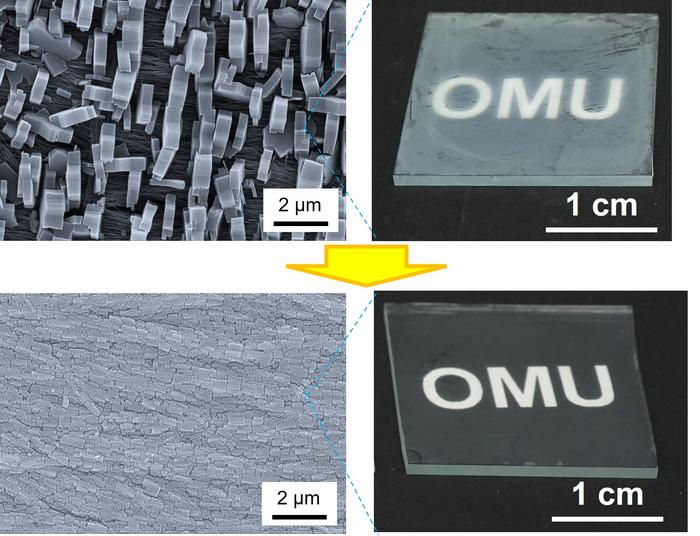
Metal-organic frameworks are one such material. Crystalline with micropores, thin films of these nanomaterials have been attracting attention as a next-generation material that could also have an impact on environmental issues such as hydrogen storage and carbon dioxide capture. An Osaka Metropolitan University, Graduate School of Engineering team has found a way to control the growth of crystals on such thin films so that light scattering is reduced significantly.

Associate Professor Kenji Okada and Professor Masahide Takahashi led the team in developing a technique for forming thin films on substrates by having the crystals grow in an orderly manner through the use of a modulator. A mixture of diluted acetic acid, the main acid of vinegar, and sodium acetate made up the modulator, which interacted with the copper-based medium to grow crystals in only one direction.

By arranging the crystals neatly without gaps, the team succeeded in fabricating a thin film of unprecedented high quality.

“The thin films fabricated in this research have numerous molecular-sized pores that allow light to pass through them well,” Professor Okada explained. “They are expected to be used as optical sensors, optical elements, and transparent gas adsorption sheets that utilize the change in optical properties during molecular adsorption.”

The findings were published in Nanoscale.

###

About OMU 

Established in Osaka as one of the largest public universities in Japan, Osaka Metropolitan University is committed to shaping the future of society through “Convergence of Knowledge” and the promotion of world-class research. For more research news, visit and follow us on social media: X, Facebook, Instagram, LinkedIn.


Journal

Nanoscale

DOI

10.1039/D4NR01885K

Method of Research

Experimental study

Subject of Research

Not applicable

Article Title

Improved optical quality of heteroepitaxially grown metal–organic framework thin films by modulating the crystal growth

Article Publication Date

20-Jun-2024

COI Statement

There are no conflicts to declare.

Share26Tweet17
Previous Post

How does organic farming benefit honeybees?

Next Post

Does cognitive behavioral therapy benefit cancer survivors?

Related Posts

Interfacial Electrocatalyst Converts Biomass into Biodegradable Plastic Precursor at Low Voltage with Unprecedented Selectivity — Chemistry
Chemistry

Interfacial Electrocatalyst Converts Biomass into Biodegradable Plastic Precursor at Low Voltage with Unprecedented Selectivity

May 26, 2026
Tangoing Requires Two Combs: A Scientific Spin on the Phrase — Chemistry
Chemistry

Tangoing Requires Two Combs: A Scientific Spin on the Phrase

May 26, 2026
Revolutionary Advances in Synthetic Cell Research Unveiled — Chemistry
Chemistry

Revolutionary Advances in Synthetic Cell Research Unveiled

May 26, 2026
Scientists Discover Multiple Cosmic Pathways to Black Hole Formation — Chemistry
Chemistry

Scientists Discover Multiple Cosmic Pathways to Black Hole Formation

May 26, 2026
Breakthrough Discoveries from MSK Research – May 26, 2026 — Chemistry
Chemistry

Breakthrough Discoveries from MSK Research – May 26, 2026

May 26, 2026
Tracking Single Molecules Uncovers the Source of Reaction Chirality — Chemistry
Chemistry

Tracking Single Molecules Uncovers the Source of Reaction Chirality

May 26, 2026
Next Post
Does cognitive behavioral therapy benefit cancer survivors?

Does cognitive behavioral therapy benefit cancer survivors?

  • Mothers who receive childcare support from maternal grandparents show more parental warmth, finds NTU Singapore study

    Mothers who receive childcare support from maternal grandparents show more parental warmth, finds NTU Singapore study

    27649 shares
    Share 11056 Tweet 6910
  • University of Seville Breaks 120-Year-Old Mystery, Revises a Key Einstein Concept

    1053 shares
    Share 421 Tweet 263
  • Bee body mass, pathogens and local climate influence heat tolerance

    680 shares
    Share 272 Tweet 170
  • Researchers record first-ever images and data of a shark experiencing a boat strike

    543 shares
    Share 217 Tweet 136
  • Groundbreaking Clinical Trial Reveals Lubiprostone Enhances Kidney Function

    529 shares
    Share 212 Tweet 132
Science

Embark on a thrilling journey of discovery with Scienmag.com—your ultimate source for cutting-edge breakthroughs. Immerse yourself in a world where curiosity knows no limits and tomorrow’s possibilities become today’s reality!

RECENT NEWS

  • Platinum-Antibody Conjugates Enhance Tumor Recognition by the Immune System
  • Lund University Professor Appointed Chair of Lancet Commission on Precision Medicine
  • Sanguinarine: The Key that Flips BiP to Battle Lung Cancer
  • Daily Glass of 100% Fruit Juice May Promote Mental Wellbeing, Study Finds

Categories

  • Agriculture
  • Anthropology
  • Archaeology
  • Athmospheric
  • Biology
  • Biotechnology
  • Blog
  • Bussines
  • Cancer
  • Chemistry
  • Climate
  • Earth Science
  • Editorial Policy
  • Marine
  • Mathematics
  • Medicine
  • Pediatry
  • Policy
  • Psychology & Psychiatry
  • Science Education
  • Social Science
  • Space
  • Technology and Engineering

Subscribe to Blog via Email

Enter your email address to subscribe to this blog and receive notifications of new posts by email.

Join 5,146 other subscribers

© 2025 Scienmag - Science Magazine

Welcome Back!

Login to your account below

Forgotten Password?

Retrieve your password

Please enter your username or email address to reset your password.

Log In
No Result
View All Result
  • HOME
  • SCIENCE NEWS
  • CONTACT US

© 2025 Scienmag - Science Magazine

Discover more from Science

Subscribe now to keep reading and get access to the full archive.

Continue reading
