


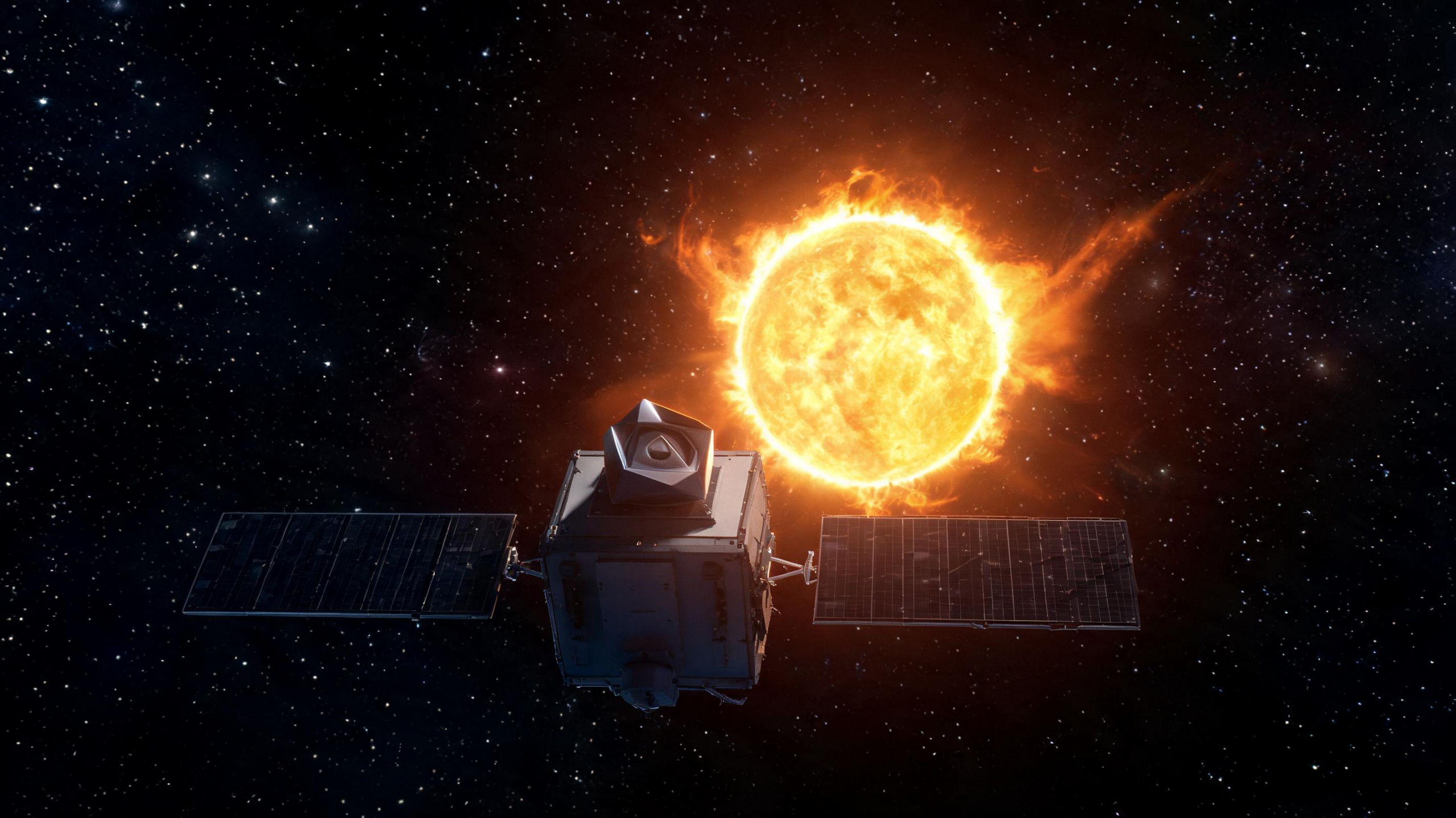
Small satellites depend on reliable knowledge of where they are pointing, yet the instruments that provide that information can be among the most expensive and technically demanding components of a spacecraft. A new study describes a low-cost solar sensor built around a pyramidal structure that is designed to give spacecraft a broad view of the Sun while maintaining accuracy comparable to commercial devices. The work, published in the International Journal of Aeronautical and Space Sciences, combines optical sensing, digital signal processing and mechanical analysis in a single development effort. The researchers report that their proposed configuration achieved an approximately 60 percent reduction in cost compared with existing commercial solar sensors. The result is aimed particularly at missions in which budgets, mass and available engineering resources are tightly constrained, including small satellites and CubeSats. The device has not yet completed environmental qualification or demonstrated operation in orbit, but the study establishes a tested prototype and identifies the next steps needed before space deployment. Its central idea is straightforward: use several light-sensitive units arranged around a pyramid so that the Sun can be detected across a wide range of directions rather than only through a narrow optical opening.
A solar sensor is an important part of a spacecraft attitude-determination system. By measuring the direction of incoming sunlight, it provides a reference that flight computers can use to estimate the spacecraft’s orientation. That information supports functions such as pointing instruments, managing communications and directing solar panels toward illumination. In a conventional sensor, the Sun’s rays interact with a detector through an aperture, slit or shaped optical element. The resulting signal changes as the spacecraft rotates, allowing the angle of the Sun relative to the sensor to be calculated. A wide field of view is valuable because a spacecraft may emerge from an eclipse, tumble after deployment or operate while its attitude changes substantially. If the Sun lies outside the sensor’s useful angular range, the instrument may temporarily lose its reference. The pyramidal design addresses this limitation by distributing sensitive units across multiple faces. Light arriving from different directions can therefore illuminate different detector elements, producing signals that encode both azimuth, the horizontal angle, and elevation, the vertical angle. Together, these measurements define the Sun’s position in the sensor’s coordinate system.
The study’s sensor uses OPT101 sensitive elements and associated electronics to convert incident light into measurable electrical signals. The researchers tested the sensitive units and their electronics through several processes rather than treating the detector as an isolated component. This system-level approach matters because the accuracy of a solar sensor depends not only on the geometry of its housing, but also on detector response, electronic noise, signal conditioning and the algorithms used to interpret the measurements. Photodetectors do not always produce perfectly clean or linear outputs, particularly when measurements are affected by noise or changing illumination conditions. To improve the quality of the readings, the team applied a novel digital filtering algorithm. Digital filtering processes a sampled signal mathematically, suppressing unwanted fluctuations while retaining the information associated with the Sun’s direction. Better signal quality can make the transition between angular measurements more stable and reduce the risk that random variations will be mistaken for a change in spacecraft orientation. The article reports that the filtering successfully enhanced the sensor signal, although the available source does not specify a single numerical improvement in accuracy attributable only to the algorithm.
The pyramidal geometry also provides a practical optical strategy. Instead of relying on one detector and one viewing path, the arrangement allows several sensitive areas to observe different portions of the surrounding sky. As the angle of incoming sunlight changes, the relative responses of the units change as well. Comparing those responses provides the basis for estimating the Sun’s azimuth and elevation. In principle, a multi-face arrangement can maintain useful sensitivity over a larger angular range than a flat, single-face detector. It can also supply directional information without requiring a mechanically moving optical assembly, which helps simplify the design. The source article identifies wide field-of-view performance as a key advantage of the proposed configuration and states that experiments involving azimuth and elevation confirmed this behavior. The researchers also compared the device with other existing technologies and found accuracy comparable to commercial solar sensors. That comparison is important for small spacecraft, where a lower purchase and manufacturing cost is useful only if the instrument still provides sufficiently dependable orientation data for the mission’s control system.
Because the instrument is intended for space, its optical performance is only part of the engineering challenge. A sensor housing must withstand the mechanical stresses associated with launch, including vibration and shock, without allowing the detector geometry to shift. Even a small deformation could alter the relationship between the pyramid faces and the sensitive units, introducing a pointing error that software alone might not correct. The researchers therefore conducted a structural assessment of the proposed design using candidate materials and analysis of the mechanical behavior. Their results identified aluminum as the best material choice for the structure. Aluminum is widely used in spacecraft hardware because it combines relatively low density with useful strength and established manufacturing practices, although the study’s conclusion is specific to the analyzed sensor configuration. Structural analysis can reveal how a component responds to applied loads, where stresses concentrate and whether displacement remains within acceptable limits. For a solar sensor, maintaining dimensional stability is especially important because the optical geometry is directly linked to the conversion of detector signals into angular coordinates.
The reported cost reduction reflects the project’s focus on accessibility as well as performance. Commercial space-qualified sensors can impose a significant burden on missions with limited budgets, while custom development can require specialized manufacturing and testing. A design based on comparatively accessible detector technology and a simple pyramidal mechanical structure may offer an alternative for universities, emerging space programs and small-satellite teams. The authors are affiliated with the University of Abdelhamid Ibn Badis in Mostaganem, the Algerian Space Agency and the National Polytechnic School of Oran Maurice Audin. Their work places the sensor within a broader effort to develop affordable spacecraft subsystems without abandoning formal engineering assessment. The approximately 60 percent cost reduction reported in the study is not presented as a universal price guarantee for every mission; actual costs would depend on production volume, qualification requirements, integration and procurement. Nevertheless, the result suggests that careful mechanical design and signal processing may reduce the trade-off between affordability and functional capability. For missions that need several attitude sensors for redundancy, or for projects operating under strict financial limits, that difference could be significant.
The prototype’s current status also highlights the gap between a successful laboratory or test-bench demonstration and a flight-ready space instrument. The paper reports testing of the sensitive units and electronics, structural analysis, and experiments measuring azimuth and elevation. It does not report environmental qualification or in-orbit validation as completed achievements. Space hardware must generally be evaluated against the conditions expected during launch and operation, which can include vibration, shock, thermal changes, vacuum and radiation exposure. Qualification testing is intended to show that the design can survive those conditions while continuing to meet its performance requirements. Calibration is another essential step: the relationship between detector output and Sun angle must be characterized, and that relationship may need to be checked after environmental testing. The authors identify environmental qualification testing and in-orbit validation as future work. Those stages will determine whether the demonstrated wide field of view, comparable accuracy and structural performance remain available in the operational environment. Until then, the sensor should be regarded as a promising development rather than a fully qualified replacement for established flight hardware.
The broader significance of the research lies in its integration of geometry, electronics, computation and structural engineering around a specific spacecraft need. A solar sensor does not have to be large or mechanically elaborate to provide useful attitude information, but it must produce interpretable signals across the directions relevant to its mission and remain stable under launch conditions. The pyramidal concept offers a way to expand coverage while using multiple fixed sensitive units, and the digital filter addresses the quality of the measurements produced by those units. The structural assessment adds evidence that the physical assembly can be built around aluminum without compromising the intended design. Together, these elements form a practical route toward a lower-cost sensor for small spacecraft. The next tests will be decisive: qualification will challenge the structure and electronics, while orbital validation will reveal how the instrument performs amid real sunlight, spacecraft motion and the changing conditions of space. If those evaluations confirm the study’s findings, the design could give more small-satellite missions access to wide-angle solar attitude sensing at a substantially lower cost.
For attitude determination, the sensor’s azimuth and elevation measurements are most useful when combined with a spacecraft’s other available information, such as a dynamical model or additional attitude sensors. A solar direction defines a line of reference, but by itself it does not generally distinguish every possible spacecraft orientation about that line. This makes the reported angular experiments relevant to system integration: they characterize how the pyramidal detector translates sunlight into coordinates that a flight computer can use alongside other measurements. The practical value of the wide field of view therefore depends not only on angular accuracy, but also on how reliably the sensor can provide a valid Sun vector during changing spacecraft attitudes.
The study also illustrates why validation must proceed in stages. Component and electronics tests can establish whether the photodetectors and readout produce usable signals, while azimuth and elevation experiments examine the measurement principle. Structural analysis addresses a different question: whether the physical assembly preserves its geometry under modeled loading. Environmental qualification and orbital validation would connect these separate results by testing the integrated instrument under mission-relevant conditions. The authors state that supporting data are available from the corresponding author upon reasonable request, which may allow further examination of the reported methods and results as development progresses.
Subject of Research: Low-cost pyramidal solar sensing for small-spacecraft attitude determination
Article Title: Design and Structural Assessment of a Low-Cost Wide Field-of-View Pyramidal Solar Sensor for Space Applications
Article References: Nehila, A., Teffah, K., Roubache, R., Slimane, S. A., Bennaceur, M. A., Adnane, A., Cheriet, M. E.-A., & Bensabri, O. (2026). Design and Structural Assessment of a Low-Cost Wide Field-of-View Pyramidal Solar Sensor for Space Applications. International Journal of Aeronautical and Space Sciences. https://doi.org/10.1007/s42405-026-01286-5
Image Credits: AI Generated
DOI: 10.1007/s42405-026-01286-5
Keywords: solar sensors, CubeSats, small satellites, spacecraft attitude, pyramidal structures, wide field of view, digital filtering, aluminum structures, finite element analysis, Design, Structural, Assessment
Cite Scienmag News
Grant Pearson. (August 28, 2026). Pyramid Sensor Widens Small Satellites’ View of the Sun. Scienmag. https://scienmag.com/pyramid-sensor-widens-small-satellites-view-of-the-sun/
Grant Pearson. "Pyramid Sensor Widens Small Satellites’ View of the Sun." Scienmag, 28 August 2026, https://scienmag.com/pyramid-sensor-widens-small-satellites-view-of-the-sun/. Accessed 4 October 2026.
Grant Pearson. "Pyramid Sensor Widens Small Satellites’ View of the Sun." Scienmag. August 28, 2026. https://scienmag.com/pyramid-sensor-widens-small-satellites-view-of-the-sun/


