


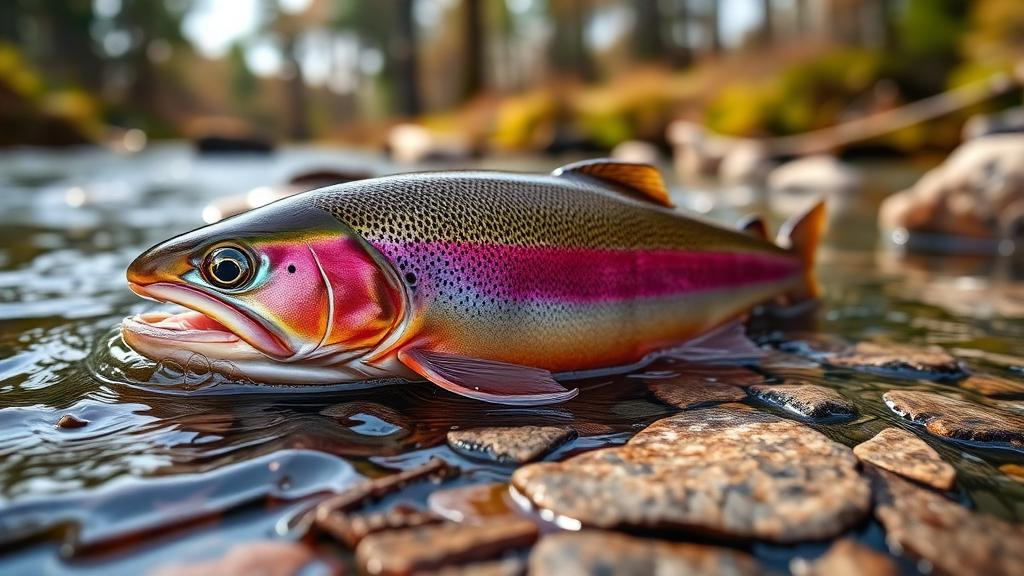
For fisheries managers across Central Europe, the rainbow trout has long been the backbone of a simple and popular business model: hatch the fish, truck them to the river, and let anglers catch them soon afterward. A new long-term analysis of Czech fishing grounds now provides one of the most detailed pictures yet of how this put-and-take system actually plays out on the water, and the numbers are striking. On rivers managed for general coarse fishing, more than nine in ten stocked rainbow trout were caught and harvested within just two weeks of their release, a tempo that leaves little doubt about the fate of the vast majority of stocked fish.
The study, published in the journal Acta Ichthyologica et Piscatoria, draws on records from five fishing grounds spanning four rivers in the Czech Republic between 2007 and 2020. Researchers from local angling associations compiled stocking dates, fish numbers and weights alongside mandatory entries in anglers’ yearly fishing permits, then analyzed how quickly stocked rainbow trout, Oncorhynchus mykiss, were caught and whether returns differed between two distinct types of water management. The comparison pitted non-trout fishing grounds, where anglers may use natural baits with few restrictions, against designated trout grounds, where only artificial flies and lures are permitted and the season is limited to mid-April through the end of November.
The rainbow trout is not native to Europe. Introduced to the Czech Republic at the end of the nineteenth century, the species now supports a substantial aquaculture industry that produced 438 tonnes in 2022, of which 81 tonnes were taken by anglers in open waters. Because natural reproduction in Czech rivers is highly unlikely, every rainbow trout an angler catches was almost certainly stocked. Between 2017 and 2022, the mean annual catch reported by the two major angling unions reached 167,563 fish weighing 73,488 kilograms, making the rainbow trout the third most commonly caught species in the country after common carp and common bream.
The centerpiece of the analysis was the Svitava River, a non-trout fishing ground that flows directly through the city of Brno and its 400,000 residents. There, the pattern was dramatic. Across three sampled years, between 72.8 and 96.6 percent of all rainbow trout caught on local permits were landed within the first two weeks after a stocking event. Catch numbers spiked immediately after each release and fell essentially to zero in the days just before the next batch of fish arrived, indicating that fish from earlier stockings contributed almost nothing to later catches. By contrast, the four designated trout grounds showed a significantly lower two-week share, averaging 64.1 percent compared with 92.3 percent on the non-trout ground, a difference the authors confirmed as highly significant using generalized linear mixed models.
The researchers attribute this contrast to the rules of the game. On trout grounds, anglers are limited to three one-day trips per week and must fish with barbless artificial flies and lures, and only holders of a trout permit may fish at all. On the non-trout ground, no weekly trip limit exists, baited hooks are allowed, and fishing is legal year-round. The result is intense, bait-driven fishing pressure concentrated in the fortnight after each release on the Svitava, while trout grounds spread catches more evenly across the season, with roughly 30 to 50 percent of fish typically taken later than two weeks after stocking.
Return rates over the full year, however, turned out to be remarkably similar between the two management regimes. Individual return rates ranged from 36.8 to 53.4 percent on the non-trout ground and from 29.8 to 68.4 percent on trout grounds, while weight-based returns spanned 47.7 to 79.5 percent and 34.4 to 75.3 percent respectively, with no statistically significant differences in either measure. In other words, regardless of how the river was regulated, only about half of the stocked rainbow trout were ever caught and harvested, leaving the fate of the other half largely unknown.
That missing half is a familiar puzzle in put-and-take fisheries. Studies from North America suggest hatchery rainbow trout disperse rapidly from stocking sites, with nearly all fish either dying quickly or emigrating through long-range movements. The Czech authors point to additional pressures including transport stress, predation by fish-eating birds, illegal fishing and unregistered removals. Somewhat surprisingly, the density of human population around each fishing ground did not predict return rates. The Brno city stretch and sparsely populated headwaters delivered comparable returns, and neither the number of stocking events nor the number of release sites appeared to matter, suggesting weather, hydrology and the timing of releases relative to weekends and holidays are the real drivers of fishing success.
The data also revealed an amusing quirk of self-reported catch records. On average, anglers reported fish heavier than those stocked, most dramatically in 2019 on the Svitava, where fish averaging 314 grams at release were reported at 468 grams when caught. Given that most fish were caught within days of stocking, the authors suggest anglers may consult an indicative weight table in their regulation booklets or simply overestimate their catch, a phenomenon they describe as subjectively distorted reporting. Slightly longer residence times on trout grounds, where fish can genuinely feed and grow after release, may account for part of the pattern, since stocked trout do begin taking natural drift and benthic prey almost immediately even if their post-hatchery diets differ from those of wild salmonids.
The findings carry practical weight well beyond the Czech Republic. Put-and-take stocking is a widespread tool for sustaining recreational fisheries on non-native salmonids, and the Czech return rates of roughly 30 to 60 percent compare favorably with figures from North American and Australian waters, which often hover near 23 to 27 percent, likely because those lakes and rivers are far larger and the fish harder to catch. The results also touch on animal welfare, since catch-and-release mortality is known to be far higher with baited barbed hooks, common on non-trout grounds, than with the barbless artificial flies and lures mandated on trout grounds. For managers, the message is clear: in put-and-take systems, most stocked trout are essentially a short-term delivery of harvestable fish, and the timing of releases matters as much as the number of fish in the tank.
Subject of Research: Stocking efficiency and catch timing of rainbow trout in Czech recreational fisheries
Article Title: Annual catch of rainbow trout, Oncorhynchus mykiss ( Actinopterygii , Salmoniformes , Salmonidae ), in fishing grounds in the Czech Republic, related to stocking
Article References: Adámek, Z., Šlapanský, L., & Jurajda, P. (2025). Annual catch of rainbow trout, Oncorhynchus mykiss (Actinopterygii, Salmoniformes, Salmonidae), in fishing grounds in the Czech Republic, related to stocking. Acta Ichthyologica et Piscatoria, 55, 151-160. https://doi.org/10.3897/aiep.55.148612
Image Credits: AI Generated
Keywords: rainbow trout, Oncorhynchus mykiss, stocking, recreational fishing, put-and-take fisheries, Czech Republic, return rates, trout fishing grounds, fisheries management, anglers' catches, non-indigenous species, Annual
Cite Scienmag News
Scott Patterson. (October 19, 2026). Put-and-Take Angling in Czech Rivers: Most Stocked Rainbow Trout Are Caught Within Two Weeks. Scienmag. https://scienmag.com/put-and-take-angling-in-czech-rivers-most-stocked-rainbow-trout-are-caught-within-two-weeks/
Scott Patterson. "Put-and-Take Angling in Czech Rivers: Most Stocked Rainbow Trout Are Caught Within Two Weeks." Scienmag, 19 October 2026, https://scienmag.com/put-and-take-angling-in-czech-rivers-most-stocked-rainbow-trout-are-caught-within-two-weeks/. Accessed 19 October 2026.
Scott Patterson. "Put-and-Take Angling in Czech Rivers: Most Stocked Rainbow Trout Are Caught Within Two Weeks." Scienmag. October 19, 2026. https://scienmag.com/put-and-take-angling-in-czech-rivers-most-stocked-rainbow-trout-are-caught-within-two-weeks/


