


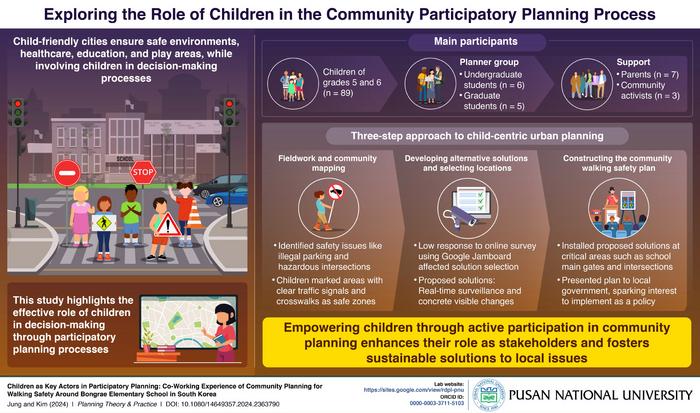
The United Nations Convention on the Rights of the Child defined child-friendly cities as those that prioritize children’s access to safe environments, healthcare, education, green spaces, and the right to participate in decision-making processes about their surroundings. Despite the importance, children are often overlooked in urban planning, consulted mainly for ideas rather than being actively involved in implementation of the ideas. Involving children fosters community interaction and enhances their understanding of how physical environments impact well-being. However, despite these benefits, children often face exclusion from public spaces due to limited capacity for independent movement and physical activity.

Credit: Professor Donghyun Kim from Pusan National University, Korea
The United Nations Convention on the Rights of the Child defined child-friendly cities as those that prioritize children’s access to safe environments, healthcare, education, green spaces, and the right to participate in decision-making processes about their surroundings. Despite the importance, children are often overlooked in urban planning, consulted mainly for ideas rather than being actively involved in implementation of the ideas. Involving children fosters community interaction and enhances their understanding of how physical environments impact well-being. However, despite these benefits, children often face exclusion from public spaces due to limited capacity for independent movement and physical activity.
Recently, researchers from Pusan National University, led by Professor Donghyun Kim, Associate Professor at the Department of Urban Planning and Engineering, aimed to address this gap. Their study focused on conducting a participatory planning process with children and apply the findings to improving walking safety in a school zone in Busan. This study was published online on 17 June 2024 in the journal of Planning Theory & Practice. Sharing the purpose of their study Dr. Kim explains, “Our study aims to construct a community participatory planning process involving children and apply this planning process to a case related to the road safety problem of the school zone.”
The study used a three-step participatory community planning process, that was designed based on interactions between the planner (comprised of six undergraduate and five graduate students from the Department of Urban Planning and Engineering at Pusan National University) and participants (89 children of grades 5 and 6). Initially, both planner and participant groups conducted separate field work and community mapping exercises. Despite initial challenges, the children effectively identified various walking safety risks, such as illegal parking zones, intersections, unsafe crosswalks near their school which were mapped and discussed using online tools like KakaoTalk Open Chat. All the identified spaces were congested with heavy vehicle movement in unpredictable directions and speeds.
In the second step, the planner group reviewed their findings and developed multiple solutions for the identified problems. Children rank preferences among the proposed solutions based on safety, impact, convenience, and cost, through an online survey. Sites for selected solutions including pedestrian-first streets, raised crosswalks, painted sidewalks, and bollards to prevent illegal parking, were then marked using Google Jamboard.
The final step involved creating a comprehensive community walking safety plan. Combining the survey results, the planners proposed installing pedestrian-first streets, painting sidewalks, adding bollards, marking crosswalks, and installing parking entrance alarms in and around the school area. This plan was then presented to the local government and local council and proposed as a policy.
The study highlighted how children successfully took part in participatory planning, despite challenges posed by restrictions due to COVID-19 and varying participant interest. Community maps, virtual tools, and shared understanding acted as effective tools in effectively utilizing children’s participation.
Dr. Kim pointed out, “Our study shows that children can be the main actors in planning for community issues. The communicative planning process proposed in our study can be applied to bridge the gap between planners and residents in solving problems of various themes such as pedestrian safety problem for children, community renewal, and community climate change adaptation.”
To conclude, this innovative urban planning approach empowers children, enabling their unique perspectives to contribute to the creation of safer, and more inclusive environments.
***
Reference
Title of original paper: Children as Key Actors in Participatory Planning: Co-Working Experience of Community Planning for Walking Safety Around Bongrae Elementary School in South Korea
Journal: Planning Theory & Practice
About the institute
Pusan National University, located in Busan, South Korea, was founded in 1946 and is now the No. 1 national university of South Korea in research and educational competency. The multi-campus university also has other smaller campuses in Yangsan, Miryang, and Ami. The university prides itself on the principles of truth, freedom, and service, and has approximately 30,000 students, 1200 professors, and 750 faculty members. The university is composed of 14 colleges (schools) and one independent division, with 103 departments in all.
About the author
Professor Donghyun Kim is an Associate Professor at the Department of Urban Planning and Engineering, Pusan National University. His research interests include participatory planning, collaborative governance, and community resilience. Before coming to Pusan National University, he worked at Korea Environment Institute. Dr. Kim has published several articles about community participatory planning and urban resilience. Prof. Donghyun received his PhD in Urban Planning and Engineering from Yonsei University in 2012.
Website:
ORCID id: 0000-0003-3711-5103
Journal
Planning Theory & Practice
Method of Research
Case study
Subject of Research
People
Article Title
Children as Key Actors in Participatory Planning: Co-Working Experience of Community Planning for Walking Safety Around Bongrae Elementary School in South Korea
Article Publication Date
17-Jun-2024
COI Statement
No potential conflict of interest was reported by the author(s)
Cite Scienmag News
Courtney Benton. (July 11, 2024). Pusan National University researchers explore the role of children in community participatory planning process. Scienmag. https://scienmag.com/pusan-national-university-researchers-explore-the-role-of-children-in-community-participatory-planning-process/
Courtney Benton. "Pusan National University researchers explore the role of children in community participatory planning process." Scienmag, 11 July 2024, https://scienmag.com/pusan-national-university-researchers-explore-the-role-of-children-in-community-participatory-planning-process/. Accessed 4 September 2026.
Courtney Benton. "Pusan National University researchers explore the role of children in community participatory planning process." Scienmag. July 11, 2024. https://scienmag.com/pusan-national-university-researchers-explore-the-role-of-children-in-community-participatory-planning-process/

