


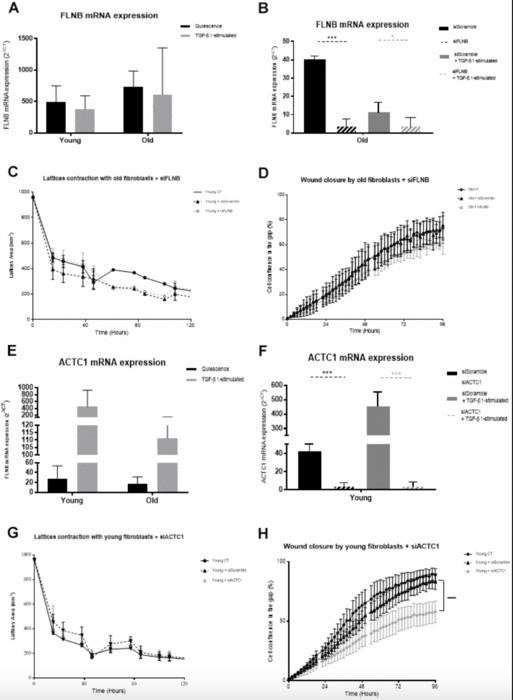
“Our present data reinforce knowledge about an age-related alteration in the synthesis of major proteins linked to the migratory and contractile functions of dermal human fibroblasts.”

Credit: © 2024 Boismal et al.
“Our present data reinforce knowledge about an age-related alteration in the synthesis of major proteins linked to the migratory and contractile functions of dermal human fibroblasts.”
BUFFALO, NY- September 3, 2024 – A new research paper was published on the cover of Aging (listed by MEDLINE/PubMed as “Aging (Albany NY)” and “Aging-US” by Web of Science) Volume 16, Issue 16 on August 27, 2024, entitled, “Proteomic and secretomic comparison of young and aged dermal fibroblasts highlights cytoskeleton as a key component during aging.”
As noted in the abstract of this paper, dermal fibroblasts orchestrate the synthesis and degradation of extracellular matrix components, which is crucial for skin homeostasis. Alterations in the expression of components such as collagens and enzymes can lead to reduced mechanical cutaneous tension and impaired skin wound healing during aging.
Researchers Françoise Boismal, Sandy Peltier, Sophie Ly ka so, Guillaume Chevreux, Loïse Blondel, Kévin Serror, Niclas Setterblab, Elina Zuelgaray, David Boccara, Maurice Mimoun, Christelle Guere, Armand Benssussan, Marie Dorr, Gallic Beauchef, Katell Vie, and Laurence Michel from Saint-Louis Hospital, Paris; Paris University, Paris Cité; Jacques-Monod Institute, Paris; and Clarins Laboratories, Pontoise, aimed to better understand the molecular alterations in fibroblasts during aging. They compared secretomic and proteomic signatures of fibroblasts from young (<35 years) and aged (>55 years) skin donors, in quiescent and TGF-stimulated conditions, using HLPC/MS.
This study revealed a significant decrease in fibroblast protein secretion with age and an enhancement of more than 60% of cytoplasmic protein accumulation.
“Our present data reinforce knowledge about an age-related alteration in the synthesis of major proteins linked to the migratory and contractile functions of dermal human fibroblasts.”
Read the full study: DOI: https://doi.org/10.18632/aging.206055
Corresponding Author: Laurence Michel – laurence.michel@inserm.fr
Click here to sign up for free Altmetric alerts about this article.
About Aging-US
The mission of the journal is to understand the mechanisms surrounding aging and age-related diseases, including cancer as the main cause of death in the modern aged population.
The journal aims to promote 1) treatment of age-related diseases by slowing down aging, 2) validation of anti-aging drugs by treating age-related diseases, and 3) prevention of cancer by inhibiting aging. (Cancer and COVID-19 are age-related diseases.)
Please visit our website at www.Aging-US.com and connect with us:
- X
- YouTube
- Spotify, and available wherever you listen to podcasts
Click here to subscribe to Aging publication updates.
For media inquiries, please contact media@impactjournals.com.
Aging (Aging-US) Journal Office
6666 E. Quaker St., Suite 1
Orchard Park, NY 14127
Phone: 1-800-922-0957, option 1
Journal
Aging-US
Method of Research
News article
Subject of Research
Not applicable
Article Title
Proteomic and secretomic comparison of young and aged dermal fibroblasts highlights cytoskeleton as a key component during aging
Article Publication Date
27-Aug-2024
COI Statement
The authors have the following interests. This work was supported by Clarins Laboratories Pontoise France. Christelle Guere, Gallic Beauchef, Marie Dorr and Katell Vie are employed by Clarins Laboratories Pontoise France. There are no patents, products in development or marketed products to declare.
Cite Scienmag News
Beatrice Stafford. (September 3, 2024). Proteomic and secretomic analysis reveals cytoskeleton’s role in aging. Scienmag. https://scienmag.com/proteomic-and-secretomic-analysis-reveals-cytoskeletons-role-in-aging/
Beatrice Stafford. "Proteomic and secretomic analysis reveals cytoskeleton’s role in aging." Scienmag, 3 September 2024, https://scienmag.com/proteomic-and-secretomic-analysis-reveals-cytoskeletons-role-in-aging/. Accessed 3 September 2026.
Beatrice Stafford. "Proteomic and secretomic analysis reveals cytoskeleton’s role in aging." Scienmag. September 3, 2024. https://scienmag.com/proteomic-and-secretomic-analysis-reveals-cytoskeletons-role-in-aging/

