


In a groundbreaking study published in the latest volume of Oncotarget, researchers have unveiled a critical role for the protein collagen triple helix repeat containing 1 (CTHRC1) in the progression of colorectal cancer (CRC). This new research provides compelling evidence suggesting that CTHRC1, a secreted protein abundant in the tumor microenvironment, significantly accelerates tumor growth by modulating immune responses and altering tumor architecture.
Colorectal cancer remains a formidable health challenge worldwide, ranking among the top causes of cancer-related mortality. Despite extensive investigation into cancer cell-intrinsic mechanisms driving CRC, the tumor microenvironment (TME) has emerged as a pivotal player influencing tumor progression, metastasis, and response to therapy. The TME comprises a complex milieu of stromal fibroblasts, immune cells, extracellular matrix components, and signaling molecules that interact dynamically with malignant cells.
The study, spearheaded by Haylee Duval at the Center for Molecular Medicine within the MaineHealth Institute for Research, utilized genetically engineered mouse models to dissect the function of CTHRC1 within the CRC microenvironment. By creating a global knockout of CTHRC1 (Cthrc1 KO), the team systematically compared tumor growth kinetics, immune cell infiltrate profiles, and histological features with those observed in wild-type (WT) mice following subcutaneous inoculation of colorectal cancer cells.
Their findings were remarkable. Tumors developing in Cthrc1 KO mice were consistently smaller and demonstrated regression over time. Most strikingly, survival analysis revealed a profound extension of median survival from 28 days in WT mice to 69 days in those lacking CTHRC1. This enhancement in longevity underscores the tumor-promoting influence of CTHRC1 and suggests potential therapeutic value in targeting this protein.
Immune profiling indicated that CTHRC1 exerts a suppressive effect on anti-tumor immunity. Quantitative analyses showed increased percentages of CD3+ T lymphocytes in both the tumors and spleens of Cthrc1-deficient mice, implying a reactivation of immune surveillance mechanisms. Conversely, levels of myeloid-derived suppressor cells and other immunoregulatory myeloid populations were attenuated. These observations illuminate CTHRC1 as a critical immune checkpoint modulator within the CRC microenvironment, facilitating immune evasion by tumor cells.
Interestingly, the researchers confirmed through rigorous assays that colorectal cancer cells per se did not express detectable CTHRC1. Instead, the protein localized predominantly to stromal fibroblasts and extracellular matrix compartments encasing the tumor mass. This localization highlights the significance of host stromal components in mediating tumor progression, emphasizing that the microenvironment—not merely cancer cells—can orchestrate oncogenic processes.
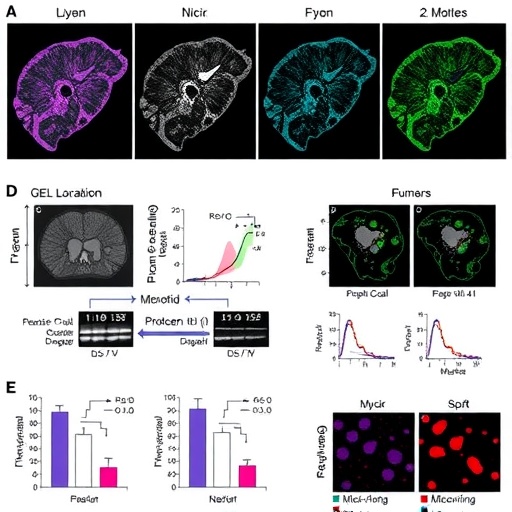
Histological analyses reinforced these conclusions. Using specialized staining techniques such as Trichrome and Hematoxylin and Eosin (H&E), the investigators revealed striking structural differences between WT and Cthrc1 KO tumors. Tumors from KO mice displayed reduced cellularity and evidence of fibrotic regression, whereas WT tumors maintained dense cellular matrices conducive to aggressive growth. Immunostaining confirmed the presence of CTHRC1 protein exclusively in WT tumor capsules, correlating with the fibrotic and immunosuppressive tumor architecture.
The study also explored vascular characteristics through CD31 immunostaining to assess angiogenesis. Both WT and KO tumors showed presence of blood vessel-like structures; however, the influence of CTHRC1 on vascular remodeling and its potential contribution to tumor nourishment and metastasis remain areas for further investigation.
Mechanistically, the data support a model whereby stromal-derived CTHRC1 modifies the tumor niche to impair effective immune cell infiltration and activation, thereby shielding tumor cells from immune attack. This immunomodulatory effect likely facilitates uninterrupted tumor cell proliferation and survival, underscoring the importance of targeting microenvironmental factors in cancer therapy.
The implications of these findings are far-reaching. By pinpointing stromal CTHRC1 as a pro-tumorigenic factor, the study opens new avenues for therapeutic intervention that extend beyond conventional cancer cell-centric approaches. Inhibiting CTHRC1 function could restore immune competence within tumors, enhance immunotherapy responses, and ultimately improve patient outcomes in colorectal cancer.
Moreover, the demonstration that host-derived CTHRC1—not tumor cell-derived—drives disease progression challenges existing paradigms and emphasizes the necessity for holistic views of cancer biology incorporating both tumor and stromal elements. Future studies focused on the molecular pathways downstream of CTHRC1 signaling may reveal druggable targets within the tumor microenvironment.
In conclusion, the research provides compelling evidence that CTHRC1 is a pivotal modulator of colorectal cancer progression by fostering an immunosuppressive and structurally supportive microenvironment. This protein’s dual role in immune evasion and tumor architecture underscores its potential as a novel biomarker and therapeutic target. As the global burden of colorectal cancer continues to rise, insights into TME regulation such as those presented in this study are vital for developing next-generation treatments.
The authors acknowledge that further clinical validation and development of CTHRC1-targeting agents are necessary steps toward translating these preclinical findings into effective patient-centered therapies. Nevertheless, the study significantly advances understanding of CRC biology and highlights the promise of stromal-targeted interventions in combatting this deadly disease.
News Publication Date: 20-May-2026
Web References:
https://doi.org/10.18632/oncotarget.28878
Cite Scienmag News
Nathaniel Bowman. (June 2, 2026). Protein in Tumor Microenvironment Drives Colorectal Cancer Progression and Immune Evasion. Scienmag. https://scienmag.com/protein-in-tumor-microenvironment-drives-colorectal-cancer-progression-and-immune-evasion/
Nathaniel Bowman. "Protein in Tumor Microenvironment Drives Colorectal Cancer Progression and Immune Evasion." Scienmag, 2 June 2026, https://scienmag.com/protein-in-tumor-microenvironment-drives-colorectal-cancer-progression-and-immune-evasion/. Accessed 4 September 2026.
Nathaniel Bowman. "Protein in Tumor Microenvironment Drives Colorectal Cancer Progression and Immune Evasion." Scienmag. June 2, 2026. https://scienmag.com/protein-in-tumor-microenvironment-drives-colorectal-cancer-progression-and-immune-evasion/


