


Breast cancer remains the most frequently diagnosed malignancy and a leading cause of cancer death among women worldwide, with more than two million new cases each year. Although surgery, radiotherapy, chemotherapy, endocrine therapy, and targeted agents have improved survival, many patients with advanced, metastatic, or resistant disease continue to relapse. A new review published in Molecular Biology Reports by Hannah Lalengzuali Fanai, Basuvan Babu, Kalirajan Rajagopal, and Gowramma Byran of JSS College of Pharmacy examines how proteolysis-targeting chimeras, or PROTACs, are reshaping the therapeutic landscape by shifting drug discovery from occupancy-based inhibition toward event-based targeted protein degradation, offering a catalytic strategy against formerly undruggable and treatment-resistant targets.
Conventional therapeutics, whether small-molecule inhibitors or monoclonal antibodies, bind to oncogenic proteins and block their catalytic activity or extracellular portions. Yet many disease-driving proteins in breast cancer lack enzymatic functions, acting instead through scaffolding or transcription-regulator roles with extensive flat or disordered binding interfaces that conventional inhibitors cannot engage. Targeted protein degradation represents a paradigm change: rather than temporarily silencing a protein’s activity, PROTACs remove the protein entirely from the cellular setting by exploiting the ubiquitin-proteasome system, the cell’s central quality-control machinery. This approach achieves both functional silencing and complete protein elimination over time, potentially eliminating all catalytic and non-catalytic effects and circumventing adaptive resistance through pathway recovery.
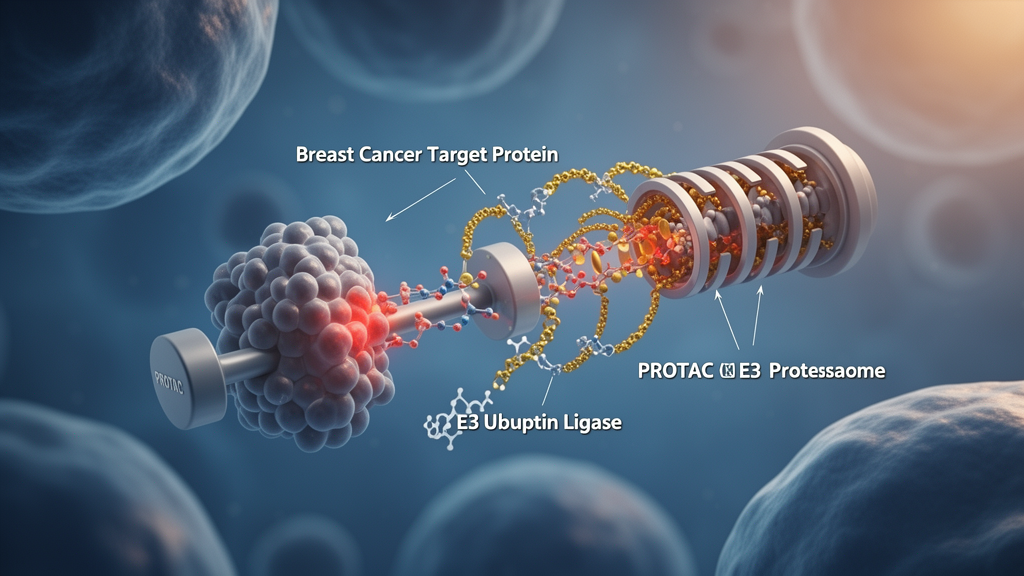
PROTACs are bifunctional molecules comprising a warhead that binds the protein of interest, a ligand that recruits an E3 ubiquitin ligase, and a linker joining the two. Upon binding, the PROTAC acts as a molecular bridge, facilitating formation of a transient ternary complex of PROTAC, E3 ligase, and target protein. Productive ternary-complex formation positions the target for ubiquitin transfer through the E1-E2-E3 enzymatic cascade, resulting in polyubiquitination and recognition by the 26S proteasome. Because the molecule is event-driven, it can engage in sequential rounds of degradation, producing long-lasting effects from sub-stoichiometric exposures. The composition and stability of the ternary complex are key determinants of PROTAC activity, depending on linker length, flexibility, and spatial orientation of the binding domains. However, one of the biggest pharmacological issues is the hook effect: at high concentrations, PROTACs form non-productive binary complexes with either the target or the E3 ligase, reducing degradation efficiency and complicating in vivo dosing.
The field has evolved through distinct generations. Early peptide-based constructs proved the concept of proximity-induced ubiquitination but suffered from poor cell penetration, rapid protease degradation, and low bioavailability. The transition to small-molecule PROTACs created more drug-like molecules with better chemical stability, oral bioavailability, and cellular permeation, enabling degradation of kinases, nuclear receptors, and transcription factors. Nevertheless, even these second-generation molecules had poor pharmacokinetics due to high molecular weight, high lipophilicity, and low metabolic stability, alongside limited tissue selectivity. Third-generation platforms now address these shortcomings: PHOTACs allow light-activated degradation control in space and time; CLIPTACs assemble in cells via click chemistry from membrane-permeable precursors; AUTACs redirect proteins to the autophagy-lysosome pathway; and RIBOTACs mediate selective degradation of RNA targets, critically expanding the scope of targets and cellular compartments.
Breast cancer is a heterogeneous disease with molecular subtypes characterised by expression of estrogen receptor, progesterone receptor, and HER2. In hormone receptor-positive breast cancer, which encompasses roughly seventy percent of cases, standard therapies such as tamoxifen and fulvestrant fail long-term due to ESR1 mutations, receptor amplification, or ligand-independent activation. PROTACs like ARV-471 mitigate these limitations by facilitating prolonged degradation of ERα, including mutant forms resistant to conventional treatments. In triple-negative breast cancer, which lacks all three receptors and has limited treatment options, degradation of BRD4 and CDK4/6 provides a different approach: BRD4 degradation decreases MYC-dependent transcription, while CDK4/6 degradation causes irreversible cell cycle arrest and increased tumour cell apoptosis in preclinical models. In HER2-positive malignancies, resistance often arises from HER2 mutations or truncated isoforms such as p95HER2; PROTACs targeting HER2 degrade both full-length and mutant receptor forms, shutting down kinase-dependent and scaffold activities. Novel degraders against focal adhesion kinase and the immune checkpoint protein PD-L1 combine tumour growth inhibition with immune escape suppression simultaneously.
ARV-471, also known as vepdegestrant, represents a key clinical innovation for hormone receptor-positive breast cancer. Endocrine therapies, including selective estrogen receptor modulators and degraders such as fulvestrant, are regularly hindered by ESR1 transformation, inefficient receptor downregulation, and pharmacokinetic constraints; fulvestrant’s low oral bioavailability and intramuscular injection requirement make long-term management difficult. ARV-471 was rationally designed as a PROTAC driving proteasome-dependent ER destruction via the cereblon E3 ubiquitin ligase. Its catalytic, event-driven pharmacology efficiently depletes ERα, including mutant versions generally resistant to standard therapy, and potently inhibits estrogen-mediated gene expression, tumour growth, and cell proliferation in preclinical pharmacodynamic studies. In xenograft models resistant to fulvestrant, ARV-471 demonstrated potent antitumor activity and therapeutic resilience. Phase I/II clinical trials revealed a favourable safety profile and therapeutic benefit in patients with metastatic hormone receptor-positive breast tumours who had received extensive pretreatment, including prior endocrine therapy and CDK4/6 inhibitors.
PROTAC molecular design involves a complex relationship among the warhead, the recruited E3 ligase, and the linker. Potency must be optimised alongside selectivity, pharmacokinetics, and cell permeability. Unlike conventional inhibitors, PROTAC warheads need only transient associations with the target to initiate ubiquitination, but poorly designed warheads risk off-target effects or ineffective ternary-complex formation. Computational tools increasingly estimate warhead binding affinity and orientation within the ternary complex, enabling selective targeting of protein isoforms or mutant variants. The linker determines the overall geometry and stability of the ternary complex; its length, flexibility, and composition affect degradation efficiency and metabolic stability. Innovations including PEGylation, alkyl chain optimisation, and cleavable groups aim to balance stability with functional efficiency. Perhaps the most overlooked aspect concerns the E3 ligase component: of over 600 E3 ligases in the human proteome, fewer than ten are routinely used, most commonly cereblon and VHL. This narrow selection limits cellular and tissue targeting, drives resistance or redundancy, and constrains the therapeutic repertoire. Computational virtual screening of E3 ligase pockets against small-molecule collections may expand the ligase toolbox, while antibody-based PROTACs can degrade extracellular or membrane-bound proteins using antigen-specific antibodies conjugated with E3 recruiters.
Despite revolutionary promise, PROTACs face significant limitations in bioavailability, tissue selectivity, toxicity, and off-target effects. Their complexity and large molecular weight diminish pharmacokinetic properties, producing low oral bioavailability and poor membrane permeability. Structural flexibility of the ternary complex contributes to variable degradation profiles that can drive unpredictable toxicity. Off-target degradation is among the most urgent questions: small differences in protein expression localisation may cause unwanted protein degradation, particularly when structurally related off-target proteins are highly expressed in non-pathological tissues, resulting in cytotoxicity or immune activation. Rational optimisation of ternary-complex energetics based on structure-guided modelling may reduce off-target interactions. Tissue-specific delivery remains a major obstacle, as most PROTACs show crude biodistribution. Prodrug-based PROTACs are accelerating in response: these constructs are inactive in the systemic circulation but selectively activated in disease-specific microenvironments, such as in the presence of tumour-associated proteases or acidic pH, localising the degradation effect. Encapsulation in lipid or polymeric nanoparticles is also proving effective, extending circulation half-life and increasing cellular uptake while enabling ligand-mediated delivery to specific cell types.
Translational issues surround in vivo pharmacology, metabolic stability, and efficacy prediction. Enzymatic breakdown, hepatic clearance, and first-pass effects considerably influence PROTAC pharmacokinetics; molecules with high degradation efficacy in vitro often fail to achieve sufficient plasma exposure or tissue distribution in vivo. The physicochemical characteristics of PROTACs, usually high molecular weight combined with lipophilicity, converge in poor water solubility and unpredictable tissue distribution, making formulation challenging and fuelling unpredictable pharmacodynamics. Renal and hepatic clearances do not necessarily cross species, and conventional animal models often fail to recapitulate human-specific enzyme activity or transporter interactions, providing invalid efficacy and toxicity readouts. Standard cell line-based assays fail to mimic the tumour microenvironment and cellular heterogeneity found in patients, breaking the chain of response prediction. In response, organoid systems and patient-derived xenografts offer more physiologically relevant platforms that preserve native tumour structure, gene expression, and microenvironmental interactions, enabling iterative optimisation of PROTACs against clinically relevant endpoints before proceeding to humans.
An emerging frontier concerns PROTAC research targeting pro-metastatic kinases and epithelial-to-mesenchymal transition markers to interfere with invasive and immune-evasive properties. Crosstalk between protein degradation and immune modulation remains understudied, particularly dual-activity mechanisms that degrade oncogenic signalling while activating immune responses. New design approaches target dual-action PROTACs capable of degrading oncogenic drivers such as AXL or SRC while simultaneously attacking PD-L1 or immunosuppressive controls in the tumour microenvironment, potentially rewiring it to an immune-permissive state. Such degraders could be combined with immune checkpoint blockers or cytokine-directed therapies to counter resistance, increase therapy duration, and improve clinical outcomes in metastatic cancer. Overall, PROTACs constitute a revolutionary treatment platform in breast cancer, providing an event-based pharmacological system that overcomes the intrinsic limitations of traditional inhibitors. Their long-term innovation and considered clinical development could transform personalised oncology and offer durable solutions against resistance across the full range of breast cancer subtypes.
Subject of Research: Harnessing the ubiquitin-proteasome system: advances and challenges of PROTACs in breast cancer
Article Title: Harnessing the ubiquitin-proteasome system: advances and challenges of PROTACs in breast cancer
Article References: Fanai, H. L., Babu, B., Rajagopal, K., & Byran, G. (2026). Harnessing the ubiquitin-proteasome system: advances and challenges of PROTACs in breast cancer. Molecular Biology Reports, 53(1), Article 1733. https://doi.org/10.1007/s11033-026-12830-7
Image Credits: AI Generated
DOI: 10.1007/s11033-026-12830-7
Keywords: Harnessing, ubiquitin-proteasome, system, advances, challenges, PROTACs, breast, cancer, scientific research
Cite Scienmag News
Nathaniel Bowman. (October 18, 2026). PROTACs Recruit the Ubiquitin-Proteasome System to Degrade Breast Cancer Proteins. Scienmag. https://scienmag.com/protacs-recruit-the-ubiquitin-proteasome-system-to-degrade-breast-cancer-proteins/
Nathaniel Bowman. "PROTACs Recruit the Ubiquitin-Proteasome System to Degrade Breast Cancer Proteins." Scienmag, 18 October 2026, https://scienmag.com/protacs-recruit-the-ubiquitin-proteasome-system-to-degrade-breast-cancer-proteins/. Accessed 18 October 2026.
Nathaniel Bowman. "PROTACs Recruit the Ubiquitin-Proteasome System to Degrade Breast Cancer Proteins." Scienmag. October 18, 2026. https://scienmag.com/protacs-recruit-the-ubiquitin-proteasome-system-to-degrade-breast-cancer-proteins/


