


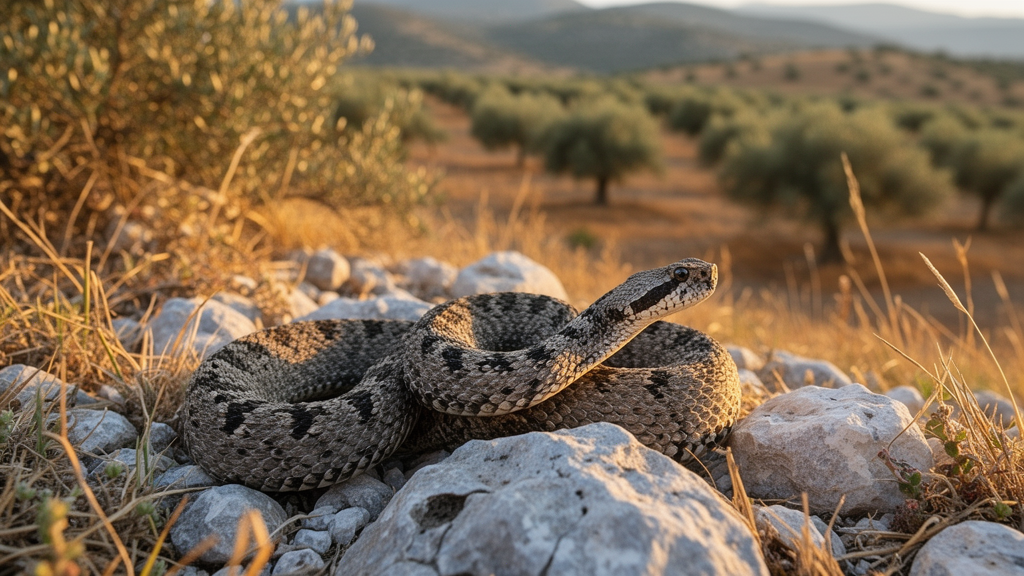
A venomous snake has quietly rewritten its own map. The Ottoman viper (Montivipera xanthina), long considered a species confined to the far northeastern corner of mainland Greece, has now been confirmed in the Drama Prefecture — roughly 130 kilometres west of the previously known westernmost limit of its range. The discovery, published in the journal Herpetozoa, transforms what looked like an isolated anomaly into evidence of a hidden, continuous population threading its way through the foothills of northern Greece, and it raises urgent questions about biodiversity monitoring, conservation planning, and even hospital preparedness in a region few scientists had bothered to survey.
The Ottoman viper is the only member of its genus to reach European soil. The genus Montivipera comprises large vipers endemic to Western Asia, barely extending into Europe, with a distribution stretching from Greece’s northeastern coasts and Aegean islands through Turkey, Lebanon, and Syria, and into central Iran. Within the genus, two species complexes are recognised: the Xanthina complex, distributed across Anatolia, eastern Greece, and fragmented populations in Lebanon and Syria, and the Raddei complex, found in Iran, Armenia, and eastern Turkey. Genetic analyses suggest the Xanthina complex split into two major clades — the bornmuelleri and xanthina clades — sometime between the Late Miocene and Early Pliocene, each containing deeply divergent evolutionary lineages. While the lineages within the bornmuelleri clade are each recognised as distinct species, all four lineages of the xanthina clade are currently lumped under a single name: Montivipera xanthina.
Until now, the species’ known distribution in mainland Greece included only Thrace, the northeastern extremity of the country. Its westernmost confirmed limit was the Kryoneri–Almyros area in the Rhodopi Prefecture. The viper favours rocky maquis habitats and appears to avoid the Evros forests and the cultivated lowlands and wetlands of Thrace stretching from the Nestos to the Lissos River. Those wetland areas, part of the Natura 2000 network, have been extensively surveyed by researchers and naturalists. In contrast, the foothills and mountainous regions along the northern edge of the Thracian plain remain largely underexplored — a gap that now appears to have concealed far more than anyone expected.
The story began on 8 June 2024, when a citizen contacted the researchers requesting identification of a snake filmed near the village of Aggitis in the Drama Prefecture. The footage clearly depicted a juvenile Ottoman viper. Initially, the team considered the possibility that this observation resulted from an accidental introduction, potentially due to the high volume of tourist traffic to the nearby Aggitis Cave, by vehicles arriving from Thrace or even Turkey. Such transport is not far-fetched: snakes have been documented passively travelling by vehicles over distances exceeding 300 kilometres, including one case of a male Ottoman viper unintentionally carried on a recreational vehicle from Alexandroupoli to Thermi, Thessaloniki, in 2021.
To verify the record and assess whether an established population was present, the researchers conducted two field surveys in the area, on 27 October 2024 and 15 March 2025. During these surveys, they documented three additional individuals: two adults and one juvenile. The first adult was observed approximately 100 metres southwest of the initial sighting location, while the other two individuals were recorded about 420 metres northwest of the same point. The area encompassing all confirmed observations, calculated using a Minimum Convex Polygon in QGIS, covers 36,318 square metres — a tiny footprint, but one that proves the species is not merely passing through.
One of the adult individuals was captured for documentation. After photographic recording and non-invasive DNA sampling via buccal swab, the specimen was released at the site of capture. The voucher specimen has been formally catalogued, preserving the physical evidence of this remarkable range extension. To protect the population from potential poaching or other threats, the precise coordinates of all observations have been withheld but are available upon legitimate scientific request — a precaution that reflects growing concern about illegal wildlife trade targeting rare reptiles.
Although the Aggitis population initially seemed to result from an introduction event, the acquisition and evaluation of additional Ottoman viper records from several intermediate localities suggest a very different explanation. These unpublished records, including photographic evidence and a second voucher specimen, indicate that the species may instead maintain a previously undocumented, continuous distribution extending westward from the Rhodopi Prefecture to the newly discovered locality — and possibly beyond. This hypothesis is further supported by the existence of a narrow ecological corridor comprising rocky maquis habitats and low-elevation foothills that connects these records and runs along the northern margin of Thrace’s lowlands, interrupted only by narrow rivers such as the Kompsatos and Nestos around the Galani and Paradeisos area, and extends up to the border between the Drama and Serres prefectures. Such habitat continuity can provide suitable resources for healthy populations and facilitate the species’ active dispersal.
The implications of this discovery ripple outward in several directions. First, it significantly extends the known western range limit of the Ottoman viper by approximately 130 kilometres, suggesting a broader distribution than previously recognised and demanding an update to the species’ range map. Second, it carries weight for biodiversity monitoring and conservation planning, as the viper’s presence crosses into new prefectures and municipalities that had no reason to anticipate it. Third — and perhaps most strikingly — it has direct public health consequences. As a highly venomous snake, its presence may necessitate the revision of envenomation treatment protocols at local hospitals, which must now prepare for potential bites from a species previously absent from their catchment areas.
The discovery also opens scientific questions about ecological interactions in the region. The researchers highlight the need to assess potential competition with other co-occurring snake species, in particular the more common Nose-horned viper (Vipera ammodytes), which occupies similar habitats across much of the Balkans. How these two vipers partition resources — or whether the Ottoman viper’s westward expansion will bring it into increasing conflict with its relative — remains unknown. Ongoing research aims to further clarify the species’ actual mainland range and to better understand its ecology and genetics, including whether the Drama population represents a genetically distinct lineage worthy of taxonomic recognition.
Beyond the viper itself, this study underscores the extent to which the region of Eastern Macedonia and Thrace remains underexplored. Along with several other significant herpetofaunal records published in the past decade, it highlights the urgent need for more comprehensive surveys to better understand the region’s species composition, distribution, and population densities. A venomous snake slipping 130 kilometres westward unnoticed is a vivid reminder that even in Europe — a continent with centuries of natural history documentation — entire populations can persist just beyond the edge of the map, waiting for a curious citizen with a camera to bring them into the light.
Subject of Research: A 130 km westward range extension of Montivipera xanthina (Serpentes, Viperidae) in mainland Greece
Article Title: A 130 km westward range extension of Montivipera xanthina ( Serpentes , Viperidae ) in mainland Greece
Article References: Strachinis, I., Iakovidis, D., Gogolos, N., Papagoras, A., & Daftsios, T. (2025). A 130 km westward range extension of Montivipera xanthina (Serpentes, Viperidae) in mainland Greece. Herpetozoa, 38, 187-190. https://doi.org/10.3897/herpetozoa.38.e161288
Image Credits: AI Generated
DOI: 10.3897/herpetozoa.38.e161288
Keywords: Ottoman viper, Montivipera xanthina, range extension, Greece, herpetology, venomous snakes, ecological corridor, biodiversity survey, conservation, Drama Prefecture, Thrace, public health
Cite Scienmag News
Margaret Porter. (October 18, 2026). Venomous Ottoman Viper Found 130 km Further West in Greece Than Ever Before. Scienmag. https://scienmag.com/venomous-ottoman-viper-found-130-km-further-west-in-greece-than-ever-before/
Margaret Porter. "Venomous Ottoman Viper Found 130 km Further West in Greece Than Ever Before." Scienmag, 18 October 2026, https://scienmag.com/venomous-ottoman-viper-found-130-km-further-west-in-greece-than-ever-before/. Accessed 18 October 2026.
Margaret Porter. "Venomous Ottoman Viper Found 130 km Further West in Greece Than Ever Before." Scienmag. October 18, 2026. https://scienmag.com/venomous-ottoman-viper-found-130-km-further-west-in-greece-than-ever-before/


