


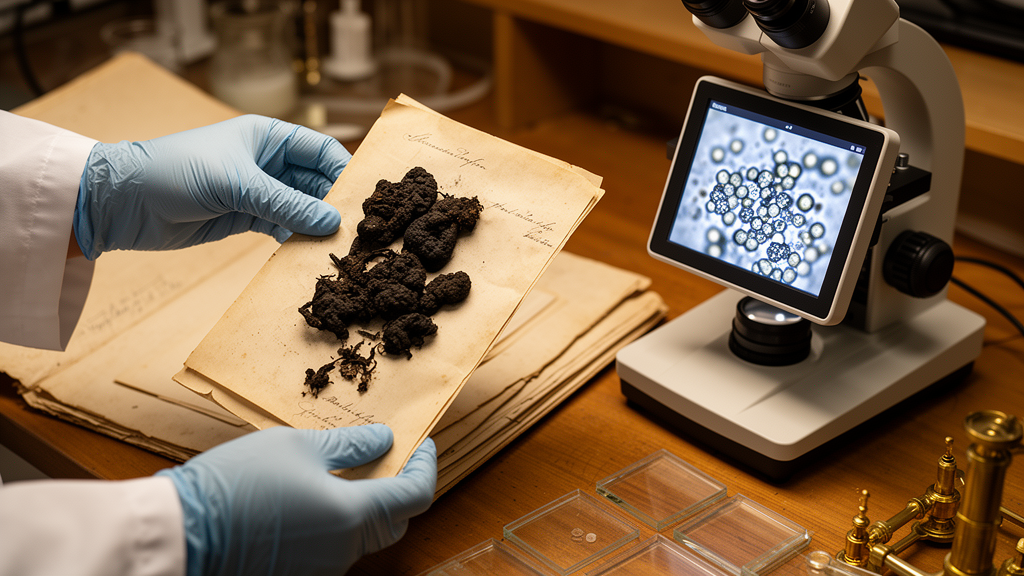
Deep inside the A. A. Jaczewski Mycological Herbarium at the All-Russian Institute of Plant Protection in Pushkin, Russia, a small box of herbarium sheets holds some of the most scientifically valuable slime mold specimens in the country. These are type specimens, the physical reference points against which the names of species are anchored, and many of them have not been seriously examined since they were collected in the late nineteenth and early twentieth centuries. A new study published in Natural History Collections and Museomics reports the first modern re-examination of six such taxa using light microscopy and scanning electron microscopy, and the results reshape how several of these names should be understood.
The herbarium itself, known by the abbreviation LEP, is one of the oldest and largest mycological collections in Russia. Its first specimens were gathered in 1892 by Artur Arturovich Jaczewski, a phytopathologist whose true passion included the strange, creeping organisms known as myxomycetes, or slime molds. Jaczewski corresponded widely with collectors across the Russian Empire and abroad, and in 1907 he produced a monograph on Russian myxomycetes that ran to more than 400 pages and remained the only Russian-language identification guide for 86 years. The herbarium grew rapidly between 1907 and 1941, absorbing personal collections, purchased series, and dozens of exsiccata sets, including Fungi Europaei, Mycotheca Universalis, and Fungi exsiccati praesertim scandinavici.
Remarkably, the collection survived the Siege of Leningrad completely intact, thanks to the dedicated efforts of Professor S. M. Tupenevich, who safeguarded it within the premises of the All-Union Institute of Plant Industry. After the war, the myxomycete section stagnated for lack of specialists, which paradoxically preserved it as an almost entirely historical collection of great value. Today LEP holds more than 150,000 specimens, of which 1,916 are myxomycetes, all indexed in an electronic catalog and stored in labeled folders, matchbooks, envelopes, cardboard boxes, and wooden cabinets.
Between 2018 and 2024, researchers conducted a critical revision of the entire myxomycete collection, and the second installment of that work, now published, focuses on the separately stored type collection. The team examined three true syntypes, two specimens in quotation-marked syntype status whose names turned out to be invalidly published, and one quotation-marked holotype of a name that was never validly described. For the first time, modern imaging tools were applied to all of these specimens.
The methods combined classical and contemporary techniques. Sporocarps were photographed with an Olympus SZX16 dissecting microscope and stacked digital images processed with Helicon Focus, while measurements of spores, capillitium, and fruiting bodies were made in ImageJ. Light microscopy used an Olympus BX 53 with specimens mounted in 4 percent potassium hydroxide, and spore surfaces and capillitial threads were examined with a Thermo Fisher Quattro S scanning electron microscope at Moscow State University, with samples sputter-coated in gold-palladium. Because myxomycete taxonomy still rests primarily on sporocarp morphology, including capillitium structure, spore ornamentation, and the distribution of lime deposits, such detailed imaging of type material is among the most important directions in modern slime mold systematics.
Among the confirmed identifications, the syntype of Didymium subcastaneum, collected by Romell in Sweden in 1885 and preserved in an envelope cleverly protected with small pieces of wood, proved to match Polyschismium trevelyanii exactly. Its triple-layered peridium, densely reticulate capillitium, and warted spores measuring a mean of 12.54 micrometers were documented in striking detail, including scanning electron micrographs showing baculate warts that sometimes coalesce. Similarly, the syntype of Stegasma australe, gathered on decaying Agave americana leaves in a Naples botanical garden in 1874, was confirmed as Perichaena depressa, supporting conclusions first drawn by Arthur Lister in 1894 and echoed by Jaczewski himself in his 1907 monograph.
The syntype of Trichia bavarica, distributed by de Thümen in Mycotheca Universalis from Bayreuth in 1876, was shown to be a heterotypic synonym of Oligonema schweinitzii, confirming a suspicion raised as early as 1882 by Bayley Balfour. Yet the study also revealed that published descriptions of O. schweinitzii differ considerably from the type material in colony density, elater ornamentation, and spore characters, suggesting the species may be a complex deserving its own revision. The authors note that spore ornamentation under scanning electron microscopy, including cristate patching and rarely perforated bands, provides characters that earlier generations of taxonomists simply could not see.
Three of the six names examined proved to be invalidly published under the International Code of Nomenclature. Didymium neapolitanum, distributed as exsiccata number 2675 in 1881, carries an authorial note questioning whether the material was actually D. crustaceum, which means the name was never accepted by its own author and is invalid under Article 36.1a. The morphology nevertheless confirms Arthur Lister’s view that it represents a sessile form of Craterium crateriachea, although the team cautions that scanning electron micrographs of that species’ spores are lacking in the literature and future comparisons should focus on ornamentation details. The quotation-marked holotype of Dianema czerniakowskii, collected by botanist Ekaterina Georgievna Reineke-Chernyakovskaya during a 1924 expedition to Turkmenistan near the snowline of the Kopet Dag range, was never validly described and is here identified as Didymium dubium, potentially the only record of nivicolous, snowline-dwelling myxomycetes in Soviet Central Asia.
Perhaps the most intriguing specimen is the quotation-marked syntype of Licea circumscissa f. pannosa, described by the French botanist Casimir Roumeguère in 1879 from rotting old canvas in Toulouse, a substrate reflected in the Latin epithet pannus, meaning piece of cloth. The name was published without any description or diagnosis and is invalid under Article 38.1, and it appears to have been mentioned for the first time since its description, being absent from the Eumycetozoa database, MycoBank, Index Fungorum, and the major myxomycete monographs. The specimen itself is poorly preserved, containing only peridium fragments and a few collapsed spores, but scanning electron microscopy of the inner peridium revealed distinctive crater-like thickenings that may eventually help clarify whether the epithet pannosa should be resurrected for a new species of Perichaena.
The broader message of the study is a warning about a quiet crisis in slime mold taxonomy. As molecular phylogenetics has surged, taxa lacking available DNA marker sequences, especially those tucked away in synonymy, are increasingly overlooked by systematists. Combined with a modern tendency to split species, this neglect inevitably leads to superfluous naming of organisms for which valid, rarely used names already exist. The authors argue that meticulous study of type specimens, paired with color macrophotography capturing the often diagnostic shape and color of sporangia, should be recognized as good practice, because a well-preserved envelope of dried sporocarps from 1879 can still overturn assumptions a century and a half later.
Subject of Research: Taxonomic revision of historical myxomycete type specimens using light and scanning electron microscopy
Article Title: Critical revision of the myxomycete ( Myxomycota , Myxomycetes ) collection at the A. A. Jaczewski mycological herbarium ( LEP ): II. Type collection
Article References: Gmoshinskiy, V. I., & Bortnikov, F. M. (2025). Critical revision of the myxomycete (Myxomycota, Myxomycetes) collection at the A. A. Jaczewski mycological herbarium (LEP): II. Type collection. Natural History Collections and Museomics, 2, 1-18. https://doi.org/10.3897/nhcm.2.146512
Image Credits: AI Generated
Keywords: myxomycetes, type specimens, herbarium, scanning electron microscopy, taxonomy, nomenclature, slime molds, LEP herbarium, Jaczewski, Perichaena, Didymium, biodiversity collections
Cite Scienmag News
Roger Howard. (October 18, 2026). Slime Mold Treasures Reexamined: Century-Old Type Specimens Get a Modern Microscopy Makeover. Scienmag. https://scienmag.com/slime-mold-treasures-reexamined-century-old-type-specimens-get-a-modern-microscopy-makeover/
Roger Howard. "Slime Mold Treasures Reexamined: Century-Old Type Specimens Get a Modern Microscopy Makeover." Scienmag, 18 October 2026, https://scienmag.com/slime-mold-treasures-reexamined-century-old-type-specimens-get-a-modern-microscopy-makeover/. Accessed 18 October 2026.
Roger Howard. "Slime Mold Treasures Reexamined: Century-Old Type Specimens Get a Modern Microscopy Makeover." Scienmag. October 18, 2026. https://scienmag.com/slime-mold-treasures-reexamined-century-old-type-specimens-get-a-modern-microscopy-makeover/


