


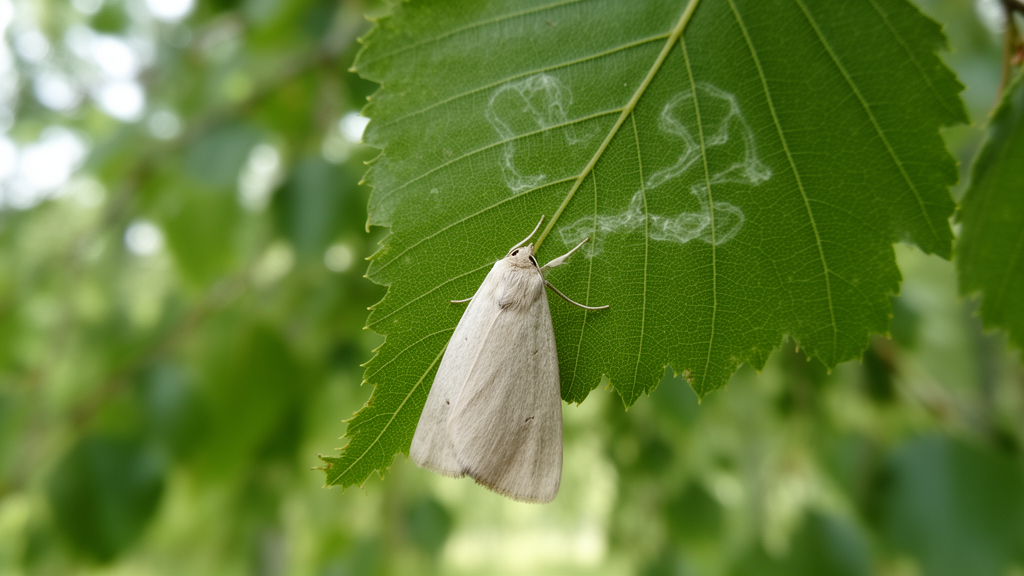
A minuscule moth that spends its larval life tunnelling inside birch leaves has been quietly colonising Western Europe, and almost nobody noticed until now. Stigmella naturnella, a member of the tiny moth family Nepticulidae, has been recorded for the first time in France, Croatia, Ukraine, Belgium and the Netherlands, according to a review published in the journal Nota Lepidopterologica. Since 2018 the species has expanded into the two latter countries with remarkable speed, and much of the evidence came not from museum expeditions but from photographs posted online by amateur naturalists.
The species was described in 1936 by the Austrian lepidopterist Joseph Klimesch from specimens collected in the warm inner-Alpine valleys of South Tyrol in northern Italy, near the village of Naturno, from which its name derives. For decades afterwards it was regarded as a rare, heat-loving specialist of the southern Alps, known from scattered records and considered nearly impossible to distinguish from related species by its leafmines alone. That reputation for rarity, the new study argues, was largely an artefact of identification problems rather than a reflection of true abundance.
The adult moth is a true pygmy even by nepticulid standards: males have forewings of only 1.7 to 2.2 millimetres, giving a wingspan of roughly four to five millimetres. The forewing is shining dark grey to almost black at the base, crossed by a narrow silvery-white fascia slightly beyond the middle, with a contrasting darker apical area and a distinct fringe line separating a white terminal fringe. A relatively short antenna, in females reaching less than halfway between the wing base and the fascia, helps separate it from superficially similar birch-feeding relatives. The male genitalia, with a shallow uncus, closely connected gnathos arms and a phallus bearing eight to ten strong cornuti, are highly characteristic.
The life history holds the key to the moth’s success. Females lay eggs on the upper or lower surface of birch leaves, most often away from the midrib and major veins, and in the studied samples about two-thirds of eggs were found on the underside. The larva then excavates a linear gallery mine, typically 22 to 53 millimetres long, in which the early section frequently appears green from above because the young larva feeds only in the spongy parenchyma layer, leaving the upper tissue intact. The pale larva feeds with its venter upwards and shows a single conspicuous brown circular suboesophageal ganglion, a decisive diagnostic character. Crucially, the species is one of the very few nepticulids in Europe that hibernate as adults, sheltering under bark, often of plane trees in cities, from November to March.
That adult hibernation strategy may explain the northward expansion in a warming climate. Because the moths emerge in autumn and overwinter as free adults rather than as larvae or pupae in cocoons, they can take advantage of mild winters and of an extended growing season that allows at least two generations per year, possibly more. The only other European nepticulid known to hibernate as an adult, Stigmella aceris, has likewise expanded its range considerably, although in that case the widespread planting of its maple hostplants also played a role. Birch, by contrast, is a common native tree that colonises heathlands and sandy soils spontaneously, so hostplant availability cannot be a limiting factor for S. naturnella.
The study’s author, Erik van Nieukerken of the Naturalis Biodiversity Center in Leiden, combined fresh fieldwork, re-examination of historical leafmine collections, DNA barcoding and citizen-science data to reconstruct the species’ distribution history. DNA barcodes of the mitochondrial COI gene from 35 specimens spanning the range from the Netherlands to Japan all fall within a single barcode cluster, with a maximum variation of just 1.63 percent and the greatest diversity in the Russian Far East. This pattern suggests the species spread westwards from Siberia relatively recently after the last glaciations, and that the current west European expansion involves populations showing little or no barcode variation.
The historical detective work also corrected the record. Old leafmine reports from Germany and Bohemia, identified in the 1930s by the amateur specialist Hugo Skala, had long been doubted. Re-examination of the preserved mines showed that the specimens collected by Albert Wörz near Stuttgart in 1935 were indeed correctly identified, confirming the species’ presence in Baden-Württemberg nearly ninety years ago, while most of Buhr’s records from Berlin and elsewhere proved to belong to other species such as S. glutinosae and S. luteella. A lectotype was designated for Nepticula naturnella, and the Far Eastern name Astigmella dissona Puplesis, 1984 remains a synonym, confirming that the species ranges continuously from the North Sea to Japan.
Identifying the mines remains the central challenge, and the paper provides a revised diagnostic key to the linear leafmines of European Stigmella species on birch to help. Mines of S. naturnella are most easily recognised when the egg sits on the leaf upperside or when the early mine appears green; vacated mines without these features can be confused with those of S. confusella, although the latter produces considerably longer and wider mines. Adding to the confusion, two species normally feeding on alder, S. glutinosae and S. alnetella, were confirmed by rearing and DNA barcoding to occur occasionally on birch and are now included in the key. The author cautions that single vacated mines, especially in areas where a species has not been recorded before, should never be the sole basis for identification, and that studying a series of mines from a population is always preferable.
The speed of the recent spread is striking. Online observations suggest the moth first appeared in Belgium and the Netherlands around 2017, and by 2020 it was already established throughout the southern half of the Netherlands, often ranking among the commonest leafminers on birch. Between 2020 and 2022 its known Dutch distribution shifted roughly 50 kilometres northwards, reaching the province of Overijssel and the coastal dunes of Zeeland. The author predicts that Denmark, Sweden, the Baltic states and even the United Kingdom may be next, and calls for birch stands in northern Germany, Poland and the Low Countries to be monitored for the tell-tale mines.
The ecological consequences remain uncertain. Leafmine densities appear generally low, but earlier studies of birch-feeding Stigmella communities found fine-grained ecological segregation among species, possibly driven by limited availability of suitable leaves, so the arrival of an abundant new competitor could disturb existing populations. The author also notes that the moisture-loving northern species S. lapponica and S. confusella were seldom encountered during recent Dutch fieldwork, a decline more plausibly attributed to warming and drying conditions than to competition. Beyond the biology, the study is a testament to the power of open biodiversity platforms: photographs uploaded by naturalists to waarneming.nl, waarnemingen.be and iNaturalist, once validated, provided the crucial early records that formal science had missed, and the author urges collection managers to digitise historical leafmine herbariums so that future range shifts can be traced with the same rigour.
Subject of Research: Range expansion and identification of the birch leafmining moth Stigmella naturnella in Europe
Article Title: Stigmella naturnella (Klimesch, 1936) ( Lepidoptera , Nepticulidae ) a fast-spreading European leafminer of Betula , with a revised key to linear leafmines on Betula
Article References: van Nieukerken, E. J. (2023). Stigmella naturnella (Klimesch, 1936) (Lepidoptera, Nepticulidae) a fast-spreading European leafminer of Betula, with a revised key to linear leafmines on Betula. Nota Lepidopterologica, 46, 37-82. https://doi.org/10.3897/nl.46.99360
Image Credits: AI Generated
DOI: 10.3897/nl.46.99360
Keywords: Stigmella naturnella, Nepticulidae, leafminer, Betula, range expansion, DNA barcoding, citizen science, hibernation, Notа Lepidopterologica, lectotype, birch, insect spread
Cite Scienmag News
Gavin Prescott. (October 18, 2026). Tiny moth’s stealthy march: birch leafminer spreads across Europe unnoticed. Scienmag. https://scienmag.com/tiny-moths-stealthy-march-birch-leafminer-spreads-across-europe-unnoticed/
Gavin Prescott. "Tiny moth’s stealthy march: birch leafminer spreads across Europe unnoticed." Scienmag, 18 October 2026, https://scienmag.com/tiny-moths-stealthy-march-birch-leafminer-spreads-across-europe-unnoticed/. Accessed 18 October 2026.
Gavin Prescott. "Tiny moth’s stealthy march: birch leafminer spreads across Europe unnoticed." Scienmag. October 18, 2026. https://scienmag.com/tiny-moths-stealthy-march-birch-leafminer-spreads-across-europe-unnoticed/


