


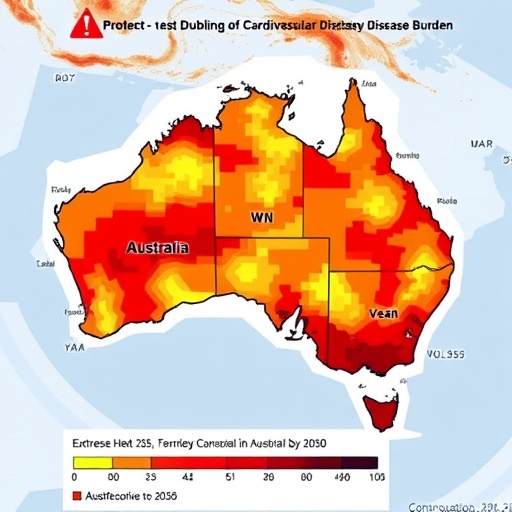
The impact of extreme heat on public health is becoming increasingly evident, especially as climate change continues to exacerbate rising temperatures worldwide. In Australia, a recent study published in the European Heart Journal has unveiled a staggering statistic: hot weather accounts for nearly 50,000 years of healthy life lost annually due to cardiovascular disease. This represents approximately 7.3% of the total burden of morbidity and mortality caused by cardiovascular issues. The implications of these findings are significant not only for Australians but for populations globally, as they highlight a critical intersection between environmental change and health outcomes.
The research led by Professor Peng Bi from the University of Adelaide is a comprehensive investigation into how higher temperatures correlate with an increase in cardiovascular disease risk. Cardiovascular diseases are known to place a heavy toll on public health systems, and understanding the role of temperature in exacerbating these conditions is an urgent matter. As temperatures rise, the human heart is faced with increased demands to regulate body temperature, which can be particularly hazardous for individuals already suffering from heart disease. This added cardiovascular strain can lead to negative health outcomes, including premature death.
One of the standout predictions from the study is the potential doubling or tripling of the disease burden attributed to extreme heat by mid-century if greenhouse gas emissions continue on their current trajectory. This alarming outlook suggests that without substantial intervention, the health of countless individuals could be compromised in the near future. The predictions concerning the future burden of cardiovascular illness offer a critical perspective on the importance of addressing climate change proactively.
The methodology employed by the researchers involves a quantitative approach known as disability-adjusted life years (DALYs), a metric used to measure the overall disease burden by accounting for years lost due to illness or premature death. By analyzing data from the Australian Burden of Disease Database from 2003 to 2018, the researchers were able to quantify the impact of temperature-related cardiovascular cases across various Australian regions. This nuanced analysis revealed that the majority of years lost to cardiovascular disease due to hot weather were associated with fatalities rather than chronic illness.
To project future health impacts linked to climate change, the researchers utilized two scenarios provided by the Intergovernmental Panel on Climate Change, forecasting potential outcomes based on different greenhouse gas emission trajectories. Under the Representative Concentration Pathway 4.5 scenario, which presumes some stabilization of emissions, the number of DALYs lost to hot weather-related cardiovascular disease is expected to reach almost 90,800 by 2030—a staggering 83.5% increase. By 2050, under this more optimistic scenario, DALYs are projected to rise to approximately 139,800, representing a total increase of 182.6%.
Things look even more dire under the RCP8.5 scenario, where emissions continue to rise without intervention. In this scenario, DALYs lost due to cardiovascular disease caused by extreme heat could hit over 95,300 by 2030, with a projection of around 161,100 by 2050, marking an over 225% increase in disease burden. Such projections serve as an urgent call to action, underscoring the pressing need for climate action, public health preparedness, and strategic planning.
Professor Bi emphasizes that the work combines various critical factors, including climate change, demographic shifts, and adaptation strategies, offering a detailed perspective on the disease burden in Australia. By mapping the intersection of these elements, the research contributes significantly to existing literature, as it stands among the pioneering studies of its kind globally. However, the inherent uncertainties in predictive modeling are acknowledged, and researchers urge a careful interpretation of the findings as they rely on specific assumptions that may not fully encapsulate real-world dynamics.
The anticipated increase in cardiovascular disease burden due to heat is expected to disproportionately affect vulnerable populations, including the elderly and those with pre-existing health conditions. These groups often lack the resources or capacity to adequately respond to extreme weather events, thus intensifying the urgency for public health interventions. The study highlights practical strategies that can be employed to mitigate these health risks, focusing on adaptation tactics that communities can adopt to cope with rising temperatures, such as urban cooling initiatives and public health campaigns aimed at educating the populace on managing heat stress.
As cities expand and climates shift, forward-thinking urban planning must prioritize cooling solutions, particularly in densely populated areas. Furthermore, health agencies must ramp up efforts to ensure that populations at higher risk of heat-related illness receive the necessary education, resources, and support systems to safeguard their health during periods of extreme heat. The findings of scholars like Professor Bi serve as a vital reminder that climate change’s health consequences are rapidly materializing and require immediate investment in adaptation and mitigation strategies.
In conclusion, the research illustrates an undeniable connection between increased temperatures and the risk of cardiovascular disease, emphasizing that this issue transcends national boundaries. As hot weather becomes a more persistent threat worldwide, it is crucial for governments and healthcare administrators to not only recognize the urgency but also act collaboratively. By prioritizing public health initiatives and climate resilience strategies, there exists a meaningful opportunity to minimize the adverse health impacts of climate change in the coming decades.
Cite Scienmag News
Ophelia Keating. (March 17, 2025). Projected Doubling of Cardiovascular Disease Burden Due to Extreme Heat in Australia by 2050. Scienmag. https://scienmag.com/projected-doubling-of-cardiovascular-disease-burden-due-to-extreme-heat-in-australia-by-2050/
Ophelia Keating. "Projected Doubling of Cardiovascular Disease Burden Due to Extreme Heat in Australia by 2050." Scienmag, 17 March 2025, https://scienmag.com/projected-doubling-of-cardiovascular-disease-burden-due-to-extreme-heat-in-australia-by-2050/. Accessed 6 September 2026.
Ophelia Keating. "Projected Doubling of Cardiovascular Disease Burden Due to Extreme Heat in Australia by 2050." Scienmag. March 17, 2025. https://scienmag.com/projected-doubling-of-cardiovascular-disease-burden-due-to-extreme-heat-in-australia-by-2050/


