


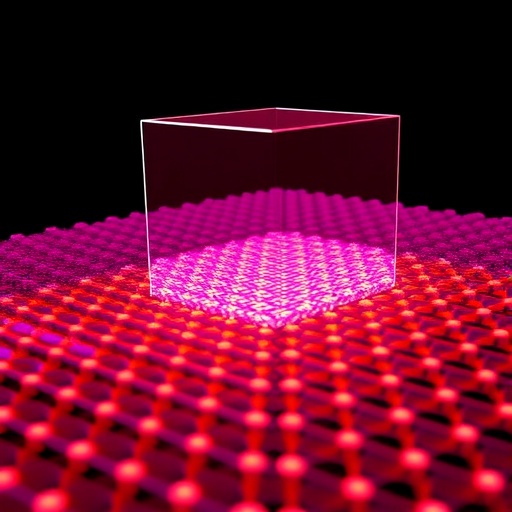
In a groundbreaking advancement at the frontier of photonics and terahertz technology, researchers have unveiled a revolutionary subarray programmable terahertz metasurface capable of executing complex optical logic operations and delivering high-order amplitude modulation. This innovation transcends traditional static metasurfaces by introducing a dynamically tunable platform, promising to significantly enhance optical computing, communication systems, and signal processing frameworks. The ability to manipulate terahertz waves with unprecedented precision facilitates a paradigm shift in how information can be encoded, processed, and transmitted at ultrafast speeds.
At the heart of this breakthrough lies a metasurface meticulously engineered at the subarray level, allowing intricate control over both phase and amplitude of electromagnetic waves within the terahertz frequency range. This level of control is critical because terahertz radiation—often dubbed the “terahertz gap”—has remained challenging to harness effectively due to its unique physical interactions and the scarcity of capable materials and devices. The research team, led by Wang, Gong, and Xia, has surmounted these limitations by designing programmable units within the metasurface that can respond dynamically to external stimuli, thus enabling reconfigurable functionalities that were previously unattainable.
The research article, published in the prestigious Light: Science & Applications, meticulously details the architecture of the subarray programmable metasurface. It integrates tunable meta-atoms—miniature resonators—whose electromagnetic parameters can be altered via external controls such as electrical biasing or optical pumping. Each meta-atom can be programmed independently, setting the stage for high-fidelity optical logic operations which are crucial for developing optical analogs of electronic circuits. This technological innovation could serve as a cornerstone for next-generation optical computation devices, where speed and parallel processing capabilities substantially outperform current electronic equivalents.
One of the key aspects explored in the study is the metasurface’s capacity for high-order amplitude modulation. Traditional modulation schemes have often been limited to binary or quadrature amplitude modulation due to material and design constraints. The reported metasurface surpasses these confines by achieving multi-level amplitude control, thereby enabling denser encoding of information per terahertz signal cycle. This capacity not only boosts data throughput but also introduces versatility in signal processing strategies, including error correction, multiplexing, and adaptive communication protocols.
The utilization of a subarray structure within the metasurface offers a strategic advantage by balancing complexity and programmability. Instead of controlling every single meta-atom individually—which would be technically formidable and resource-intensive—the device segments the metasurface into coordinated subarrays. Each subarray operates collectively, yet remains independently programmable. This ingenious design simplifies signal routing and power distribution, enhances scalability, and permits fine-tuning of wavefronts with high spatial resolution.
An additional highlight of the work is the demonstration of optical logic gates constructed using the programmable metasurface. Logic gates are fundamental building blocks of computational systems, and their physical realization at terahertz frequencies confirms the metasurface’s potential as a platform for all-optical computing. By manipulating the incident terahertz wavefront and amplitude profiles via tailored configurations, the metasurface performs fundamental logic operations such as AND, OR, and XOR directly on the electromagnetic signals. This capability could lead to ultrafast, low-energy computing paradigms that bypass the limitations of electron charge-based processors.
Furthermore, the research involves detailed electromagnetic simulations and experimental validations that substantiate the metasurface’s performance. The study employs advanced characterization techniques such as terahertz time-domain spectroscopy to capture the dynamic response of the device. These results confirm the metasurface’s rapid reconfigurability, high modulation depth, and robust logic functionalities over a broad bandwidth. The integration of both theoretical and empirical analyses strengthens the validity of the proposed concepts and opens avenues for real-world implementations.
This research also addresses a persistent challenge in terahertz technology: the efficient generation and manipulation of terahertz waves for practical applications. By exploiting the metasurface’s programmable properties, the team demonstrated precise control over beam steering, focusing, and shaping, along with amplitude modulation, which are essential for wireless communications, imaging, and sensing. The ability to reconfigure these parameters on demand provides adaptability to changing environmental conditions and application requirements, thereby enhancing system resilience and versatility.
The potential applications of this programmable subarray metasurface extend into diverse fields such as secure communications, where high-order modulation formats can increase data security and reduce susceptibility to interception. In biomedical imaging, dynamically tunable terahertz beams can improve resolution and contrast by adapting to various tissue properties in real time. Additionally, the field of quantum information processing could benefit from the metasurface’s optical logic gate capabilities, effectively bridging classical and quantum computing domains.
Importantly, the approach outlined by Wang and colleagues represents a scalable and cost-effective avenue for metasurface fabrication. Utilizing photolithography and other semiconductor manufacturing techniques, the subarray metasurface can be mass-produced with high reproducibility. This scalability is vital for translating laboratory-phase inventions into commercial devices, which require not only performance but also manufacturability at industrial scales.
The interplay between the metasurface’s structural design and the underlying material properties also opens exciting research directions. By exploring novel tunable materials—such as phase-change compounds, graphene, or liquid crystals—in conjunction with metasurface architectures, future devices could achieve even broader modulation ranges, faster switching speeds, or multi-functional responses including polarization control and nonlinear optical effects. The current work lays a solid foundation for these exploratory domains.
Moreover, the dynamic programmability of the metasurface aligns well with the ongoing trend toward adaptive optics and smart electromagnetic environments. In future communication networks, metasurfaces embedded in infrastructure could dynamically adjust wave propagation to optimize data transmission pathways, mitigate interference, and enhance energy efficiency. This research contributes a fundamental building block to such intelligent systems by providing a versatile and programmable manipulation interface at terahertz frequencies.
From a computational standpoint, the ability to perform logic operations using light rather than electrons has profound implications. Optical logic gates fabricated via programmable metasurfaces can reduce latency, minimize heat generation, and enable parallel processing architectures that significantly boost computing throughput. Integrating these metasurfaces with existing photonic circuits could pave the way for hybrid optical-electronic processors that harness the strengths of both domains.
The discovery also encourages revisiting fundamental physical phenomena associated with terahertz wave interactions. The flexible control over electromagnetic phase and amplitude within subarrays invites new explorations into wave dynamics, coherence properties, and nonlinear processes that could unlock further functionalities beyond conventional paradigms. Such investigations could deepen understanding in fields spanning condensed matter physics, quantum optics, and materials science.
In conclusion, the introduction of a subarray programmable terahertz metasurface marks a transformative leap toward the realization of fully reconfigurable photonic devices capable of complex signal modulation and all-optical computing. By marrying meticulous structural engineering with advanced material functionalities, the research spearheaded by Wang, Gong, and Xia propels terahertz metasurfaces from static prototypes to dynamic architectures with tangible applications. This innovation sets a vibrant course for future investigations and technological breakthroughs in photonics, communications, and beyond.
Cite Scienmag News
Denise Maddox. (May 7, 2026). Programmable Terahertz Metasurface Enables Optical Logic. Scienmag. https://scienmag.com/programmable-terahertz-metasurface-enables-optical-logic/
Denise Maddox. "Programmable Terahertz Metasurface Enables Optical Logic." Scienmag, 7 May 2026, https://scienmag.com/programmable-terahertz-metasurface-enables-optical-logic/. Accessed 4 September 2026.
Denise Maddox. "Programmable Terahertz Metasurface Enables Optical Logic." Scienmag. May 7, 2026. https://scienmag.com/programmable-terahertz-metasurface-enables-optical-logic/


