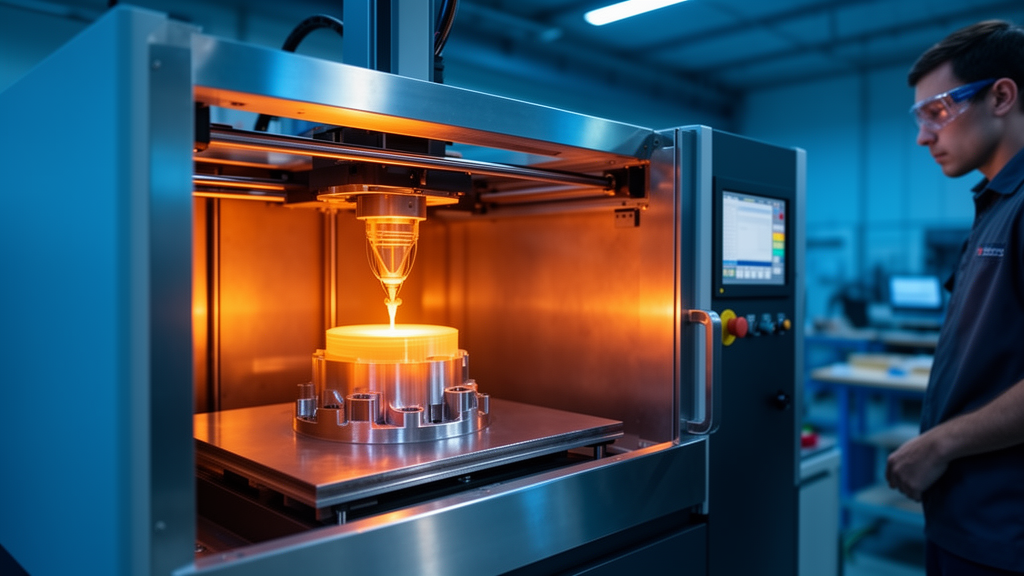
In a systematic study of material extrusion 3D printing of polylactic acid, the team found that printing one part at a time, rather than several parts simultaneously on the same build plate, raised average ultimate tensile strength by roughly 16 percent and toughness by about 30 percent, while cutting energy consumption and carbon dioxide emissions by approximately 10 percent each. The finding matters because print sequence has been largely overlooked in previous studies of printing parameters, which have focused heavily on nozzle temperature, layer height, infill density and orientation while treating the production strategy itself as a fixed background condition.
The experiments used a commercial open-frame material extrusion printer with a 0.4 millimeter brass nozzle and a commercial PLA+ filament with a nominal diameter of 1.75 millimeters. The researchers constructed a full factorial design of 32 experimental runs, varying five process parameters at two levels each: print sequence, print orientation at 45 degrees on-edge versus 90 degrees upright, nozzle temperature at 215 versus 230 degrees Celsius, cooling fan speed at 50 versus 80 percent, and infill density at 70 versus 100 percent. Printing speed was held constant at 30 millimeters per second, the bed temperature at 60 degrees Celsius, and all parts were built with a rectilinear infill pattern, a raster angle configuration of 0 and 90 degrees, and two wall loops. For each of the 32 conditions, a single independent build was produced, from which three tensile specimens were fabricated and tested according to the ASTM D638 Type I geometry with a thickness of 7 millimeters. The researchers treated these three specimens as within-build subsamples rather than independent replicates, a methodological choice that shaped how they later analyzed the data.
Two print sequence strategies were compared directly. In the one-print-at-a-time approach, each part is completed sequentially before the next begins, while the multiple-prints-at-a-time strategy fabricates several parts simultaneously within a single build. Because the sequence governs how thermal exposure, nozzle travel and deposition continuity evolve during fabrication, it influences both the interlayer bonding that determines mechanical integrity and the build time, material consumption, energy demand and emissions that determine sustainability. Energy use was monitored with an energy meter recording instantaneous power at one-minute intervals, and carbon dioxide emissions were estimated using the United Arab Emirates grid emission factor of 0.34 kilograms of CO2 per kilowatt-hour, reflecting the regional electricity mix where the experiments were conducted. The authors note that while absolute emissions would change under a different electricity mix, applying the same factor to all alternatives does not affect their relative ranking.
The mechanical advantage of sequential printing was consistent across nearly all matched processing conditions. On average, ultimate tensile strength rose from 20.59 megapascals under simultaneous printing to 23.92 megapascals under sequential printing, while toughness increased from 0.47 to 0.61 megajoules per cubic meter. The effect was strongly orientation-dependent. For specimens printed at 45 degrees, which require support structures, sequential printing improved strength and toughness by only about 5.2 and 8.1 percent respectively. For unsupported 90-degree upright specimens, however, the gains were dramatic: strength increased by approximately 31 percent and toughness by 84 percent. The explanation lies in thermal history. Sequential printing keeps a more continuous deposition path, so each new layer is applied while the previous one is still hot enough for polymer chains to diffuse across the interface and fuse properly. Simultaneous printing forces the nozzle to travel repeatedly between parts, allowing previously deposited layers to cool excessively and weakening interlayer cohesion.
Fracture surface examination under a scanning electron microscope provided direct visual evidence for this mechanism. Comparing 90-degree specimens printed under otherwise identical conditions, the sequentially printed part showed a mixed fracture behavior with multi-plane interlayer fracture, ridged terraced morphology and enhanced fusion zones, indicating that cracks had to propagate across multiple interfaces and dissipate more energy. The simultaneously printed counterpart instead displayed planar interfacial fracture, filament stringing, incomplete wall contact and filament breakage. In this specific comparison the sequential specimen was stronger and tougher by roughly 45 and 76 percent respectively. Similar but milder differences appeared at 45 degrees, where support structures absorb some of the travel-induced oozing, so defects concentrate between supports rather than directly on the tensile specimens. Notably, the severe defects observed in one simultaneous-printing specimen should not be considered characteristic of all such parts, since their severity depends strongly on the combined orientation, sequence and temperature settings.
Sustainability indicators told a parallel story. Mean build time fell by about 9.2 percent under sequential printing, while energy consumption and CO2 emissions each dropped by roughly 10 percent. Material consumption was essentially unaffected, with a mean difference of only 0.03 grams between the two strategies, attributed to weighing error. The study also quantified how slicing software misestimates build time: under sequential printing, predicted and actual times aligned closely, with a root-mean-square error of 1.98 minutes and a mean absolute percentage error of 1.2 percent, whereas simultaneous printing showed systematic deviations of 15.31 minutes and 8.7 percent, indicating that slicers do not fully capture the timing behavior of concurrent fabrication. Other parameters showed their own trade-offs. Raising infill density from 70 to 100 percent boosted strength by nearly 66 percent and toughness by about 57 percent, but increased build time by roughly 15.9 percent, material use by about 21.4 percent, and energy and emissions by more than 15 percent. The 45-degree orientation outperformed 90 degrees mechanically but cost about 21.6 percent more build time and 23.8 percent more material due to support structures. Higher nozzle temperature reduced strength by about 8.8 percent on average yet barely affected sustainability metrics, while faster cooling fan speed lowered both toughness, by about 20 percent, and energy efficiency.
To resolve the resulting conflicts between mechanical performance and environmental impact, the team embedded the 32 experimental conditions in a multi-criteria decision-making framework using the Technique for Order Preference by Similarity to Ideal Solution, or TOPSIS, under four weighting schemes: equal weights, an objective entropy-based method that weights criteria by their data dispersion, and two Analytic Hierarchy Process scenarios representing load-bearing and non-load-bearing application priorities. Entropy weighting assigned 53.05 percent of total weight to toughness and 23.36 percent to tensile strength, reflecting the greater variability of the mechanical data. Rankings agreed strongly among the equal, entropy and performance-oriented schemes, with Spearman correlations of 0.926, 0.918 and 0.990, but the sustainability-oriented scenario correlated negatively with the others, exposing the underlying trade-off: alternatives favored for strength are penalized when efficiency and emissions dominate. Experiment 14, combining sequential printing, 90-degree orientation, 230 degrees Celsius nozzle temperature, 50 percent fan speed and 100 percent infill, emerged as the strongest integrated solution, retaining 95 percent satisfaction under the performance-oriented scenario and 82.1 percent under the sustainability-oriented one, with a geometric joint measure of 88.3 percent.
The researchers then stress-tested these conclusions. A Pareto-based integration of the two application scenarios identified four non-dominated alternatives, with Experiment 14 dominating all three compromise measures. Cross-validation with an independent method, MOORA, preserved four of the five leading alternatives under every weighting scheme, and changing the weighting scheme affected rankings more than switching the decision method itself. A Monte Carlo simulation with 10,000 realizations of perturbed criterion weights, using a coefficient of variation of 10 percent, found that the preferred alternative retained its optimal position in 99.7 to 100 percent of simulations, with most rank shifts limited to about one position. A criterion-removal sensitivity analysis excluding CO2, which is perfectly correlated with energy consumption, did not change the optimal alternative under any weighting scheme. Finally, Lenth-based factorial screening of the composite performance index showed that print sequence remained an active effect under all four weighting methods, contributing 25.51 percent of factorial variation under equal weighting, 9.89 percent under entropy, 10.31 percent under performance-oriented weighting and 11.83 percent under sustainability-oriented weighting, while nozzle temperature never emerged as a dominant active effect within the tested range.
The authors are careful to frame these results within their experimental scope. All work was performed on a single commercial open-frame printer with one commercial PLA+ filament, so the quantitative improvements associated with sequential printing are representative of that specific thermal environment. Mechanical characterization was limited to ultimate tensile strength and toughness under monotonic loading, and only two representative print sequence strategies were compared. Future work, they suggest, should extend the framework to enclosed and heated-chamber printers, to amorphous, semi-crystalline, flexible and composite materials whose melt viscosity and crystallization behavior may alter sequence sensitivity, and to fatigue, fracture toughness, impact and creep performance. Optimized sequential batch printing and different arrangements of simultaneously printed parts could also be explored as additional sequence levels. Even with these caveats, the study demonstrates that a decision as mundane as when to start each part deserves a place alongside nozzle temperature and infill density in any serious assessment of sustainable 3D printing.
Subject of Research: Effect of print sequence on the mechanical performance and sustainability of material extrusion 3D printing of PLA, assessed with a hybrid TOPSIS multi-criteria framework
Article Title: Performance and Sustainability Assessment of Material Extrusion-Based 3D Printing of PLA Using a Hybrid TOPSIS Integrated with Multiple Weighting Approaches
Article References: Omer, M. A. E., Elsheikh, A., & Mourad, A.-H. I. (2026). Performance and Sustainability Assessment of Material Extrusion-Based 3D Printing of PLA Using a Hybrid TOPSIS Integrated with Multiple Weighting Approaches. Cleaner Engineering and Technology, Article 101343. https://doi.org/10.1016/j.clet.2026.101343
Image Credits: AI Generated
DOI: 10.1016/j.clet.2026.101343
Keywords: 3D printing, material extrusion, polylactic acid, print sequence, TOPSIS, multi-criteria decision-making, sustainability, energy consumption, tensile strength, interlayer bonding, Monte Carlo analysis, process parameters
Cite Scienmag News
Denise Maddox. (October 28, 2026). Print One Part at a Time: Sequencing Boosts Strength and Cuts Emissions in 3D Printing. Scienmag. https://scienmag.com/print-one-part-at-a-time-sequencing-boosts-strength-and-cuts-emissions-in-3d-printing/
Denise Maddox. "Print One Part at a Time: Sequencing Boosts Strength and Cuts Emissions in 3D Printing." Scienmag, 28 October 2026, https://scienmag.com/print-one-part-at-a-time-sequencing-boosts-strength-and-cuts-emissions-in-3d-printing/. Accessed 29 October 2026.
Denise Maddox. "Print One Part at a Time: Sequencing Boosts Strength and Cuts Emissions in 3D Printing." Scienmag. October 28, 2026. https://scienmag.com/print-one-part-at-a-time-sequencing-boosts-strength-and-cuts-emissions-in-3d-printing/