

Saturday, May 23, 2026
Science
No Result
View All Result
  • Login
  • HOME
  • SCIENCE NEWS
  • CONTACT US
  • HOME
  • SCIENCE NEWS
  • CONTACT US
No Result
View All Result
Scienmag
No Result
View All Result
Home Science News Marine

Presence of liquid water most probable explanation for data collected by mars lander

August 12, 2024
in Marine
Reading Time: 2 mins read
0
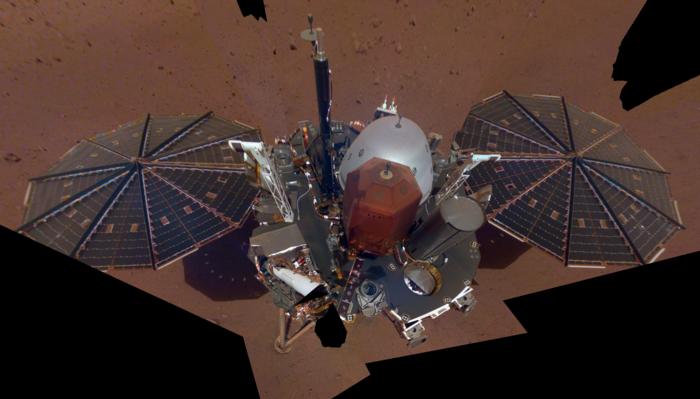
InSight’s First Selfie
66
SHARES
601
VIEWS
Share on FacebookShare on Twitter
ADVERTISEMENT

Data about Mars’ planetary crust gathered from the Mars InSight lander are best explained by the conclusion that the crust has stores of liquid water.

InSight’s First Selfie

Credit: NASA/JPL-Caltech

Data about Mars’ planetary crust gathered from the Mars InSight lander are best explained by the conclusion that the crust has stores of liquid water.

Analysis led by Vashan Wright, a geophysicist at UC San Diego’s Scripps Institution of Oceanography, provides the best evidence to date that the planet still has liquid water in addition to that frozen at its poles. If that conclusion is true, it sets the stage for new research considering the planet’s habitability and continuing a search for life that exists on a place other than Earth. The potential presence of liquid water on Mars has tantalized scientists for decades. Water is essential for a habitable planet.

“Understanding the Martian water cycle is critical for understanding the evolution of the climate, surface, and interior,” Wright said. “A useful starting point is to identify where water is and how much is there.”

The study appears the week of Aug. 12 in the journal Proceedings of the National Academy of Sciences. The Canadian Institute for Advanced Research, the National Science Foundation and the US Office of Naval Research supported the work. Besides Wright, study authors are Matthias Morzfeld from Scripps Oceanography and Michael Manga from the University of California Berkeley. 

Wright’s team used data that InSight collected during a four-year mission ending in 2022. The lander collected information from the ground directly beneath it on variables such as the speed of Marsquake waves from which scientists can infer what substances reside beneath the surface.  The data were fed into a model informed by a mathematical theory of rock physics. From it, the researchers determined that the presence of liquid water in the crust most plausibly explained the data.

“While available data are best explained by a water-saturated mid-crust, our results highlight the value of geophysical measurements and better constraints on the mineralogy and composition of Mars’ crust,” the authors wrote. 


Journal

Proceedings of the National Academy of Sciences

Article Title

Liquid Water in the Martian Mid-Crust

Article Publication Date

12-Aug-2024

COI Statement

Authors declare no competing interests

Share26Tweet17
Previous Post

Advances in drug delivery carrier microwave-assisted reactions for enhanced therapeutics and diagnostic purposes

Next Post

Forest restoration can boost people, nature and climate simultaneously

Related Posts

Rapid Drought-to-Flood Shifts Worsen Climate Governance — Marine
Marine

Rapid Drought-to-Flood Shifts Worsen Climate Governance

May 22, 2026
HKUST Scientists Uncover Carbon Storage Capacity and Biological Roles in Carbon Cycling within South China Sea Coral Reef Ecosystems — Marine
Marine

HKUST Scientists Uncover Carbon Storage Capacity and Biological Roles in Carbon Cycling within South China Sea Coral Reef Ecosystems

May 22, 2026
Unlocking the Ocean’s Medicine Cabinet: Scientists Pioneer New Horizons in Marine Peptide Drug Discovery — Marine
Marine

Unlocking the Ocean’s Medicine Cabinet: Scientists Pioneer New Horizons in Marine Peptide Drug Discovery

May 22, 2026
Beluga Whales Show Signs of Mirror Self-Recognition in Captivity, Study Finds — Marine
Marine

Beluga Whales Show Signs of Mirror Self-Recognition in Captivity, Study Finds

May 20, 2026
Understanding Climate Warming Through Paleoclimatic Insights — Marine
Marine

Understanding Climate Warming Through Paleoclimatic Insights

May 20, 2026
New Study Reveals Early Complex Life Thrived in Oxygen-Rich Seas, Upending Traditional Evolutionary Theories — Marine
Marine

New Study Reveals Early Complex Life Thrived in Oxygen-Rich Seas, Upending Traditional Evolutionary Theories

May 20, 2026
Next Post
Forest restoration can boost people, nature and climate simultaneously

Forest restoration can boost people, nature and climate simultaneously

  • Mothers who receive childcare support from maternal grandparents show more parental warmth, finds NTU Singapore study

    Mothers who receive childcare support from maternal grandparents show more parental warmth, finds NTU Singapore study

    27648 shares
    Share 11056 Tweet 6910
  • University of Seville Breaks 120-Year-Old Mystery, Revises a Key Einstein Concept

    1051 shares
    Share 420 Tweet 263
  • Bee body mass, pathogens and local climate influence heat tolerance

    679 shares
    Share 272 Tweet 170
  • Researchers record first-ever images and data of a shark experiencing a boat strike

    543 shares
    Share 217 Tweet 136
  • Groundbreaking Clinical Trial Reveals Lubiprostone Enhances Kidney Function

    528 shares
    Share 211 Tweet 132
Science

Embark on a thrilling journey of discovery with Scienmag.com—your ultimate source for cutting-edge breakthroughs. Immerse yourself in a world where curiosity knows no limits and tomorrow’s possibilities become today’s reality!

RECENT NEWS

  • Deep Phenotyping Reveals Skin Remodeling in Sclerosis Treatment
  • Unveiling Treatment Timelines in Gliomas via AI
  • Nanowire Sponge Enables Dual Disinfection, Pollutant Removal
  • Chewing, Nutrition, and Frailty in Elderly Patients

Categories

  • Agriculture
  • Anthropology
  • Archaeology
  • Athmospheric
  • Biology
  • Biotechnology
  • Blog
  • Bussines
  • Cancer
  • Chemistry
  • Climate
  • Earth Science
  • Editorial Policy
  • Marine
  • Mathematics
  • Medicine
  • Pediatry
  • Policy
  • Psychology & Psychiatry
  • Science Education
  • Social Science
  • Space
  • Technology and Engineering

Subscribe to Blog via Email

Enter your email address to subscribe to this blog and receive notifications of new posts by email.

Join 5,146 other subscribers

© 2025 Scienmag - Science Magazine

Welcome Back!

Login to your account below

Forgotten Password?

Retrieve your password

Please enter your username or email address to reset your password.

Log In
No Result
View All Result
  • HOME
  • SCIENCE NEWS
  • CONTACT US

© 2025 Scienmag - Science Magazine

Discover more from Science

Subscribe now to keep reading and get access to the full archive.

Continue reading
