


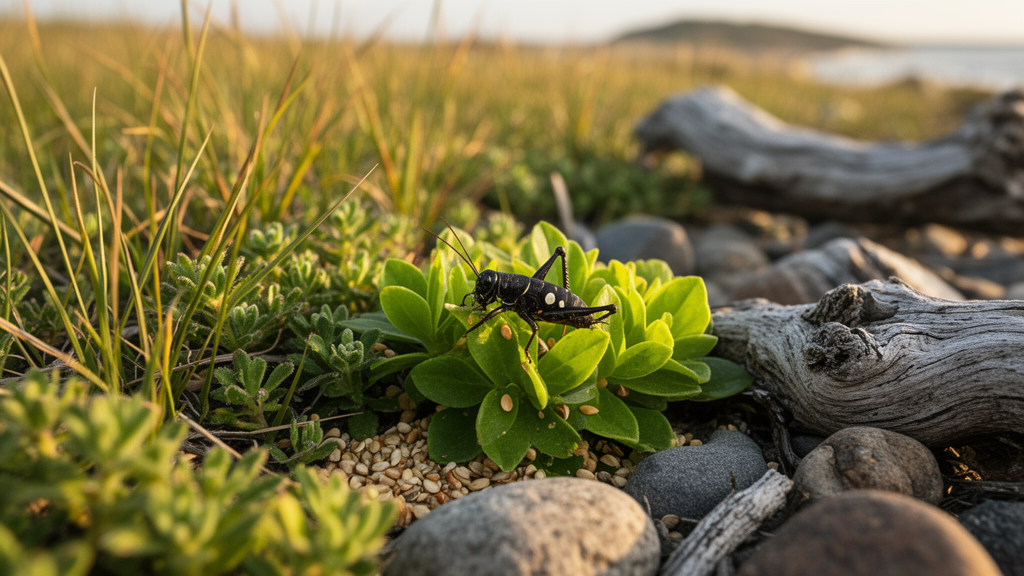
Wild two-spotted crickets on Ishigaki Island contained DNA from a wide range of plants, while animal-derived food items were detected comparatively infrequently, according to a preliminary field study combining gut-content DNA metabarcoding with stable isotope analysis. The researchers estimated that the crickets, Gryllus bimaculatus, occupy an approximate trophic position of 2.5, but cautioned that the value rests on a small sample and an indirect herbivore baseline rather than direct measurements of the plants they ate. Fifteen plant taxa were detected in the insects’ digestive tracts, whereas DNA from a land snail, domestic fowl, an ant and a pig or wild boar occurred at lower frequencies. Taken together, the methods provide preliminary evidence of mainly plant-derived feeding with possible occasional animal inputs, while leaving open whether some traces came from human-derived resources in the park.
The investigation addressed a conspicuous gap between laboratory knowledge and field ecology. Two-spotted crickets are widely used in physiology, developmental biology, neuroscience, ethology, ecology and evolutionary research because they are moderately sized, straightforward to rear and exhibit pronounced sexual dimorphism, particularly in their acoustic communication. Many studies have examined their mating behavior, sexual selection and predator avoidance under natural conditions, but their natural diet and trophic position have received much less attention. Although crickets are generally described as omnivores capable of consuming weed seeds, seedlings and dead or living arthropods, quantitative information about the food of G. bimaculatus in the wild remains limited.
For the preliminary assessment, researchers collected six adult two-spotted crickets—five females and one male—from a park on Ishigaki Island in Okinawa Prefecture, Japan, in November 2024. The sampling locality was at 24.33° N, 124.16° E. They also collected eight adults of the co-occurring grasshopper Aiolopus thalassinus tamulus, which served as a reference for estimating trophic position. All insects were captured by hand, frozen within five hours and transported to the laboratory, where they were stored at –20°C until processing. Each cricket’s digestive tract was removed for DNA analysis, while remaining body tissue was retained for isotope measurements. The restricted sample and single locality limit how broadly the findings can be generalized across the species’ range.
The two analytical approaches capture different aspects of feeding ecology. Gut-content DNA metabarcoding provides a short-term record of recently ingested material and can identify plant and animal food items using taxonomic markers. Stable isotope analysis reflects assimilated dietary sources over a longer period and can provide information about trophic position. Extracted cricket gut tissues were homogenized, freeze-dried and subjected to DNA extraction and cleanup. Plant-derived food was screened with chloroplast plant-barcode primers, while an approximately 380-base-pair region of the mitochondrial cytochrome c oxidase subunit I gene was targeted for animal DNA. A cricket-specific blocking primer was included to reduce amplification of host DNA. Libraries underwent paired-end sequencing with two 300-base-pair reads, and the resulting sequences were assigned against the NCBI nucleotide database.
The crickets carried a notably broad assortment of plant DNA. In total, 15 plant taxa were detected, encompassing four Fabaceae species and six Poaceae species. Frequently observed taxa included alyce clover, soybean, common wheat and corn, while yellow bluestem, scented-top grass, Illinois bundleflower, violet crabgrass, pillpod sandmat, brownbeard rice and other plants were also recorded. Sand palm, black medick, yellow evening primrose, Bermuda buttercup and turkey tangle frogfruit appeared less frequently. Some assignments were necessarily limited: where several plant species produced similar sequences, researchers selected the taxon known to occur on Ishigaki Island and most consistent with the sequence data, while also consulting regional floras and national distribution records. The presence of a sequence therefore establishes occurrence at the assigned taxonomic level but does not quantify how much of any plant made up the diet.
Animal-derived DNA was detected in only a minority of the sampled crickets. The identified items included a land snail, domestic fowl, an ant belonging to the genus Prenolepis, and a sequence assigned to Sus scrofa. The genetic sequence could not distinguish wild boar from domestic pig. Detection frequencies for the animal taxa were 16.7% or 33.3%, depending on the item. These are frequency-of-occurrence measurements among the six crickets, not estimates of the proportion of dietary energy supplied by animals. Moreover, the study did not establish that the crickets consumed any detected taxon directly. The results show that animal-derived DNA was present in some gut samples, but they do not determine the original source of that DNA or its nutritional contribution.
Stable isotope measurements produced a different picture of trophic position. Mean nitrogen isotope values, δ15N, were 2.11‰ ± 2.41‰ in the crickets and 0.35‰ ± 1.41‰ in the grasshoppers. Because the crickets had higher values on average, the researchers calculated a trophic position of 2.52 using the grasshopper as a herbivorous baseline and a nitrogen trophic enrichment factor of 3.4‰. The difference between the species was not statistically significant in a Welch’s t test, however, with t = 1.59 and p = 0.15. The estimate is therefore approximate, especially because the grasshopper was assumed to feed exclusively on plants and no isotope baseline was measured directly from potential plant foods. The authors also note that the estimate may be conservative if the grasshopper’s true trophic position was higher than assumed.
Carbon isotope values differed more clearly between the insects. Mean δ13C was –23.84‰ ± 3.72‰ in the crickets and –13.56‰ ± 5.24‰ in the grasshoppers, a statistically significant difference in a Welch’s t test (t = 4.29, p < 0.01). Such differences are consistent with the grasshopper having a stronger association with C4 plant resources, whose tissues generally have higher δ13C values than those of C3 plants. The crickets’ broader plant detections and lower carbon isotope values were interpreted as evidence that they exploited a wider range of plant resources, predominantly C3 plants. The contrast with the higher nitrogen isotope value of the crickets may reflect occasional assimilation of nitrogen-rich animal material, even though animal DNA was rarely detected. This remains a possible explanation rather than a direct demonstration, particularly because the two methods represent different temporal windows.
Some detected food traces may have originated in human activity rather than natural vegetation. The crickets were collected in a park containing rubbish bins, and free-ranging cats were frequently observed there. Sequences from domestic fowl or pig could have come from discarded food or pet food, while wheat and maize may likewise have represented agricultural products rather than locally growing plants. These possibilities remain unresolved because the study did not establish where individual food items were acquired or whether the vertebrates and crops were consumed directly. The findings nevertheless raise the possibility that human-derived resources contribute to the diet of G. bimaculatus in urban or peri-urban settings. That possibility is consistent with the species’ broad diet and its occurrence in parks, gardens and agricultural fields, but the present data do not quantify the contribution of any particular resource.
The study’s implications extend to the design of laboratory work on a species whose physiology and behavior are studied intensively. Artificial feeds such as cat food, rabbit food, rodent food and ornamental-fish food are commonly used to rear G. bimaculatus. The field evidence suggests that an exclusively animal-product diet may not reproduce the nutritional environment experienced by most of the sampled wild crickets. This interpretation is compatible with previous research on other crickets, in which herbivore-oriented diets supported growth and survival better than cat food alone. Incorporating plant-based foods may therefore provide a more ecologically relevant experimental condition in studies intended to connect laboratory phenotypes with conditions in nature, although the present observations did not directly test any diet or its effects on laboratory performance.
Several limitations keep the findings firmly within the category of a preliminary case study. The sample comprised only six adult crickets from one locality, including just one male, and eight grasshoppers used as the isotopic comparison. The researchers could not assess dietary differences between sexes or developmental stages, and the results cannot be generalized across the species’ extensive range across Africa, southern Europe and Asia, including Japan. Gut-content metabarcoding captures only recently ingested material, while isotope signals integrate food over a longer but less taxonomically specific period. Future work should sample multiple populations, habitats, seasons and life stages, pair molecular gut analysis with vegetation surveys, and measure isotope baselines from the plants actually consumed. Such studies would help distinguish selective feeding from use of locally abundant vegetation and clarify whether vertebrate or crop DNA reflects direct consumption. The present evidence nevertheless offers a useful field-based foundation: the sampled two-spotted crickets showed a wide range of plant-derived DNA, infrequent animal-derived detections, an approximate trophic position of 2.52 and possible use of food resources associated with human activity.
Subject of Research: Preliminary assessment of the field diet and trophic position of wild two-spotted crickets using DNA metabarcoding and stable isotope analysis
Article Title: A preliminary assessment of the field diet and trophic position of the two-spotted cricket Gryllus bimaculatus using DNA metabarcoding and stable isotope analysis
Article References: Kuriwada, T., & Kawanishi, M. (2026). A preliminary assessment of the field diet and trophic position of the two-spotted cricket Gryllus bimaculatus using DNA metabarcoding and stable isotope analysis. Journal of Orthoptera Research, 35(2), 337-342. https://doi.org/10.3897/jor.35.208967
Image Credits: AI Generated
Keywords: two-spotted cricket, Gryllus bimaculatus, field diet, DNA metabarcoding, stable isotopes, trophic position, plant-derived food, Ishigaki Island, wild ecology, animal-derived DNA, preliminary, assessment
Cite Scienmag News
Daisy Hatcher. (October 21, 2026). Preliminary island study finds plant-rich diet in wild two-spotted crickets. Scienmag. https://scienmag.com/preliminary-island-study-finds-plant-rich-diet-in-wild-two-spotted-crickets/
Daisy Hatcher. "Preliminary island study finds plant-rich diet in wild two-spotted crickets." Scienmag, 21 October 2026, https://scienmag.com/preliminary-island-study-finds-plant-rich-diet-in-wild-two-spotted-crickets/. Accessed 21 October 2026.
Daisy Hatcher. "Preliminary island study finds plant-rich diet in wild two-spotted crickets." Scienmag. October 21, 2026. https://scienmag.com/preliminary-island-study-finds-plant-rich-diet-in-wild-two-spotted-crickets/


