


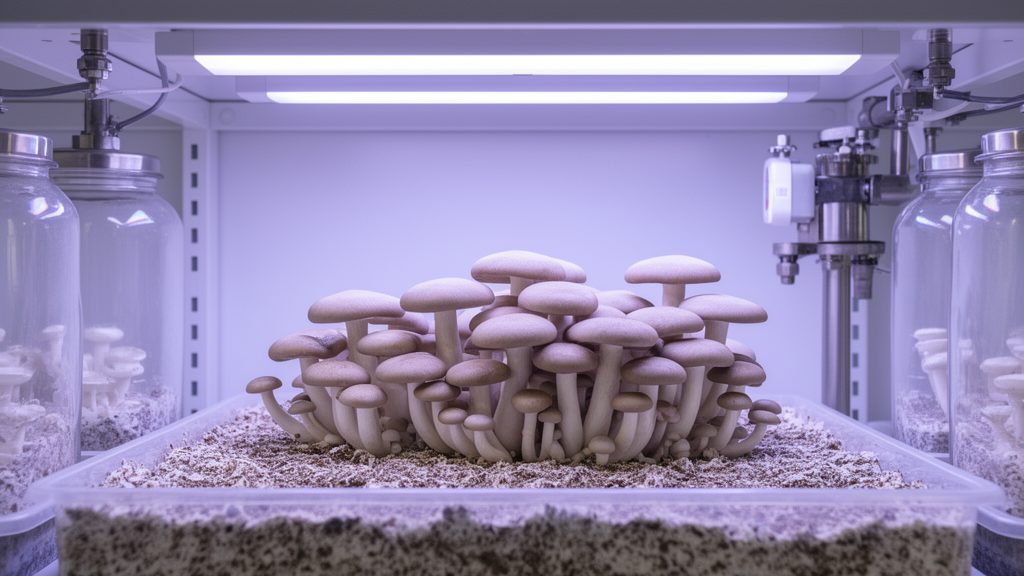
A narrative review finds that advanced extraction and tightly controlled ultraviolet irradiation can recover ergosterol and vitamin D₂ from edible mushrooms and their processing residues, but nearly all of the performance data remain tied to laboratory experiments. The authors say the most promising direction is an integrated chain that links feedstock preparation, selective extraction, photoconversion, solvent recovery and product purification rather than optimizing each step in isolation. Their central conclusion is that high recovery or enrichment measured in a small reactor does not yet demonstrate an industrially viable production process.
Ergosterol, the principal sterol in fungal cell membranes, is the natural precursor of vitamin D₂. Ultraviolet exposure opens the molecule’s B-ring to form previtamin D₂, which then undergoes thermal isomerization to vitamin D₂. This mechanism allows mushrooms to become a controllable, non-animal source of the vitamin, but exposure must be managed carefully. Continued or excessive irradiation can generate lumisterol₂, tachysterol₂, vitamin D₄ and other photoproducts rather than improving the desired fraction. Reported vitamin D₂ concentrations consequently depend not only on ergosterol abundance but also on wavelength, dose, irradiance, exposure time, moisture, temperature, particle size, matrix structure and the geometry of the irradiated material.
The feedstock is itself highly variable. Species, strain, developmental stage, anatomical part, cultivation conditions, light exposure, storage and drying can all change ergosterol content and extractability. Processing can also leave a substantial residue: non-marketable caps, stipes, trimmings and irregular fruiting bodies may account for up to 30% of production mass. These materials retain ergosterol and offer a possible alternative to using edible mushrooms specifically for nutrient production. Their composition nevertheless varies, and the chitin-, β-glucan- and protein-rich cell wall can restrict solvent penetration. Drying, milling, steaming, ultrasound, microwave, enzymatic and other pretreatments can improve access to membrane-associated sterols, but the benefits depend on the species and the extraction process that follows.
Conventional Soxhlet, maceration and heat-assisted extraction remain useful benchmarks because they are established, although they may require hours of heating, substantial solvent and several downstream steps. Their weakness is not necessarily poor recovery, but the combined burden of long treatment, thermal exposure, solvent evaporation and purification. Ultrasound-assisted extraction can shorten the process and improve mass transfer through cavitation. In one study of industrial button-mushroom stalks, ultrasound at 25 °C increased ergosterol extraction by as much as roughly twofold relative to mechanical agitation, while 96% ethanol produced about twice the yield of 70% ethanol. This illustrates a recurring feature of intensified extraction: physical treatment and solvent composition cannot be optimized independently.
Microwave-assisted extraction offers another rapid route. In button-mushroom processing by-products, approximately 19.4 minutes at 132.8 °C and 1.6 grams of dry biomass per liter produced 556.1 milligrams of ergosterol per 100 grams, comparable to conventional recovery in much less time. Pressurized liquid extraction can likewise use short cycles and food-grade ethanol, although it demands pressure-rated equipment and controlled depressurization. Supercritical CO₂ extraction is particularly useful for separating lipophilic sterols from mushroom matrices. In one optimized button-mushroom process, the point that maximized ergosterol purity did not coincide with the point that maximized recovery, demonstrating that a high total extract yield can come at the cost of co-extracted material and more demanding downstream separation.
Enzymatic pretreatment may be particularly useful with supercritical CO₂. In a comparative study, chitinase increased the ergosterol concentration in a shiitake extract to 337.53 milligrams per gram, outperforming the effects of microwave and ultrasound pretreatments under the tested conditions. Deep eutectic solvents and natural deep eutectic solvents offer another route because their properties can be tailored and reused. A proline–levulinic acid system was recycled for seven shiitake-stem extraction cycles without a significant loss in extraction efficiency, while a menthol-based system supported ultrasound-assisted ergosterol recovery, ultraviolet conversion and stabilization in the same medium. The integrated system achieved 85.41% ergosterol extraction efficiency and a 4.08% vitamin D₂ yield, but these findings remain laboratory results rather than commercial performance.
Process integration also changes how irradiation must be controlled. Irradiating whole mushrooms before extraction avoids solvent handling but can be restricted by poor light penetration, whereas irradiation of an extract improves precursor accessibility yet adds solvent-dependent photochemistry and separation steps. Studies of mushroom extracts indicate that 254-nanometre light can convert ergosterol more effectively than 365-nanometre light, although broader spectra may act faster while producing more unwanted isomers. Intense pulsed light increased vitamin D₂ in shiitake powder from 4.18 to 100.82 micrograms per gram under the most intensive reported condition. Particle size must also be optimized rather than minimized without limit: one button-mushroom powder preparation achieved a 2.59% vitamin D₂ yield at a median particle size of 130–140 micrometres, reflecting a balance among surface area, porosity, light shielding and optical penetration.
Scale-up is the principal gap identified by the review. Increasing the size of a batch can alter acoustic-field distribution, electromagnetic heating, solvent flow, heat and mass transfer, pressure drop and irradiation geometry. A larger supercritical-CO₂ system for shiitake, using a six-liter vessel and two 1.6-liter separators, produced a lower overall extraction yield than smaller systems under similar conditions but generated fractions in which ergosterol accounted for as much as about 53% of the extract. The larger apparatus also separated sterol-rich fractions of different compositions. Such results show why yield, enrichment, productivity and fractionation must all be monitored during enlargement. Larger ultrasound systems also require careful control of power density and energy distribution, and flow-through configurations are often more practical than simply scaling a laboratory batch.
Environmental and economic assessments expose further constraints. A cradle-to-gate life-cycle assessment of an ergosterol-rich extract from mushroom residues attributed roughly 31–32% of potential damage to ultrasound-assisted ethanol extraction, 31–32% to evaporation and 19–20% to lyophilization, with electricity contributing as much as 70–85% of impacts under some allocation approaches. Locally generated photovoltaic electricity reduced impacts by up to about 50% in the assessed scenario, whereas osmotic dehydration before lyophilization produced a much smaller reduction of around 9%. A separate laboratory-based economic assessment estimated production costs of €2.43 per gram for an ergosterol-rich extract and €8.28 per gram for a vitamin D₂-rich extract; ethanol recovery reduced those estimates by about 47% and 39%, respectively, with the vitamin D₂-rich figure falling to €5.04 per gram. These are process-specific estimates, not validated industrial prices, but they identify solvent recovery, electricity, purification and the extra conversion step as decisive variables.
Patent activity suggests that commercial concepts are developing faster than public pilot-scale evidence. The targeted search identified 50 patents directly related to mushroom ergosterol or vitamin D₂ processing, plus eight downstream-use applications. Early inventions centered on ultraviolet treatment of dried shiitake, while later patents addressed fresh mushrooms, controlled humidity and temperature, conveyors, vibrating beds, pulsed light and irradiation integrated into drying systems. More recent approaches combine extraction with conversion, including ethanol extraction followed by ultraviolet treatment, vegetable-oil extraction of irradiated mushrooms, supercritical-CO₂ purification and direct irradiation of natural deep eutectic solvent extracts. The next essential step is not another isolated demonstration of extraction yield, but pilot-scale validation of complete process chains with standardized mass and energy balances, product-stability testing, solvent accounting and simultaneous techno-economic and life-cycle assessment.
Subject of Research: Process intensification and scale-up of ergosterol and vitamin D2 recovery from mushrooms
Article Title: Advanced recovery of ergosterol- and vitamin D2-rich fractions from mushrooms: process intensification and scale-up challenges
Article References: Pastor, K., Vladic, J., & Nastić, N. (2026). Advanced recovery of ergosterol- and vitamin D2-rich fractions from mushrooms: process intensification and scale-up challenges. Frontiers in Nutrition, 13, Article 1987834. https://doi.org/10.3389/fnut.2026.1987834
Image Credits: AI Generated
DOI: 10.3389/fnut.2026.1987834
Keywords: mushrooms, ergosterol, vitamin D2, UV photoconversion, process intensification, supercritical CO2 extraction, deep eutectic solvents, ultrasound extraction, scale-up, life-cycle assessment, Advanced, recovery
Cite Scienmag News
Roger Howard. (October 21, 2026). Mushroom process advances target scalable vitamin D2 recovery. Scienmag. https://scienmag.com/mushroom-process-advances-target-scalable-vitamin-d2-recovery/
Roger Howard. "Mushroom process advances target scalable vitamin D2 recovery." Scienmag, 21 October 2026, https://scienmag.com/mushroom-process-advances-target-scalable-vitamin-d2-recovery/. Accessed 21 October 2026.
Roger Howard. "Mushroom process advances target scalable vitamin D2 recovery." Scienmag. October 21, 2026. https://scienmag.com/mushroom-process-advances-target-scalable-vitamin-d2-recovery/


