

Friday, August 28, 2026
Science
No Result
View All Result
  • Login
  • HOME
  • SCIENCE NEWS
  • CONTACT US
  • HOME
  • SCIENCE NEWS
  • CONTACT US
No Result
View All Result
Scienmag
No Result
View All Result
Home Science News Biology

Predictable Microbial Shifts Build Community-Wide Resilience to Environmental Stress

July 17, 2026
in Biology
Arthur F.
By Arthur F. Microbiology & Microbiome
Reading Time: 2 mins read
0
Predictable Microbial Shifts Build Community-Wide Resilience to Environmental Stress

Predictable Microbial Shifts Build Community-Wide Resilience to Environmental Stress

65
SHARES
587
VIEWS
Share on FacebookShare on Twitter
ADVERTISEMENT

Microbial communities rarely behave like chaotic crowds. Instead, new work in Nature Microbiology suggests they may shift in strikingly orderly ways—allowing an entire ecosystem of microbes to withstand environmental shocks. The study, published in 2026, examines how predictable changes in species composition can translate into resilience at the community level.

The researchers focus on a core question: when conditions turn hostile, do microbial populations merely fluctuate, or can they follow a reliable restructuring pathway? Using modeling and experimental logic grounded in community dynamics, the team argues that stress does not simply “filter” microbes randomly. Rather, it can drive a coordinated sequence of winners and losers across the network of interacting species.

A key idea is that species turnover under stress may be partially pre-programmed by ecological constraints. As environmental pressure increases, the relative abundances of certain taxa shift in a consistent direction. This predictability matters because it reduces the likelihood that the community fragments into unstable or low-function states.

The authors propose that resilience emerges when those compositional shifts preserve critical interactions and functions. Even if individual species decline, the community can reorganize such that alternative members take over their ecological roles. In other words, robustness may not require the same players to remain on the field—only that the team’s overall “capabilities” persist.

Importantly, the paper frames robustness as community-wide, not species-specific. The resilience of the whole system can be assessed by how distributions of abundances respond to stress, and how quickly the community can settle into a stable configuration afterward.

The work also highlights a practical implication for viral science news audiences: forecasting microbial responses may become feasible. If composition changes follow reproducible trajectories, then interventions—whether environmental management or biomedical targeting—could be designed to steer communities toward stable outcomes.

Finally, the study links predictable ecological transitions to a measurable form of robustness, offering a conceptual bridge between population dynamics and ecosystem persistence. As microbiomes face increasing environmental variability, such predictability could become a cornerstone for both risk assessment and rational engineering.

Subject of Research: Microbial ecology and community robustness under environmental stress.

Article Title: Predictable shifts in microbial species composition lead to community-wide robustness to environmental stress.

Article References: Huisman, J. S., Dal Bello, M., & Gore, J. (2026). Predictable shifts in microbial species composition lead to community-wide robustness to environmental stress. Nature Microbiology, 11(8), 2310-2320. https://doi.org/10.1038/s41564-026-02422-3

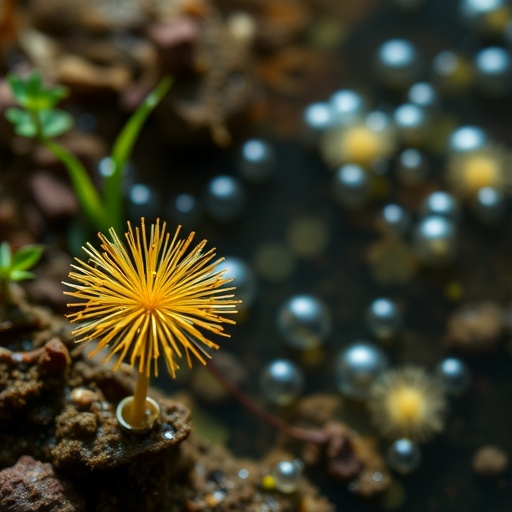
Image Credits: AI Generated

DOI: 10.1038/s41564-026-02422-3

Keywords: community restructuring pathways, ecological resilience mechanisms, ecosystem robustness against environmental shocks, ecosystem stability, environmental stress response, microbial community dynamics, microbial community resilience, microbial diversity and function, microbial interactions under stress, microbial succession modeling, predictable microbial shifts, species composition changes

Cite Scienmag News

Arthur F. (July 17, 2026). Predictable Microbial Shifts Build Community-Wide Resilience to Environmental Stress. Scienmag. https://scienmag.com/predictable-microbial-shifts-build-community-wide-resilience-to-environmental-stress/


Arthur F. "Predictable Microbial Shifts Build Community-Wide Resilience to Environmental Stress." Scienmag, 17 July 2026, https://scienmag.com/predictable-microbial-shifts-build-community-wide-resilience-to-environmental-stress/. Accessed 28 August 2026.

Arthur F. "Predictable Microbial Shifts Build Community-Wide Resilience to Environmental Stress." Scienmag. July 17, 2026. https://scienmag.com/predictable-microbial-shifts-build-community-wide-resilience-to-environmental-stress/

Tags: community restructuring pathwaysecological resilience mechanismsecosystem robustness against environmental shocksecosystem stabilityenvironmental stress responsemicrobial community dynamicsmicrobial community resiliencemicrobial diversity and functionmicrobial interactions under stressmicrobial succession modelingpredictable microbial shiftsspecies composition changes
Share26Tweet16
Previous Post

Optical anisotropy enables more robust skyrmion-based information storage

Next Post

Sleeve Gastrectomy Triggers Adipose Browning by Modulating Asprosin and ATF3-Nrf2

Related Posts

Targeting METTL3/m6A/SOCS3 Reprograms Macrophages, Boosting Anti-PD-1 Therapy in Multiple Myeloma
Biology

Targeting METTL3/m6A/SOCS3 Reprograms Macrophages, Boosting Anti-PD-1 Therapy in Multiple Myeloma

August 28, 2026
Genomes reveal how Sotalia dolphins diverged while retaining key conserved traits
Biology

Genomes reveal how Sotalia dolphins diverged while retaining key conserved traits

August 28, 2026
CHAMS-DTA Improves Drug-Target Binding Affinity Prediction with Cross-Hybrid Attention and Multistage Sampling
Biology

CHAMS-DTA Improves Drug-Target Binding Affinity Prediction with Cross-Hybrid Attention and Multistage Sampling

August 28, 2026
Indian Polistine Wasps Harbor Distinct Microbiota Across Four Species
Biology

Indian Polistine Wasps Harbor Distinct Microbiota Across Four Species

August 28, 2026
Combining noncoding RNA profiles and HPV genotyping improves cervical cancer risk assessment
Biology

Combining noncoding RNA profiles and HPV genotyping improves cervical cancer risk assessment

August 28, 2026
Machine learning reveals HLA-DQ2.5’s impact on naïve T-cell receptors in celiac disease
Biology

Machine learning reveals HLA-DQ2.5’s impact on naïve T-cell receptors in celiac disease

August 28, 2026
Next Post
Sleeve Gastrectomy Triggers Adipose Browning by Modulating Asprosin and ATF3-Nrf2

Sleeve Gastrectomy Triggers Adipose Browning by Modulating Asprosin and ATF3-Nrf2

  • Mothers who receive childcare support from maternal grandparents show more optimized

    Mothers who receive childcare support from maternal grandparents show more parental warmth, finds NTU Singapore study

    27656 shares
    Share 11059 Tweet 6912
  • University of Seville Breaks 120-Year-Old Mystery, Revises a Key Einstein Concept

    1061 shares
    Share 424 Tweet 265
  • Bee body mass, pathogens and local climate influence heat tolerance

    682 shares
    Share 273 Tweet 171
  • Researchers record first-ever images and data of a shark experiencing a boat strike

    546 shares
    Share 218 Tweet 137
  • Groundbreaking Clinical Trial Reveals Lubiprostone Enhances Kidney Function

    531 shares
    Share 212 Tweet 133
Science

Embark on a thrilling journey of discovery with Scienmag.com—your ultimate source for cutting-edge breakthroughs. Immerse yourself in a world where curiosity knows no limits and tomorrow’s possibilities become today’s reality!

RECENT NEWS

  • How Soil Management Helps Mediterranean Olive Groves Adapt to Climate Change
  • Targeting METTL3/m6A/SOCS3 Reprograms Macrophages, Boosting Anti-PD-1 Therapy in Multiple Myeloma
  • Genomes reveal how Sotalia dolphins diverged while retaining key conserved traits
  • CHAMS-DTA Improves Drug-Target Binding Affinity Prediction with Cross-Hybrid Attention and Multistage Sampling

Categories

  • Agriculture
  • Anthropology
  • Archaeology
  • Athmospheric
  • Biology
  • Biotechnology
  • Blog
  • Bussines
  • Cancer
  • Chemistry
  • Climate
  • Earth Science
  • Editorial Policy
  • Marine
  • Mathematics
  • Medicine
  • Pediatry
  • Policy
  • Psychology & Psychiatry
  • Science Education
  • Social Science
  • Space
  • Technology and Engineering

Subscribe to Blog via Email

Enter your email address to subscribe to this blog and receive notifications of new posts by email.

Join 5,150 other subscribers

© 2025 Scienmag - Science Magazine

Welcome Back!

Login to your account below

Forgotten Password?

Retrieve your password

Please enter your username or email address to reset your password.

Log In
No Result
View All Result
  • HOME
  • SCIENCE NEWS
  • CONTACT US

© 2025 Scienmag - Science Magazine

Discover more from Science

Subscribe now to keep reading and get access to the full archive.

Continue reading