


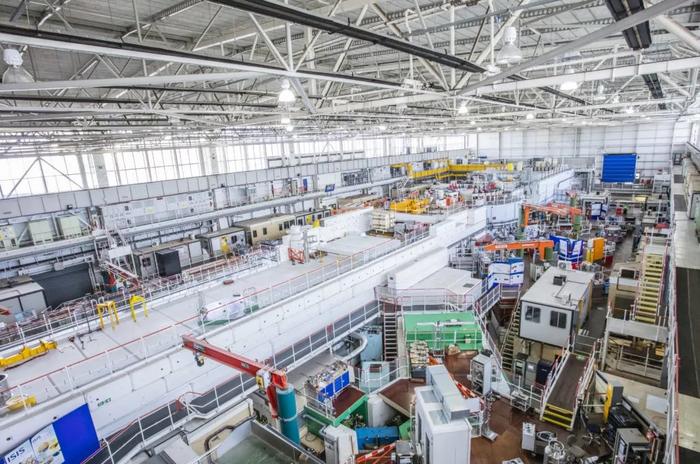
New experimental results show particles called muons can be corralled into beams suitable for high-energy collisions, paving the way for new physics.

Credit: STFC
New experimental results show particles called muons can be corralled into beams suitable for high-energy collisions, paving the way for new physics.
Particle accelerators are best known for colliding matter to probe its make-up, but they are also used for measuring the chemical structure of drugs, treating cancers, and manufacturing silicon microchips.
Current accelerators use protons, electrons and ions, but more powerful accelerators using muons – heavier cousins of electrons – have the potential to revolutionise the field. Muon accelerators would be both cheaper and smaller, so could be built on the same sites as existing colliders while accessing even higher energies.
Now, a new analysis of a muon-beam experiment has demonstrated the success of one of the key technologies required for muon accelerators. This paves the way for a muon collider to be scaled up sooner than other types of accelerators using different particles.
The analysis was led by Imperial College London researchers, as part of the Muon Ionization Cooling Experiment (MICE) collaboration, and findings are published today in Nature Physics.
First author of the study Dr Paul Bogdan Jurj, from the Department of Physics at Imperial, said: “Our proof-of-principle is great news for the international particle physics community, who are making plans for the next-generation of higher-energy accelerators. It is an important development towards the realisation of a muon collider, which could fit into existing sites, such as FermiLab in the United States, where there is a growing enthusiasm for the technology.”
Powerful particle accelerators
The most powerful particle accelerators in the world, exemplified by the Large Hadron Collider (LHC), smash together particles called protons at high energies. These collisions produce new sub-atomic particles that physicists want to study, such as the Higgs and other bosons and quarks.
To reach higher-energy collisions, and access new physics discoveries and applications, a much larger proton collider would need to be built. The LHC is shaped like a ring with a 27km circumference, and plans have been drawn up to potentially build a nearly 100km collider.
However, the considerable costs and long time needed to build such a collider means some physicists are looking elsewhere for solutions. Among the promising avenues are colliders that instead smash together muons.
Muon colliders would be more compact and therefore cheaper, reaching effective energies as high as those proposed by the 100km proton collider in a much smaller space. However, technology development is needed to ensure the muons can be collided frequently enough.
Marshalling muons
The major challenge has been getting the muons to congregate in a small enough space, so that when they are accelerated they form a concentrated beam. This is essential to ensuring they collide with the beam of muons being accelerated around the ring in the opposite direction.
The MICE collaboration previously produced such a beam by using magnetic lenses and energy-absorbing materials to ‘cool’ the muons. Initial analysis showed that this successfully shifted muons towards the centre of the beam.
The new analysis of this experiment looked at the ‘shape’ of the beam in more detail, and how much space it occupied. With this, the team were able to show the beam was made more ‘perfect’ by the cooling: it had reduced size, with the muons travelling in a more organised fashion.
The experiment was carried out using the MICE muon beamline at the Science and Technology Facilities Council (STFC) ISIS Neutron and Muon Beam facility at the STFC Rutherford Appleton Laboratory in the UK. The team are now working with the International Muon Collider Collaboration to build the next stage of demonstrations.
MICE Collaboration spokesperson Professor Ken Long, from the Department of Physics at Imperial, said: “The clear positive result shown by our new analysis gives us the confidence to go ahead with larger prototype accelerators that put the technique into practice.”
Dr Chris Rogers, based at STFC’s ISIS facility in Oxfordshire, led the MICE analysis team and is now leading the development of the muon cooling system for the Muon Collider at CERN. He said: “This is an important result that shows the MICE cooling performance in the clearest possible way. It is now imperative that we scale up to the next step, the Muon Cooling Demonstrator, in order to deliver the muon collider as soon as possible.”
Journal
Nature Physics
Article Title
Transverse Emittance Reduction in Muon Beams by Ionization Cooling
Article Publication Date
17-Jul-2024
Cite Scienmag News
Bethany Barker. (July 17, 2024). Powerful new particle accelerator a step closer with muon-marshalling technology. Scienmag. https://scienmag.com/powerful-new-particle-accelerator-a-step-closer-with-muon-marshalling-technology/
Bethany Barker. "Powerful new particle accelerator a step closer with muon-marshalling technology." Scienmag, 17 July 2024, https://scienmag.com/powerful-new-particle-accelerator-a-step-closer-with-muon-marshalling-technology/. Accessed 9 September 2026.
Bethany Barker. "Powerful new particle accelerator a step closer with muon-marshalling technology." Scienmag. July 17, 2024. https://scienmag.com/powerful-new-particle-accelerator-a-step-closer-with-muon-marshalling-technology/

