


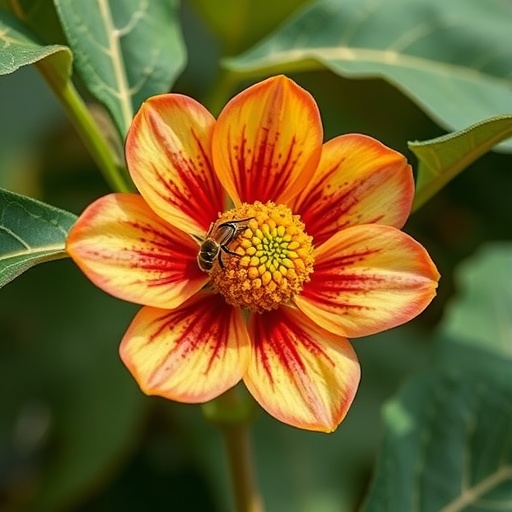
In the dense tropical forests of Thailand, a remarkable case of botanical deception has come to light—one that rewrites what scientists thought they knew about how plants manipulate their pollinators. Researchers studying a little-known species of milkweed vine have documented the first example of a flower that physically and chemically impersonates a fig, luring fig-pollinating wasps into a fatal service they will never benefit from. The study, published in the journal New Phytologist, describes how this singular plant species deploys two entirely different pollination strategies at once: honest mutualism with one group of insects and ruthless deception with another.
The star of this evolutionary drama is Heterostemma ficoides, a member of the milkweed family Apocynaceae whose species name literally translates to “fig-like.” That name is not an accident of taxonomy but a precise description of the plant’s most striking feature. The flowers of H. ficoides bear an uncanny resemblance to fig fruits in both form and coloration, and—crucially—they emit volatile chemical compounds that closely mimic the scents released by genuine figs. To the human eye and nose, the mimicry is impressive. To a fig wasp, whose entire reproductive existence depends on locating fig trees with pinpoint accuracy, the deception appears to be almost perfect.
Fig wasps of the genus Kradibia are among nature’s most specialized pollinators. Their life cycle is inseparable from that of fig trees, a partnership so ancient and tightly co-evolved that neither partner can reproduce without the other. A female fig wasp, already carrying fertilized eggs, searches for a receptive fig inflorescence—a structure that is not truly a fruit but an enclosed, hollow sphere lined on the inside with hundreds of tiny flowers. She squeezes through a minute opening called the ostiole, pollinates the fig’s flowers as she lays her eggs inside some of them, and then typically dies within the fig cavity. Her offspring develop inside the developing fig seeds that have been sacrificed to the wasps’ larvae, eventually emerging as adults to continue the cycle. It is one of the most famous mutualisms in biology, a textbook example of reciprocity refined over tens of millions of years of co-evolution.
Heterostemma ficoides has learned, in the evolutionary sense, to hack this system. When female Kradibia wasps encounter the flowers of H. ficoides, they respond as though they had found a genuine fig. The visual cues—the rounded, fig-like silhouette and coloration of the flower structure—combine with olfactory signals that replicate the volatile profile of figs to trigger the wasps’ hardwired search-and-enter behavior. The wasps visit the flowers and, in doing so, effectively pollinate them, transferring pollen and enabling the milkweed vine to set seed. But unlike in a genuine fig, the story ends badly for the insect. The researchers found that the wasps are unable to complete their life cycle on H. ficoides. The plant offers none of the larval resources that figs provide; there are no galls, no developing seeds suitable for wasp offspring, no nursery. The deceived wasps serve only as unwitting pollen couriers, and their visit is, in reproductive terms, a complete dead end.
Yet the plant’s strategy does not rest on deception alone. Alongside the betrayed fig wasps, the flowers of H. ficoides also attract Megaselia flies—a group of small phorid flies with very different ecological requirements. Unlike the wasps, the flies can actually complete their development on the flowers of the milkweed. In other words, the plant functions as a genuine brood site for the flies: larvae can develop within the floral tissue, emerge as adults, and carry on. This is a true mutualistic arrangement. The fly gains a place to reproduce; the plant gains a reliable pollination service. The combination is what makes the discovery so unusual in the annals of pollination biology.
“The mimic H. ficoides not only strikingly resembles figs in appearance but also produces similar chemical cues,” said corresponding author Aroonrat Kidyoo, PhD, of Chulalongkorn University in Thailand. “Our findings show how a single flower can integrate two contrasting pollination strategies—deception and mutualism—to exploit two very different pollinators.” Her words capture the conceptual novelty of the work. Pollination biologists have long documented cases of deceptive pollination—orchids that mimic female wasps, for instance, or flowers that promise nectar but deliver nothing—and they have equally long documented brood-site mutualisms, such as yuccas and yucca moths or figs and fig wasps. What has not been documented before is a single flower type that runs both programs simultaneously, offering honest rewards to one insect lineage while defrauding another.
This dual strategy has interesting implications for how we think about the stability of such systems. Pure deception pollination is often considered evolutionarily fragile: if the pollinator learns, or if the costs to the pollinator become too high, the mimic can drive its own pollinator population into decline and thereby lose its service. That is one reason fig–fig wasp mutualisms are so precise; cheating tends to collapse the partnership. But H. ficoides appears to have hedged its bets. By maintaining a functioning mutualism with Megaselia flies—ensuring at least one pollinator lineage benefits and continues to reproduce—the plant secures a baseline pollination service while extracting additional, cost-free service from the Kradibia wasps it deceives. The flies essentially subsidize the deception. Even if the wasp population were to decline due to the unrewarded visits, the fly-mediated mutualism could sustain the plant’s reproduction.
The evolutionary pathway that led to this arrangement is also fascinating to consider. Mimicry in plants typically evolves when a mutation or combination of traits produces signals that accidentally overlap with those of a model species—in this case, the fig trees native to the same habitat. Over many generations, any variant of the milkweed that happened to resemble figs more closely would have been visited more often by fig-seeking wasps, and thus would have enjoyed greater reproductive success. Selection would then have refined both the visual mimicry and the chemical mimicry, because the volatile blend is what fig wasps rely on most heavily for host recognition. The chemical signal, in particular, represents a remarkable achievement of convergent evolution: a plant in the Apocynaceae, a family utterly unrelated to figs, evolving to produce a volatile profile that dupes insects specialized on an entirely different lineage of plants.
The finding also raises questions about the specificity of fig wasp host recognition. Fig wasps are often held up as paragons of host fidelity—each fig species typically partnered with one wasp species, each recognizing the other through species-specific volatile cocktails. The fact that Kradibia wasps can be fooled by H. ficoides suggests that their recognition system, while finely tuned, can be spoofed by a sufficiently convincing signal. This has parallels in other pollination systems, such as sexually deceptive orchids that mimic insect pheromones with such chemical precision that male wasps and bees attempt to mate with the flowers. What distinguishes the milkweed case is the combination of that spoofing with a second, honest channel of pollination running in parallel.
Beyond its theoretical interest, the discovery underscores how much remains unknown about tropical plant–insect interactions. Heterostemma ficoides was not a well-known species before this work, and its pollination biology had not previously been studied in detail. It is entirely plausible that other plants, in Southeast Asia and beyond, employ similarly layered strategies that have simply never been observed. Pollination ecology relies heavily on painstaking field observation—watching who visits a flower, what they do there, and whether their offspring survive—and such observations are rare and time-consuming. Each detailed natural history study, like this one, has the potential to reveal strategies that overturn general assumptions about how plant reproduction is organized.
For the broader scientific community, H. ficoides now stands as a model organism for studying the interplay between mutualism and deception. It offers a natural experiment: two pollinator lineages interacting with the same floral signal set, one benefiting and one being exploited. Comparative work on the volatile chemistry of the mimic versus genuine figs, behavioral experiments with naive versus experienced wasps, and genetic analysis of the fly–plant mutualism are all obvious next steps. Such work could illuminate not just the evolutionary history of one Thai vine, but general principles about how communication systems between species evolve, how they are cheated, and how they persist.
In a world where plant–pollinator relationships are under increasing threat from habitat loss, climate change, and the decline of insect populations, understanding the full diversity of pollination strategies is more than an academic exercise. Every species like H. ficoides that depends on a narrow, highly specialized pollinator interaction is also a species at risk if that interaction is disrupted. Documenting these systems before they disappear is both a scientific imperative and a reminder of the astonishing ingenuity of evolutionary solutions. A flower that can be a fig in scent, a fig in shape, a hospitable nursery to one insect, and a fatal illusion to another—all at once—is a vivid demonstration that nature’s repertoire of reproductive strategies still holds surprises waiting to be found in the forest understory.
Cite Scienmag News
Gavin Prescott. (September 9, 2026). Flower disguises itself as figs to trick pollinating wasps. Scienmag. https://scienmag.com/flower-disguises-itself-as-figs-to-trick-pollinating-wasps/
Gavin Prescott. "Flower disguises itself as figs to trick pollinating wasps." Scienmag, 9 September 2026, https://scienmag.com/flower-disguises-itself-as-figs-to-trick-pollinating-wasps/. Accessed 9 September 2026.
Gavin Prescott. "Flower disguises itself as figs to trick pollinating wasps." Scienmag. September 9, 2026. https://scienmag.com/flower-disguises-itself-as-figs-to-trick-pollinating-wasps/


