


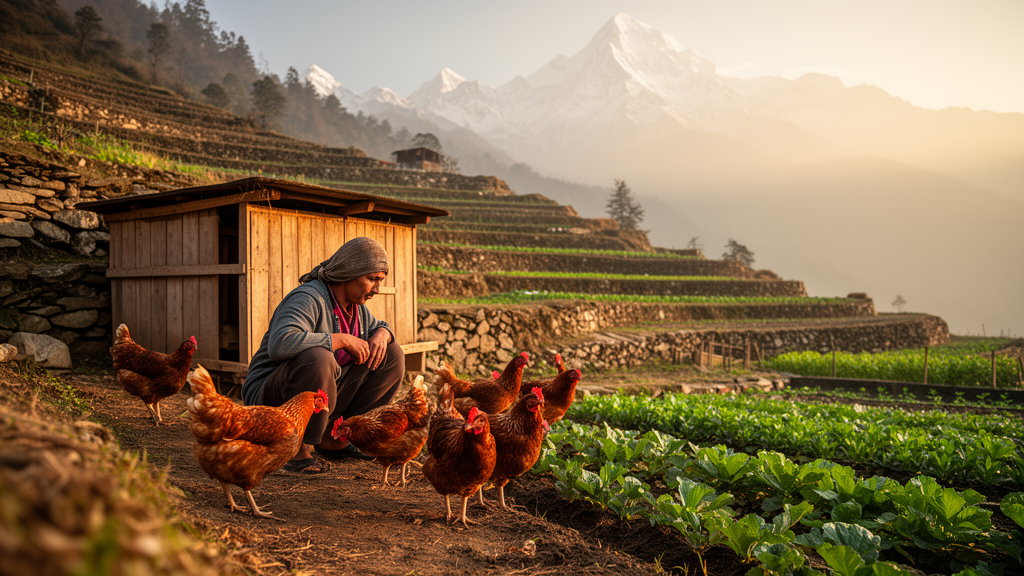
On half-hectare plots scattered across the misty hills of Meghalaya in Northeast India, a quiet agricultural experiment has just delivered one of the most encouraging results in the search for climate-resilient smallholder farming. A four-year field study conducted between 2021 and 2024 by researchers from the Indian Council of Agricultural Research tested three integrated farming system models on tribal farms in the Ri-Bhoi district, and the verdict is clear: a poultry-fish-vegetable-vermicompost combination outperformed every alternative on profitability, climate resilience, and sustainability. The findings, published in Frontiers in Agronomy, offer a rare piece of good news for the world’s smallest farmers, who face a future of shrinking plots, erratic monsoons, and mounting pressure to produce more food with fewer resources.
The stakes could hardly be higher. More than 500 million smallholder farm families worldwide cultivate less than two hectares each, representing roughly 88 percent of all operational land holdings. In India, generations of inheritance have fragmented ancestral land so severely that average holding sizes collapsed from 2.28 hectares in 1970-71 to just 0.74 hectares by 2021-22. In Northeast India, the situation is even more acute: 78.9 percent of smallholders farm micro-plots plagued by resource constraints and seasonal water shortages. For these farmers, single-enterprise agriculture is no longer viable, and the researchers argue that the only way forward is upward, a strategy they call vertical expansion, in which nutrients and inputs are recycled among multiple enterprises stacked on the same tiny parcel of land.
The study site in Liarkhla village, perched at 950 to 1,010 meters above sea level, captures the essence of Eastern Himalayan fragility. The region receives a drenching 2,500 to 3,000 millimeters of rain annually, yet more than 90 percent of it falls between June and September, leaving the October-to-April months chronically water-stressed. The soils are acidic, with a pH of just 4.8, low phosphorus, and modest organic carbon. Farmers here rely on agriculture for survival in one of the world’s most climate-vulnerable hotspots, making the location an ideal real-world laboratory for testing whether integrated systems can actually buffer smallholders against climate shocks rather than merely sounding promising on paper.
Three models were evaluated, each on 0.5 hectares and replicated across 20 farmers’ fields. The PoultryFVV system combined 55 Vanaraja birds, 800 Indian Major Carp fingerlings in a 0.1-hectare pond, 0.35 hectares of vegetables including broccoli, cabbage, tomato, potato, and French bean, and a vermicompost unit. The DuckFVV model swapped poultry for 35 Khaki Campbell ducks, while the PigFVV model used 3 Lumsniang pigs. Each was benchmarked against traditional single-enterprise fish farming. The logic of integration is elegantly simple: livestock droppings fertilize pond water to feed fish, pond water irrigates vegetables, and farm waste is converted by earthworms into vermicompost that returns nutrients to the soil, closing the loop and slashing dependence on costly external inputs.
Carbon accounting followed IPCC greenhouse gas protocols and life cycle assessment, with methane and nitrous oxide converted to carbon dioxide equivalents using global warming potentials of 28 and 298 respectively. The results revealed a nuanced environmental picture. The PoultryFVV system recorded the highest methane emissions under high-emission scenarios at 1,536.8 kilograms of CO2-equivalent, and the largest overall carbon footprint at 1,674.2 kilograms of CO2-equivalent per year. The DuckFVV model proved the greenest, with the lowest footprint at 1,473.0 kilograms. Notably, the fishery component emerged as a major emissions hotspot, with feed production alone contributing 1,800 kilograms of CO2-equivalent annually, while pond methane added another 512.4 kilograms. Vermicomposting, however, cut methane emissions from handled manure by roughly half, confirming its value as a genuinely climate-smart practice.
The resilience data may be the study’s most striking finding. When rainfall deficits of 16 to 18.7 percent struck in 2021 and 2023, classified as stress years against the 30-year normal of 1,563 millimeters, all three integrated systems held their productivity remarkably steady. Yields dipped only marginally, from 6.00 to 5.56 tonnes per unit in the poultry model, yielding climate resilience indices of 92 to 93 percent across the board. Using the Climate Resilience Adaptation Index, which weighs adaptive capacity against exposure and sensitivity, the PoultryFVV system scored highest, with an adaptive capacity of 0.633 and an overall CRAI above 0.67, placing it firmly in the high-resilience category. The duck and pig models fell into medium and low-to-medium resilience bands respectively.
Economically, the contrast with conventional farming was stark. The PoultryFVV system generated a gross return of US$2,952.77 and a net return of US$1,757.59 per year, with a benefit-cost ratio of 2.47, while also creating 227 man-days of employment annually, the highest of any model. Traditional fish monoculture, by comparison, netted a dismal US$65.12. The pig-based system, though less profitable overall, achieved the highest daily economic efficiency at US$4.82 per day, thanks to the high market value of pig biomass. Breed selection mattered too: on-farm testing showed Khaki Campbell ducks laying 260 eggs per year with a feed conversion ratio of 2.5, dramatically outperforming indigenous ducks that produced just 120 eggs on a ratio of 4.0.
Sustainability metrics reinforced the poultry model’s dominance. It achieved the highest Sustainable Value Index at 0.561, while pond water quality remained within optimal aquaculture ranges across all systems, with pH between 7.30 and 7.50 and dissolved oxygen safely above 5.0 milligrams per liter. Beyond the experimental plots, the initiative catalyzed 47 new agri-enterprises across 17 villages, with a 67 percent adoption success rate in poultry-based systems, evidence that the model works not just under research supervision but in the messy economics of real farm households.
What makes this study significant is its empirical rigor in a domain often dominated by theoretical advocacy. By quantifying carbon footprints under both low and high methane conversion scenarios, measuring yield stability through actual drought years, and tracking financial returns across four full production cycles, the researchers have produced one of the most complete validations of integrated farming for mountain agriculture to date. The trade-offs are honestly reported: the most profitable model is not the lowest-emitting one, and carbon sequestration of just 2.28 kilograms of CO2-equivalent per year is negligible against emissions measured in the hundreds. Integration alone does not make a farm carbon-neutral, but it does make it dramatically more survivable.
For the millions of smallholders clinging to fragmented hill plots across South Asia and beyond, the message is one of pragmatic hope. Climate-smart integrated farming systems, the authors conclude, offer a scalable, decentralized pathway to move vulnerable farmers from high-risk monoculture toward resilient, entrepreneurial agrifood systems. The half-hectare poultry-fish-vegetable-vermicompost model, validated across four years of capricious Himalayan weather, now stands as a tested blueprint for turning the smallest farms in the world’s most fragile mountains into engines of both adaptation and income.
Subject of Research: Climate-smart integrated farming systems for tribal smallholders in the Eastern Himalayas, India
Article Title: Sustaining hill agriculture: climate-smart integrated farming systems for tribal smallholders in Eastern Himalayas, India
Article References: Sustaining hill agriculture: climate-smart integrated farming systems for tribal smallholders in Eastern Himalayas, India. (n.d.). https://doi.org/10.3389/fagro.2026.1946224
Image Credits: AI Generated
DOI: 10.3389/fagro.2026.1946224
Keywords: integrated farming systems, climate-smart agriculture, Eastern Himalayas, smallholder farmers, carbon footprint, climate resilience, aquaculture, vermicompost, Meghalaya, tribal agriculture, livelihood security, greenhouse gas emissions
Cite Scienmag News
William Thompson. (October 16, 2026). Poultry-Powered Farming Model Emerges as Climate Champion for Himalayan Smallholders. Scienmag. https://scienmag.com/poultry-powered-farming-model-emerges-as-climate-champion-for-himalayan-smallholders/
William Thompson. "Poultry-Powered Farming Model Emerges as Climate Champion for Himalayan Smallholders." Scienmag, 16 October 2026, https://scienmag.com/poultry-powered-farming-model-emerges-as-climate-champion-for-himalayan-smallholders/. Accessed 16 October 2026.
William Thompson. "Poultry-Powered Farming Model Emerges as Climate Champion for Himalayan Smallholders." Scienmag. October 16, 2026. https://scienmag.com/poultry-powered-farming-model-emerges-as-climate-champion-for-himalayan-smallholders/


