


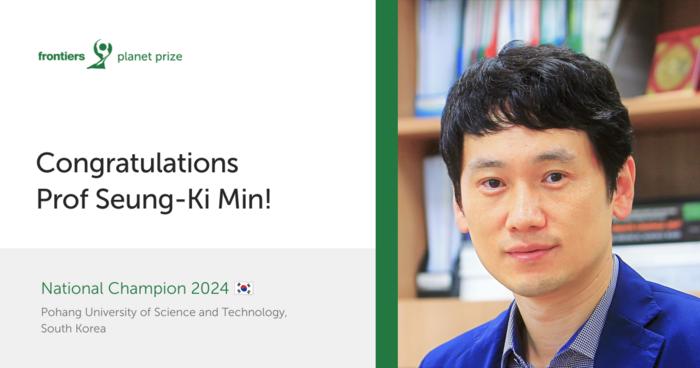
Professor Seung-Ki Min from the Division of Environmental Science & Engineering at Pohang University of Science and Technology (POSTECH) has been selected as Korea’s national champion for the “Frontiers Planet Prize 2024 competition.”

Credit: POSTECH
Professor Seung-Ki Min from the Division of Environmental Science & Engineering at Pohang University of Science and Technology (POSTECH) has been selected as Korea’s national champion for the “Frontiers Planet Prize 2024 competition.”
This accolade honors scientists dedicated to combating environmental challenges threatening our planet and addressing the Earth’s system instability. Among the national champions, three international champions will be chosen, each receiving a research grant of CHF 1 million (equivalent to approximately KRW 1.5 billion) to bolster their endeavors. The academic community eagerly anticipates whether Professor Seung-Ki Min will clinch both the National and International Champion titles during the upcoming awards ceremony in Switzerland this June.
In a recent publication in Nature Communications, Professor Seung-Ki Min, a distinguished member of POSTECH and one of the 23 National Champions, issued a warning regarding the fate of Arctic sea ice. He cautioned that if greenhouse gas emissions persist at their current rates, Arctic sea ice could vanish by the 2030s with complete disappearance projected by the 2050s, even with emission reductions. This revelation marks the first instance where the potential loss of sea ice persists regardless of global efforts toward carbon neutrality.
In his paper, Professor Min underscores the critical importance of assessing the repercussions of an ice-free Arctic on the global ecosystem. He advocates for the development of proactive environmental policies geared towards preparing for the worst-case scenario (Title of the paper: Observationally-constrained projections of an ice-free Arctic even under a low emissions scenario).
The Frontiers Planet Prize, hosted by the Frontiers Research Foundation, is currently in its second year, boasting participation from 475 esteemed universities and research institutions across 43 countries, along with involvement from 20 scientific academies. At 12:00 a.m. local time on April 22, the Frontiers Research Foundation announced the 23 national champions following a selection process overseen by a panel of judges, which included Johan Rockström, director of the Potsdam Institute for Climate Impact Research in Germany.
Cite Scienmag News
Grant Pearson. (April 23, 2024). POSTECH Professor Seung-Ki Min has been honored as the National Champion of the “Frontiers Planet Prize 2024” specializing in sustainability and environment. Scienmag. https://scienmag.com/postech-professor-seung-ki-min-has-been-honored-as-the-national-champion-of-the-frontiers-planet-prize-2024-specializing-in-sustainability-and-environment/
Grant Pearson. "POSTECH Professor Seung-Ki Min has been honored as the National Champion of the “Frontiers Planet Prize 2024” specializing in sustainability and environment." Scienmag, 23 April 2024, https://scienmag.com/postech-professor-seung-ki-min-has-been-honored-as-the-national-champion-of-the-frontiers-planet-prize-2024-specializing-in-sustainability-and-environment/. Accessed 4 September 2026.
Grant Pearson. "POSTECH Professor Seung-Ki Min has been honored as the National Champion of the “Frontiers Planet Prize 2024” specializing in sustainability and environment." Scienmag. April 23, 2024. https://scienmag.com/postech-professor-seung-ki-min-has-been-honored-as-the-national-champion-of-the-frontiers-planet-prize-2024-specializing-in-sustainability-and-environment/

