


In the evolving landscape of psychiatric treatment for major depressive disorder (MDD), the quest for optimizing maintenance strategies following electroconvulsive therapy (ECT) has reached a pivotal moment. A groundbreaking study recently published in BMC Psychiatry sheds new light on the patterns of pharmacological maintenance therapy post-ECT, offering valuable insights from a large-scale, real-world clinical setting across Japan. This investigation, encompassing 3,749 inpatients with MDD from 240 medical facilities, marks a significant stride toward understanding how clinicians manage long-term pharmacotherapy after ECT—a domain that has long remained ambiguous and varied.
Maintenance treatment is critical for preventing relapse in patients who respond to ECT, especially given the often refractory nature of major depressive episodes. Historically, antidepressant monotherapy has been the mainstay recommendation in clinical guidelines. However, clinical reality frequently demands more nuanced approaches, as many patients demonstrate inadequate response to single-agent therapies. This recent study aimed to dissect these real-world prescribing tendencies, focusing on the types and combinations of medications discharged to patients who had undergone ECT, compared to those who had not.
The cohort was segmented into two distinct groups: those treated with ECT (521 patients) and those treated without (3,273 patients). Detailed analyses were conducted on discharge prescriptions, particularly scrutinizing antidepressant monotherapy rates alongside combination regimens incorporating mood stabilizers such as lithium and antipsychotic agents. This comparative framework allowed researchers to identify unique pharmacotherapeutic trends reflective of clinical decision-making complexities inherent to post-ECT care.
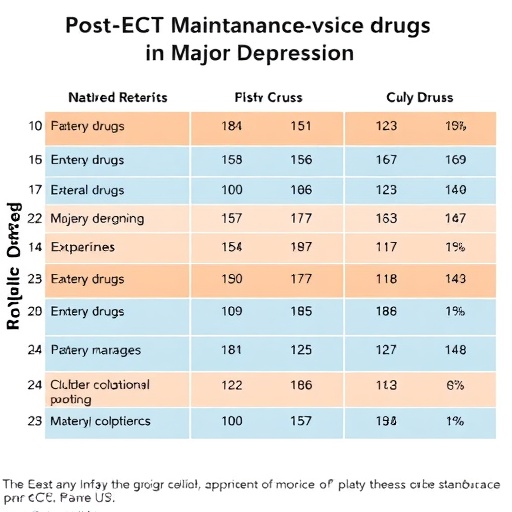
One of the most striking revelations was that the frequency of antidepressant monotherapy did not differ significantly between patients who received ECT and those who did not—clocking in at 22.6% versus 28.4%, respectively. This finding challenges prior assumptions that monotherapy might be less favored post-ECT due to the severity or treatment resistance often associated with those receiving ECT. Nonetheless, these data underscore that monotherapy remains a considerable component of treatment plans even after such intensive interventions.
Conversely, combination therapies delineated a distinctive pharmacological signature among the ECT group. Notably, the prescription of antidepressant-antipsychotic combinations was markedly elevated in patients treated with ECT, reaching 36.0% compared to 28.7% in the non-ECT cohort. This suggests a propensity for clinicians to integrate antipsychotic agents post-ECT, potentially reflecting attempts to address residual symptoms or augment antidepressant efficacy in complex clinical presentations.
Mood stabilizer use also appeared more prevalent in the ECT group, with a combination of antidepressants and mood stabilizers prescribed to 6.7% of these patients versus 3.9% in the comparison group. Although this difference did not achieve statistical significance after stringent correction, the trend is notable. Within this category, lithium stood out as the primary mood stabilizer, exhibiting a significantly higher prescription rate in ECT-treated patients (5.7% compared to 1.0% in the non-ECT group). Lithium’s neuroprotective and anti-suicidal properties may account for this preferential use in the complex post-ECT pharmacotherapy milieu.
At the granular drug level, the study illuminated that within antidepressant monotherapies, nortriptyline was distinctly favored in the ECT group, prescribed to 1.7% of patients as opposed to 0.3% in those not undergoing ECT. Nortriptyline, a tricyclic antidepressant, is traditionally known for its efficacy in treatment-resistant depression, which may explain its selected use in these cases, further emphasizing tailored approaches within maintenance regimens.
This comprehensive investigation harnessed real-world clinical data to unravel the intricate tapestry of maintenance pharmacotherapy following ECT. The diversity of 198 unique antidepressant prescription patterns observed affirms that post-ECT treatment is far from uniform, highlighting a landscape shaped by clinical judgment, patient history, and response profiles. Importantly, these findings raise pressing questions about the optimal strategies for sustaining remission and improving long-term outcomes in MDD patients who have undergone ECT.
As compelling as these observations are, they also starkly underscore the need for prospective, structured clinical trials to validate the effectiveness and safety of these commonly employed maintenance strategies. The current heterogeneity in practice points to a lack of consensus and evidence-based guidelines tailored specifically for post-ECT pharmacotherapy, a gap that this seminal work spotlights with data-driven clarity.
Furthermore, the nuanced use of medications like lithium and antipsychotics among ECT recipients prompts a re-examination of the underlying neurobiological mechanisms governing relapse and remission in severe MDD. Future research combining pharmacological, neuroimaging, and genetic approaches may unravel the determinants of differential responses, guiding personalized treatment regimens that optimize recovery trajectories.
In sum, this landmark study delivers pivotal evidence that challenges prevailing notions about maintenance therapy after ECT. The balance between monotherapy and polypharmacy, the selective preference for certain pharmacological agents, and the real-world prescription patterns collectively articulate a complex therapeutic environment. Clinicians, researchers, and policymakers must heed these insights to formulate robust, empirically grounded guidelines that enhance the durability of ECT benefits for patients battling major depressive disorder.
As the psychiatric community strides forward, integrating such large-scale clinical data with mechanistic studies could revolutionize maintenance treatment strategies, offering renewed hope for individuals navigating the arduous journey of depressive illness and recovery.
Cite Scienmag News
Glenn Wilkins. (October 9, 2025). Post-ECT Maintenance Drugs in Major Depression. Scienmag. https://scienmag.com/post-ect-maintenance-drugs-in-major-depression/
Glenn Wilkins. "Post-ECT Maintenance Drugs in Major Depression." Scienmag, 9 October 2025, https://scienmag.com/post-ect-maintenance-drugs-in-major-depression/. Accessed 4 September 2026.
Glenn Wilkins. "Post-ECT Maintenance Drugs in Major Depression." Scienmag. October 9, 2025. https://scienmag.com/post-ect-maintenance-drugs-in-major-depression/


