


Imagine knowing what berry or mushroom is safe to eat during a hike or swiftly detecting pathogens in a hospital setting that would traditionally require days to identify.

Credit: Texas A&M University Engineering
Imagine knowing what berry or mushroom is safe to eat during a hike or swiftly detecting pathogens in a hospital setting that would traditionally require days to identify.
Identification and detection of drugs, chemicals and biological molecules invisible to the human eye can be made possible through the combined technology of a cellphone camera and a Raman spectrometer — a powerful laser chemical analysis method.
Dr. Peter Rentzepis, a professor in the Department of Electrical and Computer Engineering at Texas A&M University, holds a patent for a hand-held cellphone-based Raman spectrometer system. Rentzepis’ invention allows the user to make non-invasive identifications of potentially harmful chemicals or materials in the field, especially in remote areas where laboratory spectrometers cannot be used due to their size and power needs.
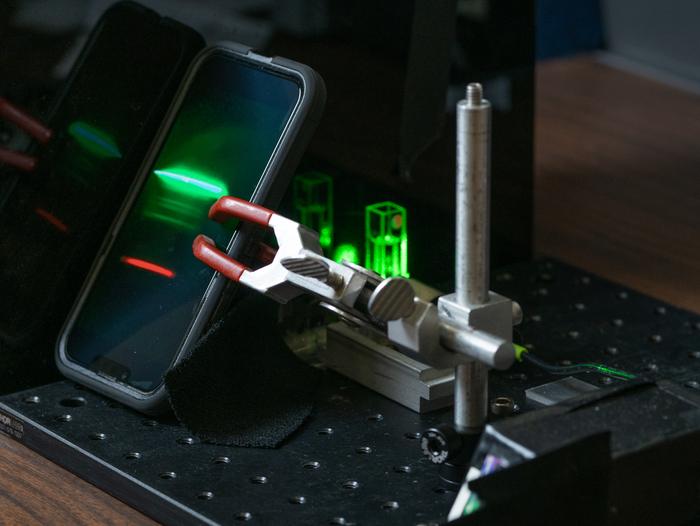
This new Raman spectrometer system integrates lenses, a diode laser and a diffraction grating — a small thin square-shaped surface that scatters light for analysis — in combination with a camera from a cellphone to record the Raman spectrum. Peaks in the spectrum provide detailed data about the chemical composition and molecular structure of a substance, depending on their intensities and positions.
To use the device, a cellphone is placed behind the transmission grating with the camera facing the grating, ready to record the Raman spectrum. A laser shoots a beam into a sample of unknown material, such as a bacterium, on a slide. The camera records the spectrum, and when paired with an appropriate cellphone application/database, this handheld instrument can enable rapid materials identification on site.
Previously, the process of identifying unknown substances involved extensive sampling of biological material and laboratory analysis, which could take several hours or even days. While traditional Raman spectrometers cost up to thousands of dollars, Rentzepis’ invention can be made at a significantly lower cost and can identify materials at a significantly quicker speed.
“It’s a small device that can tell you the composition of a particular system, material or sample,” Rentzepis said. “You can even have it in your pocket.”
Fellow inventors are former graduate students Dr. Dinesh Dhankhar, a system engineer at Thermo Fisher Scientific, and Anushka Nagpal, a process engineer at Intel Corporation.
Funding for this research is administered by the Texas A&M Engineering Experiment Station (TEES), the official research agency for Texas A&M Engineering.
Imagine knowing what berry or mushroom is safe to eat during a hike or swiftly detecting pathogens in a hospital setting that would traditionally require days to identify.
Identification and detection of drugs, chemicals and biological molecules invisible to the human eye can be made possible through the combined technology of a cellphone camera and a Raman spectrometer — a powerful laser chemical analysis method.
Dr. Peter Rentzepis, a professor in the Department of Electrical and Computer Engineering at Texas A&M University, holds a patent for a hand-held cellphone-based Raman spectrometer system. Rentzepis’ invention allows the user to make non-invasive identifications of potentially harmful chemicals or materials in the field, especially in remote areas where laboratory spectrometers cannot be used due to their size and power needs.
This new Raman spectrometer system integrates lenses, a diode laser and a diffraction grating — a small thin square-shaped surface that scatters light for analysis — in combination with a camera from a cellphone to record the Raman spectrum. Peaks in the spectrum provide detailed data about the chemical composition and molecular structure of a substance, depending on their intensities and positions.
To use the device, a cellphone is placed behind the transmission grating with the camera facing the grating, ready to record the Raman spectrum. A laser shoots a beam into a sample of unknown material, such as a bacterium, on a slide. The camera records the spectrum, and when paired with an appropriate cellphone application/database, this handheld instrument can enable rapid materials identification on site.
Previously, the process of identifying unknown substances involved extensive sampling of biological material and laboratory analysis, which could take several hours or even days. While traditional Raman spectrometers cost up to thousands of dollars, Rentzepis’ invention can be made at a significantly lower cost and can identify materials at a significantly quicker speed.
“It’s a small device that can tell you the composition of a particular system, material or sample,” Rentzepis said. “You can even have it in your pocket.”
Fellow inventors are former graduate students Dr. Dinesh Dhankhar, a system engineer at Thermo Fisher Scientific, and Anushka Nagpal, a process engineer at Intel Corporation.
Funding for this research is administered by the Texas A&M Engineering Experiment Station (TEES), the official research agency for Texas A&M Engineering.
By Katie Satterlee, Texas A&M University Engineering
###
Cite Scienmag News
Drew Townsend. (July 16, 2024). Pocket-sized invention revolutionizes ability to detect harmful materials. Scienmag. https://scienmag.com/pocket-sized-invention-revolutionizes-ability-to-detect-harmful-materials/
Drew Townsend. "Pocket-sized invention revolutionizes ability to detect harmful materials." Scienmag, 16 July 2024, https://scienmag.com/pocket-sized-invention-revolutionizes-ability-to-detect-harmful-materials/. Accessed 3 September 2026.
Drew Townsend. "Pocket-sized invention revolutionizes ability to detect harmful materials." Scienmag. July 16, 2024. https://scienmag.com/pocket-sized-invention-revolutionizes-ability-to-detect-harmful-materials/

