


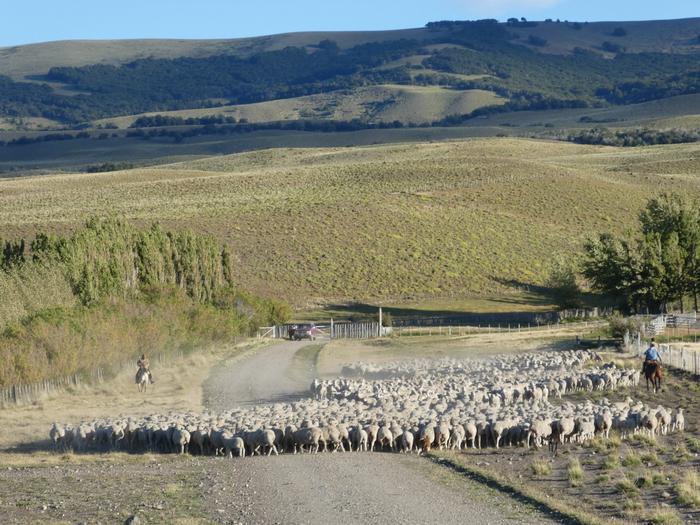
Understanding how plants cope with climatic extremes and grazing pressure is important for reliable prediction about future biodiversity and the functioning of dryland ecosystems[1].

Credit: © 2024 KAUST; Sergio Velasco Ayuso.
Understanding how plants cope with climatic extremes and grazing pressure is important for reliable prediction about future biodiversity and the functioning of dryland ecosystems[1].
An international team, coordinated by KAUST’s Fernando Maestre, has assessed how 20 chemical and morphological plant functional traits jointly respond to changes in aridity and grazing pressure across global drylands. Increasing aridity and grazing pressure could be expected to reduce the level of plant diversity. However, the diversity of plant traits — including key traits linked to nutrient cycling such as specific leaf area and foliar chemical composition — actually increased above an aridity threshold of 0.7 (close to the transition between semiarid and arid zones). This trait diversity similarly increased with increasing grazing pressure.
“Global initiatives aiming to describe plant trait diversity have focused on plant morphology and leaf carbon economy, but neglected the diversity of chemical elements that sustain plant survival and growth,” says Maestre, who co-led this study as part of the BIODESERT global survey, which he designed.
“The elemental concentration in plant leaves has major implications for plant development and determines how plants respond to grazing pressure and water scarcity,” he says.
The team conducted a field survey to investigate the impacts of aridity and grazing pressure on the chemical and morphological trait diversity of perennial plants across drylands worldwide. They selected 98 sites from 25 countries representing the aridity gradient over which dryland rangelands can be found globally. Each site included several plots spanning local gradients of grazing pressure (from ungrazed to high grazing pressure) with a total of 326 plots surveyed.
Variations in plant functional traits reflect shifts in plant adaptation strategies under changing environmental conditions. The results indicate that aridity and grazing have a similar effect on plant trait diversity by promoting a wide range of strategies to cope with water shortage and grazing.
They measured traits related to the concentration of 14 chemical elements in plant leaves, the leaf and plant size, and the leaf carbon economy (leaf area and leaf dry matter). The results provide valuable information to explore how aridity and grazing shape the covariations and trade-offs observed among multiple morphological and chemical plant traits across global drylands.
High aridity levels also promoted functionally contrasting strategies: for example, tall species with fast-growing leaves following stress-avoidance strategies (high N-P-K and low leaf dry matter content) and small conservative species following stress-tolerance strategies (low N-P-K and high leaf dry matter content) with either low or high Mg-Ca and Zn-Na concentrations in leaves.
“These elemental strategies can reflect the contrasting role of chemical elements in plants, either as a way to tolerate high aridity levels or as base elements for defensive compounds against grazers,” Maestre explains.
The study delivers novel insights into how vascular plants respond to biotic stressors and environmental extremes and sheds light on how plant traits may be shaped by joint increases in aridity and grazing pressure. A key result was that more than half the trait diversity observed only occurred in the most arid and grazed drylands, highlighting the phenotypic uniqueness of these extreme environments.
The findings indicate that drylands act as a global reservoir of plant phenotypic diversity, challenging the pervasive view that harsh environmental conditions reduce plant trait diversity. “Our results also highlight the importance of considering a plant’s chemical composition (the elementone) to understand dryland biodiversity responses to ongoing climate change,” says Maestre. “Plants could have many alternative strategies to cope with increases in environmental stress induced by climate change and land-use intensification.”
Maestre, who joined KAUST in February 2024, carried out the study in his previous role at the University of Alicante. He plans to expand the BIODESERT survey into the arid and hyper-arid ecosystems of Saudi Arabia. “Such research would contribute to the monitoring of Saudi terrestrial ecosystems, offer important insights on how Saudi plant diversity can respond to ongoing climate change and guide the selection of the most suitable species for each Saudi region to be used in ongoing and future greening programs,” he says.
Journal
Nature
Article Title
Unforeseen plant phenotypic diversity in a dry and grazed world
Article Publication Date
7-Aug-2024
Cite Scienmag News
Bethany Barker. (August 7, 2024). Plants show surprising diversity in arid landscape. Scienmag. https://scienmag.com/plants-show-surprising-diversity-in-arid-landscape/
Bethany Barker. "Plants show surprising diversity in arid landscape." Scienmag, 7 August 2024, https://scienmag.com/plants-show-surprising-diversity-in-arid-landscape/. Accessed 4 September 2026.
Bethany Barker. "Plants show surprising diversity in arid landscape." Scienmag. August 7, 2024. https://scienmag.com/plants-show-surprising-diversity-in-arid-landscape/

