

Wednesday, May 20, 2026
Science
No Result
View All Result
  • Login
  • HOME
  • SCIENCE NEWS
  • CONTACT US
  • HOME
  • SCIENCE NEWS
  • CONTACT US
No Result
View All Result
Scienmag
No Result
View All Result
Home Science News Biology

Plants defend against insects by inducing leaky gut syndrome

August 25, 2025
in Biology
Reading Time: 2 mins read
0
Plants defend against insects by inducing leaky gut syndrome
66
SHARES
600
VIEWS
Share on FacebookShare on Twitter
ADVERTISEMENT

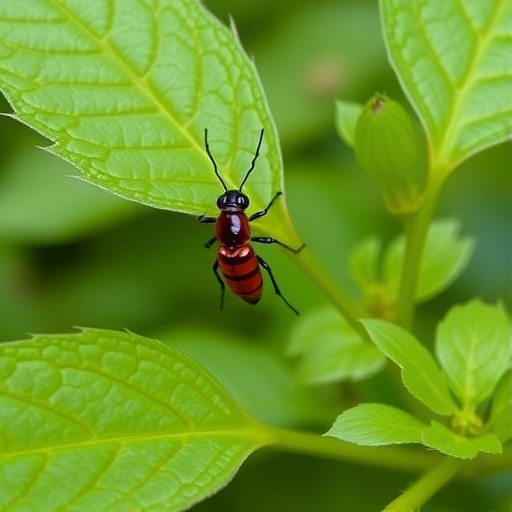
Plants may induce “leaky gut syndrome” — permeability of the gut lining — in insects as part of a multipronged strategy for protecting themselves from being eaten, according to researchers at Penn State. By improving our understanding of plant defenses, the findings could contribute to the development of new pest control methods.

“We found that a combination of physical and chemical defenses in corn plants can disrupt the protective gut barriers of fall armyworms, creating opportunities for gut microbes to invade their body cavities,” said Charles Mason, postdoctoral scholar in entomology. “This can cause septicemia, which can kill the insect, or simply trigger an immune response, which can weaken the insect.”

The researchers reared fall armyworms in the laboratory and inoculated them with one of three types of naturally occurring gut bacteria. They fed the insects on one of three types of maize — one that is known to express enzymes that produce perforations in insect gut linings; one that is characterized by numerous elongated trichomes, or fine hairs that occur on the surface of the plant and help defend against herbivores; and one that has just a few short trichomes. The team used scanning electron microscopy to evaluate the impacts of the various bacteria and maize types on the integrity of the fall armyworms’ gut linings.

The scientists found that the presence of all three types of gut bacteria decreased the ability of fall armyworm larvae to damage maize plants, especially when other defenses — such as elongated trichomes and enzymes, both of which can perforate gut linings — were present. However, the species of gut bacteria varied in the extent to which they weakened the insects. The results will appear in the July 22 issue of Proceedings of the National Academy of Sciences.

“Our results reveal a mechanism by which some plants use insects’ gut microbiota against them in collaboration with their own defenses,” said Mason.

Gary Felton, professor and head of the Department of Entomology, noted that the results should have broad significance towards understanding the ecological function of plant defenses.

“In the context of our study, disparate plant defenses, such as leaf trichomes and plant enzymes, all require certain gut microbes for their optimal defense against herbivores,” he said. “Our results predict that the variation in the effectiveness of plant defenses in nature may be, in significant part, due to the variability observed in the microbial communities of insect guts.”

The team said the results could help to inform the development of insect-resistant crops.

“It may be advantageous to ‘stack’ plant defenses that target the insect gut in order to create a ‘leaky gut’ that exposes the insect to microbial assaults on their immune system,” said Mason.

The U.S. Department of Agriculture and National Science Foundation supported this research.

Journal Reference:

Charles J. Mason, Swayamjit Ray, Ikkei Shikano, Michelle Peiffer, Asher G. Jones, Dawn S. Luthe, Kelli Hoover, Gary W. Felton. Plant defenses interact with insect enteric bacteria by initiating a leaky gut syndrome. Proceedings of the National Academy of Sciences, 2019; 201908748 DOI: 10.1073/pnas.1908748116


Tags: chemical defenses in plantscorn plant pest resistancecorn plants and insect interactionentomology research findingsfall armyworm gut permeabilitygut microbes and insect healthimproving pest management through plant biologyinsect immune response to plant defensesleaky gut syndrome in insectsmaize varieties and insect interactionsmaize varieties and insect resistancemicrobial invasion in insect gutspest control strategiespest control strategies using plant defensesphysical and chemical plant defensesphysical defenses against herbivoresPlant defense mechanismsplant defenses against insectsplant-induced septicemia in insectssepticemia in insectsunderstanding insect immune responses
Share26Tweet17
Previous Post

M-Theory: Black Objects and Calabi-Yau Geometry

Next Post

Post-Pandemic Migration Patterns and Determinants in India

Related Posts

Ancient Complex Life Thrived Along Oxygen-Rich Seafloors for Hundreds of Millions of Years — Biology
Biology

Ancient Complex Life Thrived Along Oxygen-Rich Seafloors for Hundreds of Millions of Years

May 20, 2026
How Early Sexual Debut Could Influence Aging Later in Life — Biology
Biology

How Early Sexual Debut Could Influence Aging Later in Life

May 20, 2026
New Discovery Reveals How Cancer Progresses During Cell Division — Biology
Biology

New Discovery Reveals How Cancer Progresses During Cell Division

May 20, 2026
Brookfield Zoo Chicago Achieves Major Milestone in Puerto Rican Crested Toad Conservation with Over 12,000 Tadpoles — Biology
Biology

Brookfield Zoo Chicago Achieves Major Milestone in Puerto Rican Crested Toad Conservation with Over 12,000 Tadpoles

May 19, 2026
Decoding p53 Vulnerability: Unraveling Why the Genome Guardian Often Fails — Biology
Biology

Decoding p53 Vulnerability: Unraveling Why the Genome Guardian Often Fails

May 19, 2026
New Imaging Technique Simultaneously Maps Brain Activity in Nine Cell Types — Over Four Times the Previous Limit — Biology
Biology

New Imaging Technique Simultaneously Maps Brain Activity in Nine Cell Types — Over Four Times the Previous Limit

May 19, 2026
Next Post
Post Pandemic Migration Patterns and Determinants in India

Post-Pandemic Migration Patterns and Determinants in India

  • Mothers who receive childcare support from maternal grandparents show more parental warmth, finds NTU Singapore study

    Mothers who receive childcare support from maternal grandparents show more parental warmth, finds NTU Singapore study

    27646 shares
    Share 11055 Tweet 6909
  • University of Seville Breaks 120-Year-Old Mystery, Revises a Key Einstein Concept

    1050 shares
    Share 420 Tweet 263
  • Bee body mass, pathogens and local climate influence heat tolerance

    679 shares
    Share 272 Tweet 170
  • Researchers record first-ever images and data of a shark experiencing a boat strike

    543 shares
    Share 217 Tweet 136
  • Groundbreaking Clinical Trial Reveals Lubiprostone Enhances Kidney Function

    528 shares
    Share 211 Tweet 132
Science

Embark on a thrilling journey of discovery with Scienmag.com—your ultimate source for cutting-edge breakthroughs. Immerse yourself in a world where curiosity knows no limits and tomorrow’s possibilities become today’s reality!

RECENT NEWS

  • Unveiling Sound Waves: Scientists Discover Hidden Behaviors in Acoustic Phenomena
  • Modern Medicine Significantly Reduces Gut Microbial Diversity
  • Spectacular Space Storms Illuminate Japan’s Night Sky
  • Researchers Unveil New Recyclable Resin to Advance Sustainable 3D Printing

Categories

  • Agriculture
  • Anthropology
  • Archaeology
  • Athmospheric
  • Biology
  • Biotechnology
  • Blog
  • Bussines
  • Cancer
  • Chemistry
  • Climate
  • Earth Science
  • Editorial Policy
  • Marine
  • Mathematics
  • Medicine
  • Pediatry
  • Policy
  • Psychology & Psychiatry
  • Science Education
  • Social Science
  • Space
  • Technology and Engineering

Subscribe to Blog via Email

Enter your email address to subscribe to this blog and receive notifications of new posts by email.

Join 5,146 other subscribers

© 2025 Scienmag - Science Magazine

Welcome Back!

Login to your account below

Forgotten Password?

Retrieve your password

Please enter your username or email address to reset your password.

Log In
No Result
View All Result
  • HOME
  • SCIENCE NEWS
  • CONTACT US

© 2025 Scienmag - Science Magazine

Discover more from Science

Subscribe now to keep reading and get access to the full archive.

Continue reading