


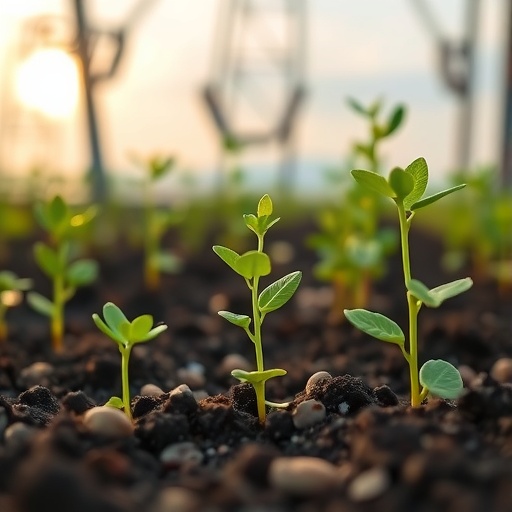
In the face of an increasingly volatile climate marked by extreme weather events, the capacity of crops to withstand and recover from environmental stresses has never been more critical. Researchers at the University of British Columbia (UBC) have unveiled groundbreaking insights into the genetic and cellular mechanisms that enable plants to pause growth during adverse conditions such as cold snaps and saltwater inundation, subsequently resuming development and ensuring survival and productivity. This discovery heralds a transformative advance in creating climate-resilient crops capable of withstanding abrupt stressors while maintaining agricultural yield.
Published in the esteemed journal New Phytologist, the study meticulously identifies the key gene pathways that underpin plants’ remarkable ability to modulate root growth in response to environmental challenges. Root growth, fundamentally reliant on the tightly regulated process of cell division, is temporarily suspended under stress conditions but reactivated when favorable environmental conditions return. This dynamic pause-and-recover growth pattern is vital for plants to survive episodic stresses like frost, salinization due to flooding, or drought.
The research team employed a model plant species subjected to controlled cold and salt stress treatments to explore root growth dynamics. They then extended their experiments to encompass two wild grass species genetically related to major crop plants, revealing conserved responses that suggest a universal cellular recovery mechanism across diverse plant taxa. This cross-species consistency underlines the evolutionary significance of the identified pathways and their potential applicability in agricultural biotechnology.
A cornerstone of the study was the detailed examination of cell cycle activity during stress and recovery phases. Utilizing fluorescently tagged proteins that mark key regulators of cell division, the researchers conducted exhaustive cell counts over several months. Their data demonstrated a marked decline in the presence of these proteins during stress periods, notably within cells actively engaged in mitotic proliferation. Remarkably, about 24 hours after stress removal and restoration of optimal growth conditions, protein levels and cell division rates rebounded to baseline values, signaling a rapid recovery process.
Central to this regulatory system is the gene Cyclin-dependent Kinase A;1 (CDKA;1), which orchestrates the transition through critical cell cycle phases. Functional disruption of CDKA;1 rendered plants incapable of resuming normal root growth post-stress, confirming its indispensable role in enabling recovery. By pinpointing CDKA;1 as a molecular switch modulating the restart of the cell cycle, the study illuminates a promising target for genetic intervention aimed at enhancing stress resilience.
This discovery gains additional significance against the backdrop of recent findings regarding plant responses to heat and osmotic stresses. Parallel research, currently under peer review, reveals that plants accelerate growth during heat stress to survive unfavorable periods, followed by a strategic pause until temperatures stabilize. Osmotic or drought stress responses also invoke a pause in root growth, although recovery intervals tend to be longer, reflecting the complexity of cellular adjustments required to re-establish homeostasis.
The implications for global food security are profound. With climate models predicting an uptick in the frequency and severity of extreme weather episodes, crops that can swiftly and effectively recover from environmental insults will be pivotal in sustaining stable yields. The capacity to engineer or breed plants with optimized pause-and-push mechanisms could mitigate harvest losses and bolster resilience in the agricultural sector.
Looking ahead, the UBC team aims to translate their model plant discoveries into practical advances for canonical Canadian crops, including various wheat cultivars. Employing cutting-edge CRISPR gene-editing technology, researchers anticipate developing novel lines with modulated expression of CDKA;1 and associated pathways to enhance recovery rates post-stress. Such innovations could fundamentally reshape crop breeding paradigms by incorporating resilience traits at the genetic level to meet the demands of future climates.
The study also reinforces the broader concept that growth modulation during stress is not merely a survival tactic but an adaptive strategy that balances preservation of cellular integrity with eventual resumption of productivity. Understanding the biochemical cues and signaling networks that govern this balance will be essential for designing tailored agricultural interventions.
Beyond agricultural applications, these findings enrich fundamental plant biology by unraveling the intricate interplay between environmental sensing and cellular proliferation. The integration of physiological and molecular data underscores the sophistication of plant responses to fluctuating environments and expands the horizon for multidisciplinary research.
Ultimately, this research exemplifies the promise of leveraging molecular genetics and advanced microscopy to map complex traits like stress recovery. By illuminating the genetic architecture and cellular choreography of growth modulation, the study equips plant scientists with new tools and targets to engineer the next generation of resilient crops.
As our climate continues its unpredictable course, scientific advances like these provide a beacon of hope. They articulate a vision in which biotechnology empowers agriculture to not only survive but thrive in the face of climatic upheaval, ensuring food security for generations to come.
News Publication Date: [Not explicitly provided in the content]
Web References:
- New Phytologist article: https://nph.onlinelibrary.wiley.com/doi/10.1111/nph.71041
- DOI link: http://dx.doi.org/10.1111/nph.71041
Cite Scienmag News
Russell Cooper. (March 11, 2026). Plants Adjust Growth Patterns—Pausing, Accelerating, or Speeding Up—In Response to Different Climate Stresses. Scienmag. https://scienmag.com/plants-adjust-growth-patterns-pausing-accelerating-or-speeding-up-in-response-to-different-climate-stresses/
Russell Cooper. "Plants Adjust Growth Patterns—Pausing, Accelerating, or Speeding Up—In Response to Different Climate Stresses." Scienmag, 11 March 2026, https://scienmag.com/plants-adjust-growth-patterns-pausing-accelerating-or-speeding-up-in-response-to-different-climate-stresses/. Accessed 3 September 2026.
Russell Cooper. "Plants Adjust Growth Patterns—Pausing, Accelerating, or Speeding Up—In Response to Different Climate Stresses." Scienmag. March 11, 2026. https://scienmag.com/plants-adjust-growth-patterns-pausing-accelerating-or-speeding-up-in-response-to-different-climate-stresses/


