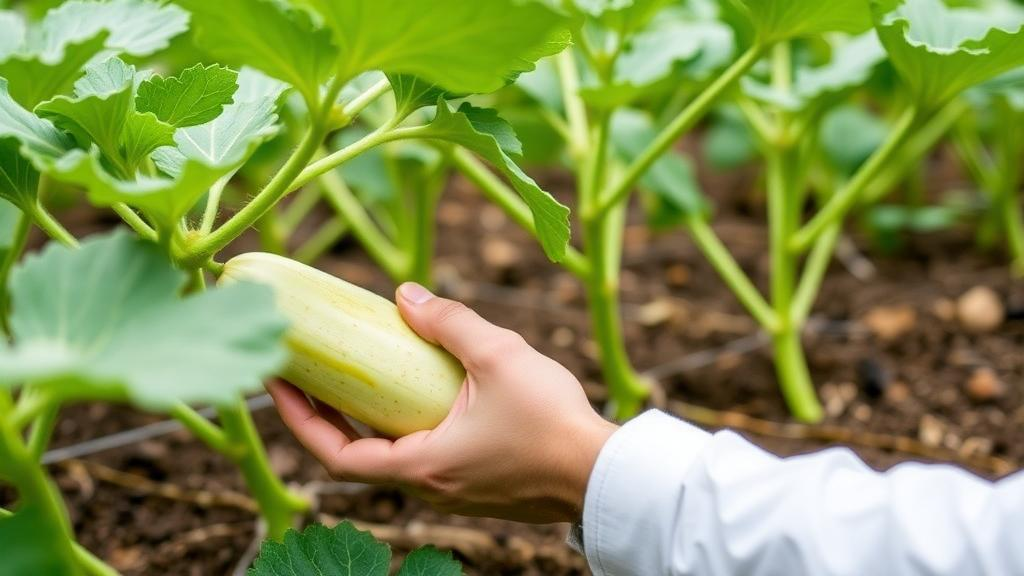
Robotic harvesters in commercial greenhouses are failing not because they cannot see cucumbers, but because they cannot physically reach them. A new study from Japan’s National Agriculture and Food Research Organization (NARO) shows that simple plant architecture traits—long fruit peduncles, a single fruit per node, and a lower fruiting position—can more than double the harvest success rate of a cucumber-picking robot, without any change to the machine itself. The work, published in Smart Agricultural Technology, suggests that breeding crops to suit robots may be a faster route to automated greenhouse farming than building ever more dexterous machines.
The research team, led by Kazuya Maeda, set out to quantify a problem that has long frustrated agricultural roboticists. Deep learning has made fruit detection highly accurate, yet actual harvesting success in commercial greenhouses remains stubbornly low. In cucumber cultivation, fruits are frequently hidden behind leaves, stems, or neighboring fruits, and the peduncles—the short stalks attaching fruit to the plant—are often buried deep within the canopy. In multi-fruiting varieties, several peduncles and fruits crowd a single node, leaving the robotic gripper almost no room to work. Even a clearly detected fruit can be unreachable if it hangs on the far side of the main stem relative to the robot’s approach direction, forcing the manipulator to collide with the stem before it can grasp.
The researchers reasoned that if the machine cannot easily be improved, the plant could be. This philosophy—adapting the crop to the machine rather than the machine to the crop—has precedent in sweet pepper and strawberry research, where dense vegetation and plant orientation were shown to influence robotic reachability. What was missing for cucumber was a quantitative link between specific architectural traits and harvesting performance. To build that link, the team first profiled the morphology of 20 commercial cucumber cultivars, mainly Japanese varieties, grown during the 2025–2026 winter season at NARO’s Ano and Tsukuba Research Centers in rockwool hydroponic greenhouses.
Four stems per cultivar were measured across seven traits: fruit peduncle length, petiole length, leaf length, fruit position measured from the top of the stem, internodal length, number of fruits per node, and the average number of fruits harvested per plant. Principal component analysis condensed this variation, with the first two components accounting for 62.8 percent of the total variance.
The harvesting trials used a commercial robotic system from AGRIST Inc. comprising a six-degree-of-freedom manipulator with a hybrid suction-and-gripper end-effector mounted on a mobile platform traveling along inter-row pipes. The robot’s workspace extended from 400 to 1250 millimeters above the ground, with a horizontal reach of up to 900 millimeters. Vision was handled by a lightweight YOLOv4-tiny detection model running on an NVIDIA Jetson Xavier NX edge computer, trained to recognize two classes—fruit and peduncle—on thousands of images from commercial greenhouses. An Intel RealSense D405 RGB-D camera in an eye-in-hand configuration converted two-dimensional bounding boxes into three-dimensional coordinates, using the median of multiple sampled depth readings to counteract noise from partial leaf occlusion. Hardware and control algorithms were held constant throughout, so that any difference in performance could be attributed to plant architecture alone.
Over seven harvesting sessions during the peak production phase, six to twelve weeks after transplanting, between 126 and 172 fruits per cultivar were targeted. Plants were defoliated to roughly 15 leaves before each trial to standardize the occlusion environment. The results were striking. ‘Proloog’ achieved a 57 percent harvest success rate and ‘Nina Z’ 42 percent, both significantly higher than ‘Josho’ at about 24 percent and ‘Marin’ at about 22 percent, according to ANOVA with Tukey’s post-hoc test. Cycle times told a similar story: ‘Proloog’ averaged roughly 80 seconds per fruit, ‘Nina Z’ 117 seconds, and ‘Josho’ the longest at 200 seconds per fruit.
To understand why, the team retrospectively analyzed system logs and classified every failure into three modes: detection failure, approach failure, and grasping failure. The pattern was decisive. Detection failures accounted for only 8.4 to 12.7 percent of errors across all four cultivars, while approach and grasping failures together made up 87.3 to 91.6 percent. Approach failures—physical collisions with the main stem or adjacent fruits before reaching the target—were the most frequent category for every cultivar, ranging from 48.3 to 56.6 percent. ‘Marin’, with its two-fruits-per-node habit, showed the highest grasping failure rate at 43.3 percent, while single-fruiting ‘Proloog’ recorded the lowest at 30.7 percent. The bottleneck, in short, was mechanical access, not machine vision.
Statistical modeling confirmed which traits mattered most. A correlation analysis found a strong positive association between fruit peduncle length and harvest success rate (r = 0.72) and a negative association between the number of fruits per node and success (r = −0.67). Because several morphological traits were inter-correlated, the team used partial least squares (PLS) regression, which is robust to multicollinearity, with the harvest success rate as the response variable. Three traits emerged with Variable Importance in Projection scores above the significance threshold of 1.0: fruit peduncle length, number of fruits per node as a negative contributor, and fruit position. Mechanistically, the authors explain, an extended peduncle provides mechanical clearance for the gripper to approach and detach fruit without damaging the stem or support wires; fewer fruits per node reduces clustering that obstructs the end-effector; and a lower fruiting position sits in a zone naturally separated from the dense vegetative mass, reducing both visual occlusion and the computational load of collision-free motion planning.
Notably, the study found no evidence that architectural simplification sacrifices harvestable yield within the robot’s workspace. Despite its single-fruit habit, ‘Proloog’ showed no decrease in the number of harvested fruits under the cultivation and evaluation conditions of the profiling experiment, consistent with the physiological principle that yield is driven primarily by light interception rather than fruit number, provided leaf area index remains optimal. The authors are careful to flag the limits of this claim: total biological yield, including fruits outside the robotic workspace, was not compared, and full-scale yield trials across multiple seasons will be needed to confirm overall agronomic productivity, fruit quality, and disease resistance. They also acknowledge potential trade-offs—excessively long peduncles could increase physical damage risk, a strict single-fruit habit might cap theoretical yield, and lower fruit positioning could alter the microclimate in ways that favor humidity-related diseases.
The study has other constraints worth noting. Only four commercial cultivars were tested, and in such varieties the favorable traits often vary together and may be genetically coupled, so the independent effects of peduncle length and single-fruit habit cannot be fully separated from this dataset. The authors call for future work with near-isogenic lines or segregating populations to establish causality. Even so, the headline numbers are compelling: ‘Proloog’ achieved a 2.4-fold higher success rate than the standard cultivar ‘Josho’ (57 percent versus 24 percent) and cut cycle time from 200 to 80 seconds per fruit, entirely through plant architecture with unchanged robot hardware and software. While 80 seconds remains slower than specialized prototypes reported at 24 to 33 seconds for other crops, the Japanese context matters—cucumbers there are harvested smaller and higher in an actively growing, densely occluded canopy, unlike the defoliated lower stems of Dutch high-wire systems. The broader message is that breeding for robot-ready traits—long peduncles, single-fruit setting, and lower fruit position—offers a viable strategy to break through the efficiency ceiling of current cucumber harvesting robots, potentially without compromising commercial productivity.
Subject of Research: Morphological traits of greenhouse cucumber cultivars that determine robotic harvesting efficiency
Article Title: Key morphological determinants of robotic harvesting efficiency in greenhouse cucumbers
Article References: Maeda, K., Yoneda, Y., Sugiyama, M., & Ahn, D.-H. (2026). Key morphological determinants of robotic harvesting efficiency in greenhouse cucumbers. Smart Agricultural Technology, 15, Article 102638. https://doi.org/10.1016/j.atech.2026.102638
Image Credits: AI Generated
DOI: 10.1016/j.atech.2026.102638
Keywords: agricultural robotics, greenhouse cucumbers, plant architecture, harvesting robots, peduncle length, fruit clustering, PLS regression, crop breeding, automation, NARO, YOLOv4-tiny, cycle time
Cite Scienmag News
Denise Maddox. (October 29, 2026). Plant Shape, Not Robot Skill, Limits Cucumber Harvesting Success. Scienmag. https://scienmag.com/plant-shape-not-robot-skill-limits-cucumber-harvesting-success/
Denise Maddox. "Plant Shape, Not Robot Skill, Limits Cucumber Harvesting Success." Scienmag, 29 October 2026, https://scienmag.com/plant-shape-not-robot-skill-limits-cucumber-harvesting-success/. Accessed 30 October 2026.
Denise Maddox. "Plant Shape, Not Robot Skill, Limits Cucumber Harvesting Success." Scienmag. October 29, 2026. https://scienmag.com/plant-shape-not-robot-skill-limits-cucumber-harvesting-success/