


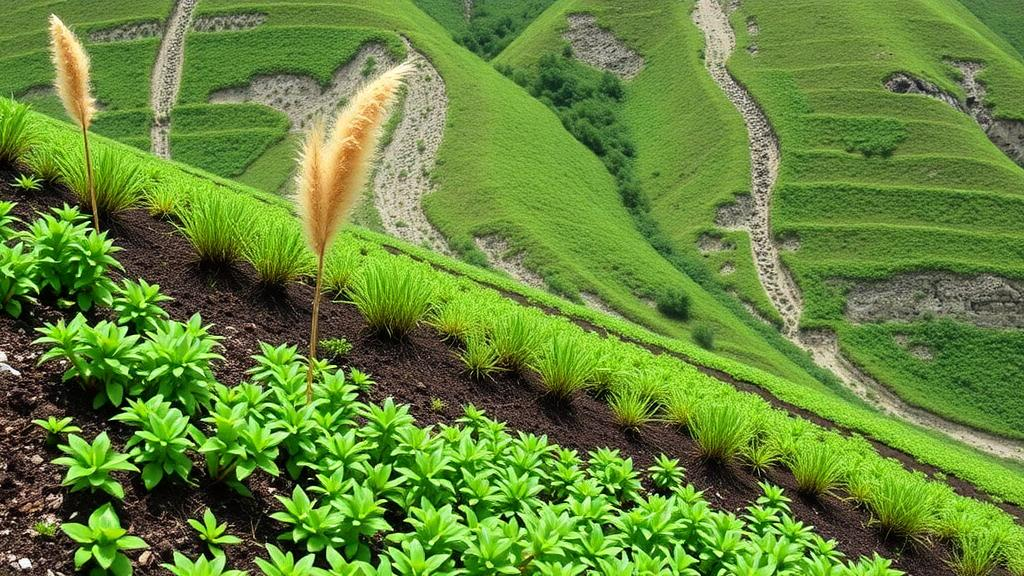
Grasslands store an enormous share of the planet’s soil carbon, and a new study from the Tianshan Mountains in northwestern China suggests that the single most important living lever over that carbon may not be the microbes so often credited with controlling it, but the plants growing above the ground. The research, published in the journal Plant and Soil, tracked soil organic carbon, plant communities, microbial communities, and plant productivity across a dramatic elevational span from 208 to 3,165 meters on the northern slope of the Tianshan range. The findings point to an indirect, productivity-mediated pathway in which plant diversity boosts aboveground net primary productivity, which in turn shows the strongest positive association with soil carbon accumulation of any factor the team measured.
The study addresses a persistent puzzle in carbon cycle science. Soil organic carbon is a major component of terrestrial carbon stocks, yet how climate, soil properties, and biotic communities jointly regulate it along elevational gradients has remained unclear. Mountains are natural laboratories for this question because they compress enormous environmental variation into short distances: temperature, moisture, soil chemistry, and vegetation all shift as one climbs a slope. By sampling along nearly 3,000 vertical meters, the researchers could observe how each of these variables rises, falls, and interacts without needing to compare sites scattered across continents.
One of the study’s most striking results is that soil organic carbon did not simply increase or decrease with elevation. Instead, it varied nonlinearly, peaking at around 2,017 meters. Plant diversity mirrored this pattern almost exactly, tracking the same mid-elevation peak. Bacterial and fungal diversity, by contrast, peaked at intermediate elevations in a pattern that did not align as tightly with the carbon maximum. This mismatch matters, because it hints from the outset that the belowground communities so often assumed to govern soil carbon may not be the primary drivers of where carbon accumulates on a mountainside.
When the team examined community composition, all three groups of organisms, plants, bacteria, and fungi, differed significantly along the gradient. But the mechanisms assembling those communities turned out to be strikingly different. Plant communities were primarily shaped by environmental filtering, meaning that only species suited to the local climate and soil conditions survive at each elevation. Bacterial communities were structured mainly by geographic distance, consistent with dispersal limitation shaping which microbes are present where. Fungal communities were governed by soil moisture, nutrients, and pH. These divergent assembly rules underscore that plants and microbes respond to fundamentally different filters, which helps explain why their diversity patterns decouple from one another along the slope.
The statistical core of the study lies in its path analysis, a technique that allows researchers to disentangle direct and indirect effects among interacting variables. The analysis revealed that climate was negatively associated with both soil properties and plant diversity, while plant diversity was positively associated with aboveground net primary productivity, or ANPP. ANPP, in turn, showed the strongest positive direct association with soil organic carbon of any pathway in the model. In other words, the chain runs from climate through plant diversity through productivity to soil carbon, with plant diversity emerging as the dominant biotic factor associated with carbon accumulation.
Perhaps the most provocative conclusion is what the analysis did not find. Microbial diversity showed no significant direct effect on soil organic carbon, and neither did its interaction with plant diversity. This challenges a prevailing view in soil science that microbial diversity dominates the regulation of soil carbon. That view has gained traction in recent years, driven in part by growing recognition that microbial necromass, the residual cell material of dead microbes, contributes substantially to stable soil organic matter, and that microbial carbon use efficiency strongly influences how much carbon is retained in soils globally. The Tianshan results do not deny that microbes process carbon, but they suggest that, at least along this elevational gradient, the amount of carbon entering the soil through plant productivity matters more than the diversity of the organisms doing the processing.
The productivity pathway makes mechanistic sense. Diverse plant communities tend to produce more biomass because different species exploit different resources, occupy different niches, and complement one another in capturing light, water, and nutrients. More biomass means more litter, more roots, and more root exudates, all of which are the raw inputs from which soil organic carbon is built. Previous work has shown that plant diversity increases soil microbial activity and soil carbon storage, and that the positive effect of plant diversity on soil carbon depends on climate. The new study extends this logic to a mountain gradient, showing that the diversity-productivity-carbon chain holds across a wide range of climatic conditions within a single landscape.
The implications for grassland management and climate policy could be significant. Grassland soil carbon sequestration is widely regarded as a nature-based climate solution, and estimates of its potential often hinge on assumptions about which factors can be manipulated to increase carbon inputs. If plant diversity is the dominant biotic lever, then restoring diverse plant communities, whether through reseeding, grazing management, or protection from degradation, may be a more reliable route to carbon gains than interventions targeting microbial communities directly. The study also highlights the special importance of mid-elevation zones, where both plant diversity and soil carbon peak, suggesting these elevational belts deserve particular attention in conservation and restoration planning.
There are, of course, caveats. The study examined relationships across an elevational gradient at a single point in time, so it identifies associations rather than experimentally proven causal chains. The authors note that their findings support an indirect, productivity-mediated pathway linking plant diversity to soil carbon accumulation, and the path analysis framework is designed to evaluate such pathways rigorously, but long-term manipulative experiments would be needed to confirm that increasing plant diversity directly causes soil carbon gains under all the climatic conditions represented along the slope. It also remains to be seen whether the pattern holds in other mountain systems, in forests, or in agricultural landscapes, where management histories and plant communities differ profoundly from natural grasslands.
Even with those caveats, the study adds an important piece to one of the biggest puzzles in Earth system science: predicting how soils will store or release carbon as the climate changes. Climate models increasingly recognize that soil carbon responses depend on the interplay between plant inputs, microbial processing, and environmental conditions, yet the relative weights of these factors remain contested. By showing that plant diversity can dominate over microbial diversity as a biotic correlate of soil carbon along a nearly 3,000-meter gradient, the Tianshan study argues for keeping plants at the center of the soil carbon conversation. For a field that has spent much of the past decade looking downward, into the lives of bacteria and fungi, the message from the mountains is to look up as well, at the diversity of the vegetation that feeds the entire belowground economy.
Subject of Research: Plant diversity effects on soil organic carbon sequestration along an elevational gradient in Tianshan Mountain grasslands
Article Title: Plant diversity promotes soil carbon sequestration via productivity pathways along elevational gradients
Article References: Zhang, Y., Zhou, X., Yan, K., Liu, J., Xin, H., Gong, L., & Li, C. (2026). Plant diversity promotes soil carbon sequestration via productivity pathways along elevational gradients. Plant and Soil. https://doi.org/10.1007/s11104-026-09093-3
Image Credits: AI Generated
DOI: 10.1007/s11104-026-09093-3
Keywords: soil organic carbon, plant diversity, elevational gradient, grassland, microbial communities, primary productivity, carbon sequestration, Tianshan Mountains, soil science, biogeography, path analysis, climate
Cite Scienmag News
Alan Morgan. (October 10, 2026). Plant Diversity, Not Microbes, Drives Soil Carbon Storage Along Mountain Slopes. Scienmag. https://scienmag.com/plant-diversity-not-microbes-drives-soil-carbon-storage-along-mountain-slopes/
Alan Morgan. "Plant Diversity, Not Microbes, Drives Soil Carbon Storage Along Mountain Slopes." Scienmag, 10 October 2026, https://scienmag.com/plant-diversity-not-microbes-drives-soil-carbon-storage-along-mountain-slopes/. Accessed 10 October 2026.
Alan Morgan. "Plant Diversity, Not Microbes, Drives Soil Carbon Storage Along Mountain Slopes." Scienmag. October 10, 2026. https://scienmag.com/plant-diversity-not-microbes-drives-soil-carbon-storage-along-mountain-slopes/


