


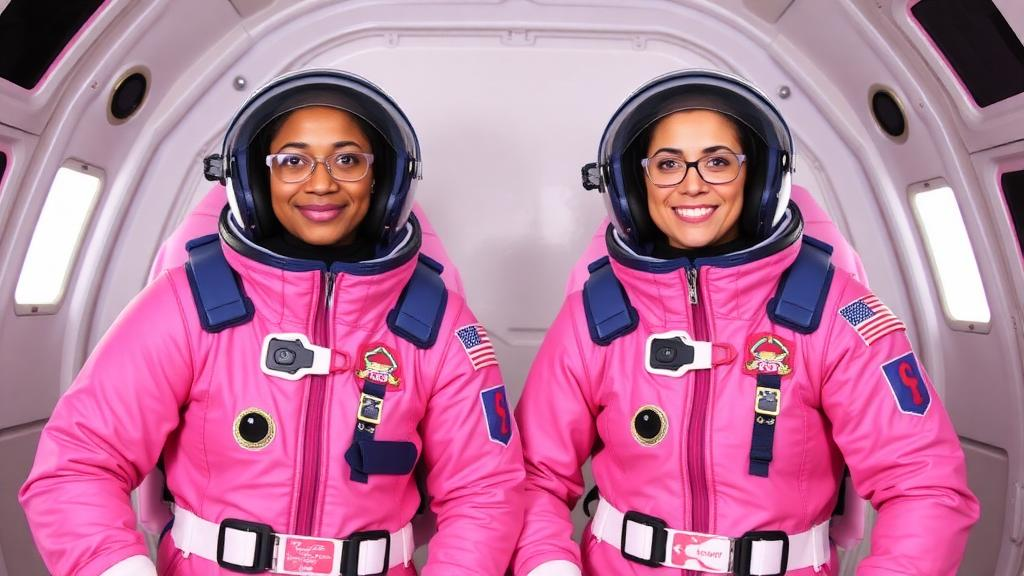
When a six-year-old girl asked her mother why a flight jacket could not be pink or purple, she was articulating, in the uncomplicated logic of childhood, a question that has shadowed women in science for generations: why should credibility and femininity be treated as opposites? Her mother, Kellie Gerardi, is an astronaut, researcher and science communicator, and when she later appeared on a television interview wearing a bright pink flight jacket, her daughter pointed at the screen with unmistakable delight. The exchange, shared through a post on Gerardi’s Instagram account, was a personal moment rendered in the visual language of social media. Yet it also carried a message with real weight for the public understanding of science: femininity and scientific authority are not mutually exclusive, and the platforms on which millions now encounter science are precisely where that message can land.
That Instagram post is one of 194 pieces of content analysed in a new study published in the Journal of Science Communication (JCOM), which examined the social media activity of three women astronauts and science influencers: Kellie Gerardi, Shawna Pandya and Norah Patten. The research was conducted by Karen Shalev and Shannon Pappas, both graduate students, and Jocelyn Steinke, professor of communication at the University of Connecticut. Its central conclusion is deceptively simple but consequential for anyone who thinks about how science reaches the public in the digital era. Science communication on social media, the authors find, involves far more than explaining facts and concepts. Personal experiences, the communicator’s own identity and the platform-specific tools of Instagram, from music and hashtags to humour and references to popular culture, all contribute to shaping the message that audiences ultimately receive.
According to Steinke, the strategic dimension of this work is what sets the study apart. The three science influencers, she explains, framed their messages on Instagram deliberately, not only to communicate scientific information and foster public interest and engagement in STEMM, the collective abbreviation for science, technology, engineering, mathematics and medicine, but also to build their own personal brands and expand their audiences on the platform. In an environment where attention is the scarcest resource, the study suggests, effective science communication looks less like a lecture and more like a carefully composed narrative in which the scientist is also a character, the laboratory is also a stage, and the audience is invited to follow a person rather than merely absorb a topic.
The material the researchers examined was bounded in time and circumstance. They analysed posts published on the three influencers’ Instagram accounts between 24 June and 24 November 2024, a window that opened after the announcement of an upcoming Virgin Galactic research mission featuring Gerardi, Pandya and Patten as an all-women, international crew. That announcement gave the study a natural focal point: three women preparing, individually and collectively, for spaceflight, and documenting the process in public. The researchers did not sample selectively. They analysed all components of the posts, including photographs, videos, written text, audio, hashtags and emojis, treating each element as part of the communicative act rather than as decoration around a written core.
Methodologically, the study asked three questions about each message: what topics the influencers selected, how they framed those topics, and which communication tactics they used to attract attention. In the language of framing theory, the researchers considered what the influencers encouraged audiences to think about, how they guided audiences to interpret those subjects, and where they directed the audience’s attention. The analysis identified six broad topics, seven message frames and five types of communication tactics across the corpus of 194 posts, a structure that allowed the team to map how the same platform can carry both technical content and intimate autobiography without one undermining the other.
The topics themselves ranged from the rigorously scientific to the deeply personal. Some posts focused on the women’s research and training, explained scientific phenomena and showed experiments conducted in microgravity. Others traced the personal journeys that had led each of them into STEMM, naming the people who had encouraged them, the challenges they had faced and the textures of their everyday lives. Gerardi, for example, has spoken publicly about motherhood, infertility and her experiences with in vitro fertilisation. Patten shared photographs from her first visit to the Kennedy Space Center with her father and brother when she was fifteen. Pandya recalled the experiences and mentors who contributed to her path to becoming an astronaut. These posts allow audiences to see not only the scientific work but the people carrying it out, along with the rarely linear routes that brought them there.
Steinke argues that this blend of expertise and intimacy is precisely the point. There is, she says, a strategic attempt not only to share knowledge about STEMM and STEMM careers but to provide an insider perspective and to connect with audiences more personally, fostering authenticity, connection and engagement with broad and diverse audiences. By sharing their experiences, the influencers can serve as influential role models for future generations and inspire girls to consider the possibility of becoming astronauts themselves. The claim matters because representation research has long suggested that visible, relatable exemplars shape who imagines themselves belonging in scientific fields. An astronaut who is also a mother, a daughter, a patient navigating fertility treatment or a person with a favourite pop star is a harder stereotype to dismiss than the austere figure of conventional imagination.
The tactics the women deploy are thoroughly native to Instagram. The posts adopt the forms and conventions of the platform: short videos, photo carousels, text overlaid on images, hashtags, emojis, trending music and references to popular culture. Taylor Swift, David Bowie and Charli xcx all feature in some of the posts. Gerardi jokingly refers to herself as a bratstronaut, a wink at a pop-cultural moment, while footage of parabolic flights is accompanied by songs about space or weightlessness. The women also use humour, wordplay and immediately recognisable visual elements, including flight suits, models, clothing decorated with stars and planets, and footage recorded during training. According to the authors, these elements are more than decorative additions. They help adapt the content to the platform, attract attention and connect science with forms of expression that are already familiar to Instagram users, lowering the barrier between specialist knowledge and everyday scrolling.
The personal dimension of the content also does quiet ideological work. In their posts, the three women present themselves simultaneously as astronauts, researchers, doctors, mothers, daughters and women interested in fashion or music. By making these multiple identities visible at once, they demonstrate that there is no single way to look or behave in order to be credible in STEMM. The pink flight jacket that opened this story is emblematic: a garment that signals belonging to the tradition of test pilots and spacefarers, rendered in a colour that tradition has historically excluded. The study’s framing analysis suggests that such choices are communicative acts, guiding audiences toward an interpretation of science and scientists that is broader and more inclusive than the one most people inherit.
The authors are careful about the limits of what they can claim. This is a qualitative analysis of messages shared by three highly visible STEMM figures on a single platform and over a limited period. The study did not establish whether every communication choice was consciously planned by the women, nor whether they manage their accounts with professional assistance. It also did not examine how audiences interpreted the posts or which content attracted the most attention and engagement, questions that future research should address. Even so, the scale of the potential reach is hard to ignore. At the time the study was conducted, the three influencers had a combined following of more than 1.5 million Instagram users, a figure that dwarfs the audience of most traditional science outreach. The findings, the authors suggest, offer useful insights for the training of scientists and science communicators, because communicating strategically means considering not only what information to convey but how to present it, which parts of one’s experience to share, and how to adapt a message to the context in which audiences will encounter it. Women in STEMM, Steinke concludes, are using social media to gain visibility and voice, to advance their goals as science communicators, to change perspectives on the role and contributions of women in the field, and to inspire younger generations to consider STEMM careers as a future option. One post at a time, the frame is being rewritten.
Subject of Research: Strategic science communication practices of women astronaut science influencers on Instagram
Article Title: "Mom says a pink flight jacket is ok"
Article References: "Mom says a pink flight jacket is ok". (n.d.). Original publication
Image Credits: AI Generated
DOI: Not provided
Keywords: science communication, Instagram, women in STEMM, astronauts, social media, framing, Kellie Gerardi, Shawna Pandya, Norah Patten, role models, JCOM, University of Connecticut
Cite Scienmag News
Grant Pearson. (October 1, 2026). Pink Flight Jackets and Hashtags: How Women Astronauts Reframe Science on Instagram. Scienmag. https://scienmag.com/pink-flight-jackets-and-hashtags-how-women-astronauts-reframe-science-on-instagram/
Grant Pearson. "Pink Flight Jackets and Hashtags: How Women Astronauts Reframe Science on Instagram." Scienmag, 1 October 2026, https://scienmag.com/pink-flight-jackets-and-hashtags-how-women-astronauts-reframe-science-on-instagram/. Accessed 4 October 2026.
Grant Pearson. "Pink Flight Jackets and Hashtags: How Women Astronauts Reframe Science on Instagram." Scienmag. October 1, 2026. https://scienmag.com/pink-flight-jackets-and-hashtags-how-women-astronauts-reframe-science-on-instagram/


