


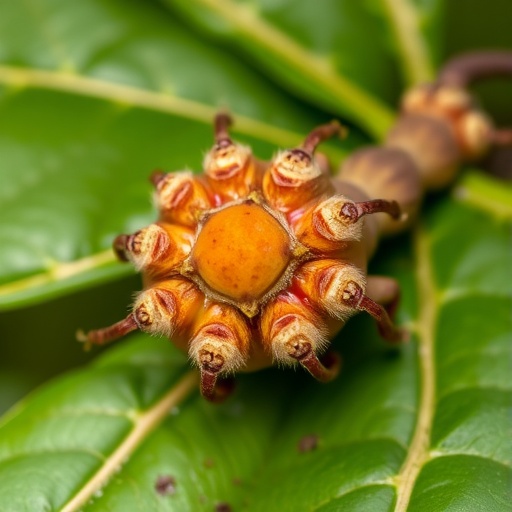
In a groundbreaking study that promises to revolutionize crop protection, researchers led by García Riaño and colleagues have unveiled the potent effects of volatile organic compounds (VOCs) derived from the yeast species Pichia kluyveri. This innovative research sheds light on the potential of these naturally occurring compounds to inhibit the growth of Moniliophthora roreri, one of the most notorious pathogens threatening cacao crops worldwide. The implications for cacao farmers and the chocolate industry could be profound, providing a sustainable alternative to synthetic fungicides.
The cacao industry faces numerous challenges, with Moniliophthora roreri being particularly devastating. This fungus is responsible for moniliasis, a disease that can decimate cacao yields, negatively impacting farmers and economies reliant on chocolate production. Traditional methods of controlling this pathogen often involve heavy reliance on chemical fungicides, which can have deleterious effects on both the environment and human health. As global consciousness shifts towards sustainability and eco-friendly practices, this research emerges as a timely and crucial development.
The study meticulously explores the biosynthetic pathways of VOCs produced by Pichia kluyveri. By analyzing the composition of these compounds, the research team identified specific volatile metabolites that exhibit antifungal properties. The impressive spectrum of VOCs not only demonstrates a remarkable ability to inhibit the growth of Moniliophthora roreri in vitro but also raises questions about their potential mechanisms of action. For instance, the study highlights how certain VOCs can disrupt the fungal cell membrane, leading to increased permeability and ultimately cell death.
Experimental results from the study reveal an unexpected twist: the application of VOCs does not merely serve as a fungicidal agent; it also enhances plant resilience. This dual-action capability could provide cacao plants with an added layer of defense against various biotic stresses. The findings suggest that when applied in cultivation practices, VOCs could not only suppress Moniliophthora roreri but could also bolster the plants’ innate immune responses, paving the way for healthier crops.
One of the remarkable aspects of this research lies in its ecological implications. The use of VOCs as biocontrol agents offers a viable pathway to reduce chemical dependency in agriculture. The study proposes a shift towards integrated pest management systems that rely on biological control methods, thus enhancing sustainability in cacao farming. This aligns seamlessly with the principles of organic farming, where the focus is on maintaining ecological balance while producing food.
Furthermore, the renewable aspect of using yeast-derived VOCs cannot be overlooked. Unlike synthetic compounds that can persist in the environment and lead to myriad issues such as resistance build-up, VOCs from natural sources can be biodegradable and less impactful on non-target organisms. This could lead to a future where farmers can utilize biopesticides derived from local yeast species, promoting not only environmental health but also economic viability.
The work conducted by García Riaño and colleagues opens the door for future research into the applications of these VOCs on a larger scale. Exploration of field trials will be crucial in determining optimal application methods, dosages, and formulations that can be integrated into existing agricultural practices. Follow-up studies should focus on evaluating the efficacy of these compounds under varied environmental conditions, which could help refine their use in diverse cacao-growing regions.
Through collaborations with farmers and agricultural practitioners, researchers can ensure that the findings are translated into practical, real-world applications. Educating farmers about the benefits of using yeast-derived VOCs could initiate a paradigm shift in cacao farming practices, moving away from high-input chemical approaches to more sustainable, low-impact alternatives. This change is not only necessary for environmental stewardship but could also enhance the long-term viability of cacao as a global commodity.
In addition to addressing Moniliophthora roreri, future research may delve into the broader applicability of Pichia kluyveri-derived VOCs. The antifungal potentials of these compounds could prove beneficial against other significant pathogens threatening various crops. Moreover, the understanding of VOC interactions in the plant microbiome could unlock additional layers of biocontrol mechanisms that further benefit agricultural systems.
The implications of this research extend beyond agriculture; they touch on important socio-economic aspects as well. By leveraging natural biocontrol agents, farmers can potentially reduce their operational costs associated with purchasing expensive chemical treatments. Consequently, this could enhance the livelihoods of smallholder cacao farmers, many of whom operate on thin profit margins. The ripple effect of such innovations could also reach consumers, who increasingly seek ethically sourced and environmentally friendly chocolate products.
In conclusion, the study conducted by García Riaño, Uribe-Gutiérrez, and Mejía illustrates a promising intersection of innovative science and practical agriculture. The VOCs produced by Pichia kluyveri emerge as a beacon of hope in the ongoing battle against cacao pathogens, with potential ramifications that could redefine pest management in agriculture. As researchers continue to explore the properties and applications of these compounds, the cacao industry stands on the brink of a sustainable transformation, potentially altering the sweet future of chocolate production.
Cite Scienmag News
Kristina Jarvis. (December 27, 2025). Pichia kluyveri Compounds Combat Cacao Pathogen Moniliophthora roreri. Scienmag. https://scienmag.com/pichia-kluyveri-compounds-combat-cacao-pathogen-moniliophthora-roreri/
Kristina Jarvis. "Pichia kluyveri Compounds Combat Cacao Pathogen Moniliophthora roreri." Scienmag, 27 December 2025, https://scienmag.com/pichia-kluyveri-compounds-combat-cacao-pathogen-moniliophthora-roreri/. Accessed 4 September 2026.
Kristina Jarvis. "Pichia kluyveri Compounds Combat Cacao Pathogen Moniliophthora roreri." Scienmag. December 27, 2025. https://scienmag.com/pichia-kluyveri-compounds-combat-cacao-pathogen-moniliophthora-roreri/


