


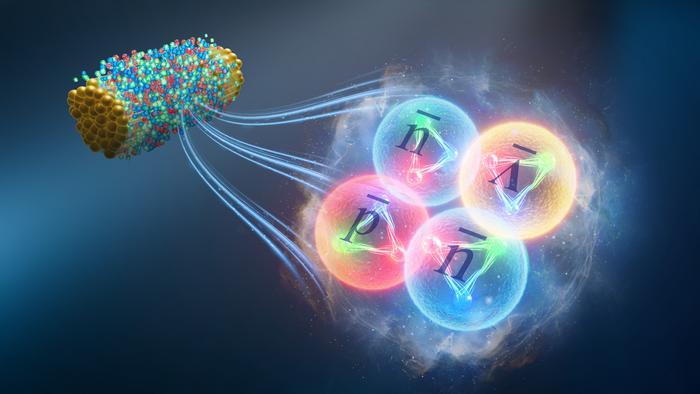
Physicists from the STAR Collaboration have observed a new antimatter hypernucleus, antihyperhydrogen-4, for the first time. This is the heaviest antimatter hypernucleus discovered in experiments to date. This study, led by researchers from the Institute of Modern Physics (IMP) of the Chinese Academy of Sciences, was published in Nature on Aug. 21.

Credit: Image by IMP
Physicists from the STAR Collaboration have observed a new antimatter hypernucleus, antihyperhydrogen-4, for the first time. This is the heaviest antimatter hypernucleus discovered in experiments to date. This study, led by researchers from the Institute of Modern Physics (IMP) of the Chinese Academy of Sciences, was published in Nature on Aug. 21.
Current physics assumes that the properties of matter and antimatter are symmetrical and that equal amounts of matter and antimatter existed at the birth of the universe. However, some mysterious physical mechanism caused the annihilation of most matter and antimatter, with only about one in ten billion matter particles surviving. These particles formed the matter world we see today.
“What caused the difference in quantities of matter and antimatter in the universe? To answer this question, an important approach is to create new antimatter in the laboratory and study its properties,” said Prof. QIU Hao from IMP.
In today’s matter-dominated world, antimatter is extremely rare because it easily annihilates with surrounding matter. Antimatter nuclei and antimatter hypernuclei (nuclei containing hyperons such as Lambda) formed by combining several antibaryons are even more difficult to produce. Since the Dirac equation indicated the existence of antimatter in 1928, scientists have discovered only six types of antimatter (hyper)nuclei over nearly a century.
The newly discovered antihyperhydrogen-4 was produced at the Relativistic Heavy Ion Collider (RHIC) in the United States. RHIC can accelerate heavy ion beams to nearly the speed of light and make them collide. These collisions simulate the conditions of the early universe in the laboratory, producing fireballs with temperatures of several trillion degrees, which contain approximately equal amounts of matter and antimatter. As the fireball rapidly expands and cools, some antimatter escapes annihilation with matter and is detected by the STAR detector.
Antihyperhydrogen-4 is composed of one antiproton, two antineutrons, and one anti-Lambda hyperon. Due to the presence of the unstable anti-Lambda hyperon, antihyperhydrogen-4 decays after traveling merely a few centimeters.
“After analyzing experimental data of approximately 6.6 billion heavy-ion collision events, we reconstructed antihyperhydrogen-4 from its decay products antihelium-4 and π+ meson, and identified a signal of about 16 antihyperhydrogen-4,” said WU Junlin, a PhD student at IMP.
The researchers also measured the lifetime of antihyperhydrogen-4 and found no significant difference compared to that of its corresponding particle hyperhydrogen-4 within the limits of measurement precision, further verifying the symmetry between matter and antimatter properties.
The discovery and study of antihyperhydrogen-4 mark a significant advancement in the exploration of antimatter and the understanding of matter-antimatter symmetry.
Cite Scienmag News
Bethany Barker. (August 21, 2024). Physicists discover heaviest antimatter hypernucleus to date. Scienmag. https://scienmag.com/physicists-discover-heaviest-antimatter-hypernucleus-to-date/
Bethany Barker. "Physicists discover heaviest antimatter hypernucleus to date." Scienmag, 21 August 2024, https://scienmag.com/physicists-discover-heaviest-antimatter-hypernucleus-to-date/. Accessed 3 September 2026.
Bethany Barker. "Physicists discover heaviest antimatter hypernucleus to date." Scienmag. August 21, 2024. https://scienmag.com/physicists-discover-heaviest-antimatter-hypernucleus-to-date/

