


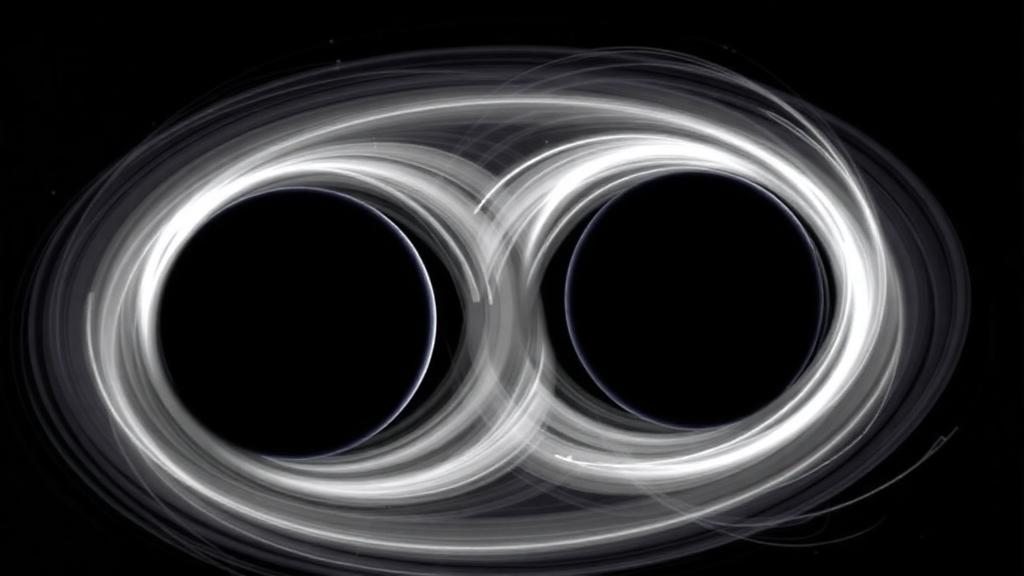
Every time the LIGO and Virgo detectors catch the chirp of two black holes spiraling into each other, scientists must compare the faint signal against millions of theoretical templates. The quality of those templates depends on how accurately theorists can describe the motion of two massive bodies tugging at each other through curved spacetime. A new study published in The European Physical Journal C by Hanjun Zou, Sheng Long, Xiaokai He and Zhoujian Cao takes a significant step forward in that effort, delivering a consistent effective metric for bound binary systems at third post-Minkowskian order, a level of precision that matters most when the two objects are moving at a substantial fraction of the speed of light.
The work is rooted in the effective-one-body (EOB) framework, a celebrated theoretical tool originally developed by Thibault Damour and Alessandra Buonanno. The central idea is elegant: instead of solving the fiendishly complicated two-body problem of general relativity directly, one maps it onto the motion of a single effective particle traveling through a deformed version of spacetime. If the mapping is done correctly, the geodesic motion of that fictitious particle reproduces the full conservative dynamics of the real binary. The catch is that the deformation, encoded in an effective spacetime metric, is not unique. Theorists must decide how quantities in the real two-body system correspond to quantities in the effective one, and different choices of this dictionary lead to different effective metrics that nonetheless describe the same physics.
Historically, the EOB framework was built on the post-Newtonian expansion, which works well when the orbiting bodies move slowly and gravity is weak, as in the early inspiral of a binary. But the final moments before merger are neither slow nor weak-field, and that is where the post-Minkowskian (PM) expansion enters. Rather than expanding in velocity, the PM expansion treats gravity’s coupling constant G as the small parameter while keeping velocities fully relativistic. Recent breakthroughs in scattering-amplitude calculations, notably by Zvi Bern and collaborators in 2019, have supplied the explicit conservative Hamiltonian for a nonspinning two-body system at third post-Minkowskian order, opening the door to pushing EOB models into the fast-motion regime.
Most previous PM-EOB constructions relied on scattering problems: two bodies fly past each other and deflect, and theorists match the scattering angle computed in the real system to the one computed in the effective spacetime. That approach has produced impressive results, but it requires an additional conceptual step, the Kalin-Porto map, to translate scattering information into predictions for bound orbits. The new study takes a more direct route. Because the most common gravitational-wave sources detected so far are bound, inspiraling binaries rather than unbound scattering events, the authors work exclusively with quantities intrinsic to closed orbits: the radial action variable and the precession angle of an elliptical trajectory.
The radial action is an adiabatic invariant, a quantity that stays constant as the orbit slowly evolves, computed by integrating the square root of an effective radial potential between the periastron and apastron turning points. Using the 3PM Hamiltonian from scattering-amplitude research, the team evaluated this integral for the real two-body system and, in parallel, for a test particle moving in a deformed Schwarzschild-like metric. A subtle technical point emerged: the direct third-order contribution to the radial action vanishes, but the full 3PM information is not lost. Because the radial action is a nonlinear functional of the potential, cross-terms appear at fourth order in G divided by the cube of angular momentum, and these terms carry exactly the missing information. Matching the real and effective radial actions at this level yields a set of correspondence relations without ever introducing genuine fourth-post-Minkowskian dynamics.
To check this result independently, the authors turned to the precession angle, the amount by which a bound orbit fails to close after each revolution, the same relativistic effect famously first observed in the orbit of Mercury. For the real system, the calculation reduces to an integral that evaluates to a complete elliptic integral of the first kind, which can be expanded analytically in the weak-binding limit. For the effective system, the team worked in isotropic coordinates, where the radial momentum squared takes a particularly clean form terminating at the inverse-cube term, dramatically simplifying the analysis. Remarkably, matching the precession angles produced exactly the same correspondence relations as the radial action method, a consistency check that strongly supports the validity of the construction.
With the correspondence established, the remaining freedom in the effective metric had to be fixed through a choice of parametrization. The authors adopted an isotropic gauge with a Schwarzschild-like parametrization, setting the first-order coefficient of the spatial part to unity and higher-order coefficients to zero, an alternative to the Finsler-type corrections used in Damour’s earlier scattering-based approach. The result is an explicit effective metric whose second- and third-order coefficients, a2 and a3, are expressed entirely in terms of the physical parameters of the real binary, including its total relativistic energy. Intriguingly, the metric depends on the conserved energy of the orbit, meaning each bound orbit is described by its own member of a family of effective geometries rather than by a single universal spacetime. The authors emphasize that this energy dependence is physically sensible: different initial configurations emit different gravitational waves, and since the energy is conserved, the corresponding effective metric remains fixed along any given conservative orbit.
The team validated the construction by comparing the binding energy of quasi-circular orbits predicted by their new 3PM Hamiltonian against existing PM-EOB models, using both a recent fourth-post-Minkowskian Hamiltonian and numerical relativity simulations as benchmarks. The new formulation tracked the high-precision baselines more closely, and it did so without introducing Finsler-type terms or post-Newtonian input, which the authors highlight as a key advantage. The agreement with existing results at second post-Minkowskian order further confirms internal consistency, while the differences between approximants grow as the binary moves from inspiral toward merger, precisely the regime where improved modeling matters most for gravitational-wave astronomy.
The implications extend beyond formal elegance. EOB models calibrated to numerical relativity are the workhorses of LIGO and Virgo data analysis, and every improvement in the underlying analytical description translates into more accurate templates, better parameter estimation, and sharper tests of general relativity in the strong-field regime. By grounding the PM-EOB program directly in bound-state observables, the new work removes a conceptual detour and provides a practical tool for modeling the gravitational waves emitted by compact binaries. The authors outline clear next steps: extending the energy map and effective metric to higher post-Minkowskian orders and generalizing the framework to binaries with spin, the configuration relevant for most of the black hole mergers actually observed. As detectors grow more sensitive and begin resolving fainter, more distant mergers, the demand for theoretical templates of ever-greater fidelity will only intensify, and constructions like this one form the mathematical backbone of that effort.
Subject of Research: Effective-one-body modeling of bound two-body dynamics in general relativity at third post-Minkowskian order
Article Title: Effective metric for bound state in an effective-one-body theory based on the third-post-Minkowskian approximation
Article References: Zou, H., Long, S., He, X., & Cao, Z. (2026). Effective metric for bound state in an effective-one-body theory based on the third-post-Minkowskian approximation. The European Physical Journal C, 86(9), Article 1128. https://doi.org/10.1140/epjc/s10052-026-16354-z
Image Credits: AI Generated
DOI: 10.1140/epjc/s10052-026-16354-z
Keywords: gravitational waves, effective-one-body, post-Minkowskian, two-body problem, black hole binaries, general relativity, precession angle, radial action, scattering amplitudes, numerical relativity, LIGO, theoretical physics
Cite Scienmag News
Grant Pearson. (October 1, 2026). Physicists Build a Sharper Gravitational Map of Orbiting Black Hole Pairs. Scienmag. https://scienmag.com/physicists-build-a-sharper-gravitational-map-of-orbiting-black-hole-pairs/
Grant Pearson. "Physicists Build a Sharper Gravitational Map of Orbiting Black Hole Pairs." Scienmag, 1 October 2026, https://scienmag.com/physicists-build-a-sharper-gravitational-map-of-orbiting-black-hole-pairs/. Accessed 4 October 2026.
Grant Pearson. "Physicists Build a Sharper Gravitational Map of Orbiting Black Hole Pairs." Scienmag. October 1, 2026. https://scienmag.com/physicists-build-a-sharper-gravitational-map-of-orbiting-black-hole-pairs/


