


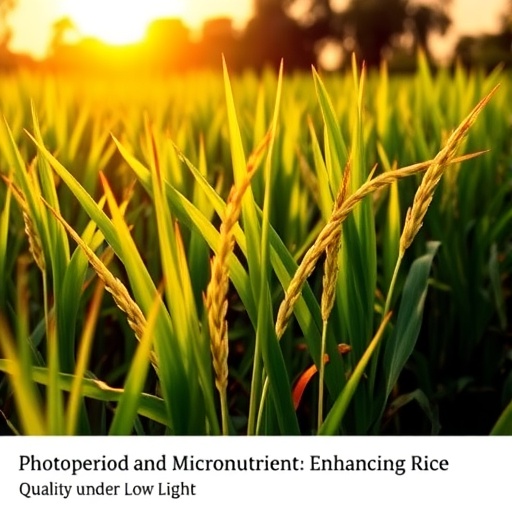
In a groundbreaking study published by a team of researchers led by Sahu and colleagues, the intricate relationship between photoperiod, micronutrients, and their impacts on rice gene networks has been unveiled. This vital research explores how variations in light conditions can influence the phytochrome activity and overall grain quality of rice, particularly under low light scenarios. As global agricultural practices continue to adapt to changing climatic conditions, understanding these relationships becomes paramount for sustainable farming.
Rice, as one of the world’s staple crops, serves as a primary source of nutrition for billions of people. The ability to harvest high-yielding rice varieties hinges significantly on the interplay of numerous factors, including genetic, environmental, and biochemical parameters. The study conducted by Sahu and his colleagues delves deeply into this nexus, revealing how photoperiod influences gene expression in rice, thereby affecting plant growth and development.
Researchers found that the duration and quality of light exposure directly impact the activation of photoreceptors, specifically phytochromes, which are vital for plant development. These proteins respond to light conditions and play a critical role in regulating various physiological processes, including seed germination, flowering, and stress responses. By understanding the complexities of these mechanisms, researchers can better guide the cultivation of rice to enhance yield and grain quality despite challenging environmental conditions.
One of the pivotal discoveries from this research was the role of micronutrients in modulating the effects of photoperiod on rice. Micronutrients, though required in smaller quantities, are essential for various metabolic processes. The researchers demonstrated that the presence of certain micronutrients can significantly influence the expression of genes linked to grain quality. This insight offers a new avenue for enhancing rice varieties, ensuring they remain resilient and productive in low-light environments.
In addition to exploring the genetic networks associated with rice development, Sahu and his team also identified specific pathways that are activated under different photoperiods. These pathways are crucial for coping with stressors such as low light, which may become more prevalent due to climate change. By elucidating these pathways, the researchers have laid the groundwork for future studies aimed at developing rice varieties that can thrive in suboptimal light conditions.
As climate variability continues to pose challenges for global agriculture, the findings of this research hold significant implications for rice cultivation strategies. Farmers must adapt to fluctuating light conditions, and the insights gained from Sahu’s work can assist in breeding programs that prioritize both resilience and quality. Through the strategic application of micronutrient fertilizers and careful selection of rice varieties, farmers could enhance crop yields while maintaining high standards for grain quality.
Furthermore, the team’s comprehensive analysis of the rice genome revealed additional targets for genetic engineering. Crop improvement efforts could focus on specific genes that are responsive to different light conditions, enabling the development of rice varieties that are tailored for specific environmental circumstances. This type of precision agriculture is essential for sustaining food security in an increasingly uncertain climatic future.
The collaborative nature of this research underscores the importance of interdisciplinary approaches in tackling complex agricultural challenges. By merging insights from genetics, environmental science, and nutrition, the authors have crafted a holistic view of rice cultivation that goes beyond mere yield metrics. Their work paves the way for more integrated farming practices that acknowledge the interconnectedness of various agricultural elements.
The study’s implications extend beyond rice cultivation alone, highlighting the broader significance of phytochrome research in the context of sustainable agriculture. As global demands for food continue to rise, understanding plant responses to their environments becomes increasingly critical. Enhanced knowledge of photoperiod influences on crops can inspire innovations across various cereals and legumes, fostering a new era of agricultural resilience.
In summary, the research led by Sahu et al. provides profound insights into the complex interactions between light conditions, micronutrients, and rice gene networks. This comprehensive study not only contributes to the scientific understanding of plant biology but also presents actionable strategies for enhancing rice quality and yield under challenging environmental conditions. As the agricultural community embraces these findings, the vision for a more sustainable and productive future in rice cultivation becomes not just a possibility, but an achievable reality.
This study highlights the indispensable role of scientific research in shaping modern agriculture practices. The innovative approaches favored by Sahu and his team reflect an adaptive mindset, seeking pathways that bridge science and practical farming. With the ongoing advancements in agriculture, tapping into genetic resources and understanding plant-environment interactions will be crucial for confronting the challenges posed by climate change.
In light of these findings, agricultural stakeholders are encouraged to explore the integration of micronutrient applications alongside traditional farming methods. The potential for improved rice varieties coupled with strategic nutrient management may offer a sustainable solution to the food production demands of the future. Therein lies the opportunity for leveraging scientific breakthroughs to effect meaningful change in the world of agriculture.
As the findings from this significant research reverberate through the agri-scientific community and beyond, it is expected that they will spark further investigations into photoperiod and nutrient interactions across a variety of crops. Their pioneering work establishes a foundation for transformative advancements, ultimately setting the stage for a brighter, more resilient agricultural future.
In conclusion, the multidisciplinary research efforts presented by Sahu et al. exemplify the incredible potential of modern science to solve pressing global issues. By harnessing the insights from studies such as this, we can foster agricultural resilience and ensure that our food systems are equipped to face the uncertainties of the future. This is a monumental step toward achieving sustainable agricultural practices that prioritize both human health and environmental integrity.
Cite Scienmag News
Alan Morgan. (January 31, 2026). Photoperiod and Micronutrients: Enhancing Rice Quality Under Low Light. Scienmag. https://scienmag.com/photoperiod-and-micronutrients-enhancing-rice-quality-under-low-light/
Alan Morgan. "Photoperiod and Micronutrients: Enhancing Rice Quality Under Low Light." Scienmag, 31 January 2026, https://scienmag.com/photoperiod-and-micronutrients-enhancing-rice-quality-under-low-light/. Accessed 4 September 2026.
Alan Morgan. "Photoperiod and Micronutrients: Enhancing Rice Quality Under Low Light." Scienmag. January 31, 2026. https://scienmag.com/photoperiod-and-micronutrients-enhancing-rice-quality-under-low-light/


